



Advertisement.
The NWT government is providing $1.35 million to fund six projects that strive to reduce greenhouse gas emissions.
The funding, provided through the GNWT’s Greenhouse Gas Grant Program, was announced on Thursday outside Yellowknife’s NWT Brewing Company, one of the funding recipients.
The funded projects – which range from electrifying a campground to capturing emissions released by brewing beer – were selected based on criteria including the amount of emissions they will displace, cost effectiveness and location.
At the Thursday announcement, the territory’s Liberal MP, Michael McLeod, said tackling climate change requires teamwork.
Advertisement.
Advertisement.
“No one can do it alone,” he said. “Today’s announcement is an important part of our investment in the Northwest Territories’ clean future.”
NWT industry minister Caroline Wawzonek said while transitioning from fossil fuels toward a lower-carbon future will take significant investments, the newly funded initiatives are “truly stepping up to the plate.”
“This is an opportunity to highlight the fact that in the North, we can be leaders,” Wawzonek said. “We might be far away, it might be difficult, but this is technology where we are really at the front end of change.”
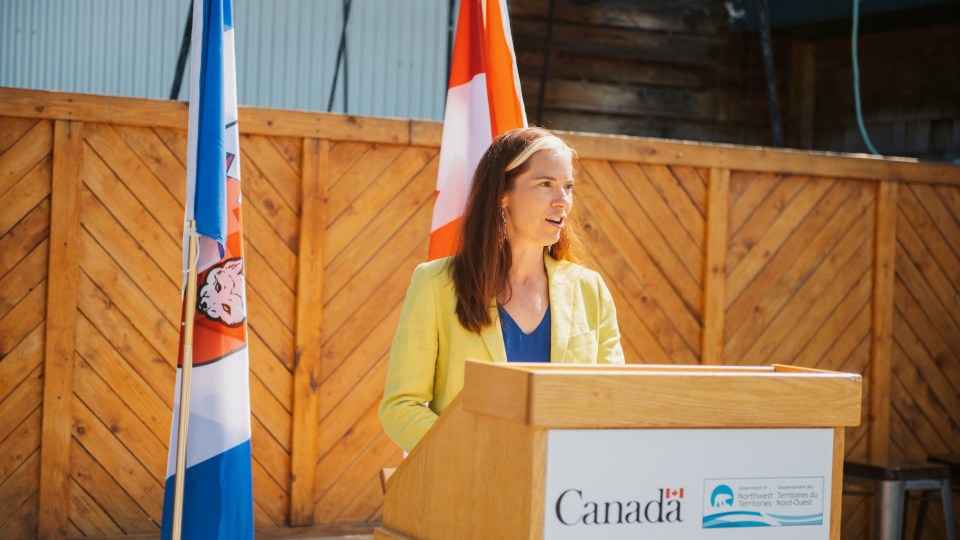
Wawzonek said NWT Brewing Company was pursuing a particularly innovative opportunity.
Advertisement.
Advertisement.
The brewery received $33,000 to purchase and install a carbon capture and utilization system, which will capture CO2 released during the brewing process to be reused in manufacturing beer.
The project is expected to cut 29.5 tonnes of emissions annually, largely by reducing imports of commercial CO2 and beer from outside the territory.
“The installation of this carbon capture and storage system would be the first for the NWT and the first installation of this caliber in the northern territories,” said Fletcher Stevens, the brewery’s owner.
Dehcho First Nations was awarded $108,205 to install solar and battery storage at off-grid cabins within the Edéhzhíe protected area.
Łı́ı́dlı̨ı̨ Kų́ę́ First Nation received $77,105 to put toward a small-scale solar and wind power generation system at an on-the-land camp in the Dehcho.
$300,000 will fund work to revitalize Yellowknife’s post office, including retrofitting the building with a wood pellet boiler, and $255,000 is dedicated to connecting the new North Arm Territorial Park campground to power supplied by the Snare hydro system.
Yellowknife-based property developer Borealis Development was awarded the biggest sum – $600,000 – to install a biomass boiler in the downtown Bellanca building, which the developer plans to turn into an apartment-style complex.
Overall, the six projects are expected to reduce an estimated 633 tonnes of emissions annually, less than one percent of the emissions the territory still has to cut to meet its 2030 target of a 30-percent reduction compared to 2005 levels.
Advertisement.
Advertisement.
As of the latest available data from 2021, the NWT emitted 1,287 kilotonnes of CO2 equivalent, putting the 2030 target roughly 193 kilotonnes away.
Asked how much of a difference the six projects will make, Wawzonek said it’s not just about tonnage, especially given the challenges of finding solutions in the North.
The projects highlight what is possible, she said.
“This is the kind of thing that we really do need communities and businesses to be thinking about,” she said, promising that as people bring ideas forward, their government will be there to respond.
“That’s what’s going to drive the bigger change.”
