



The head of a company hoping to connect mineral resources to Arctic shipping routes wants the Slave Geological Province Corridor to be a priority for the new NWT government.
Inuit-owned mineral exploration company West Kitikmeot Gold Corp is the new proponent for the Gray’s Bay road and port project, which would see an Arctic deepwater port built on the Coronation Gulf and connected to the NWT by road.
Gray’s Bay would be Canada’s first western Arctic deepwater port and would connect Nunavut to Canada’s highway and rail systems.
The Kitikmeot Inuit Association had previously developed the project since 2018. The switch in proponent also means the transfer of $21.6 million in federal funding.
“The economy of the North and future mining developments that aren’t precious metals-related will rely on this sort of infrastructure to get to coast and to get to market,” said Brendan Bell, chief executive officer of West Kitikmeot Gold and a former NWT industry minister.
Advertisement.
Advertisement.
“From a mining perspective, it’s critical. I think from a security perspective, Gray’s Bay has the potential – and ultimately I believe will be – the most capable deepwater port on the Northwest Passage.”
The proposed infrastructure corridor between southern Canada and Nunavut’s Kitikmeot region includes two phases.
The first involves constructing a 230-km road connecting Gray’s Bay to the northern end of the Tibbitt to Contwoyto winter road, which currently links Yellowknife to the NWT’s diamond mines for a short period each winter.
The second phase is the construction of a 95-km road that, when combined with the NWT government’s proposed Slave Geological Province Corridor, would provide all-season road access between the Kitikmeot and southern Canada.
Advertisement.
Advertisement.
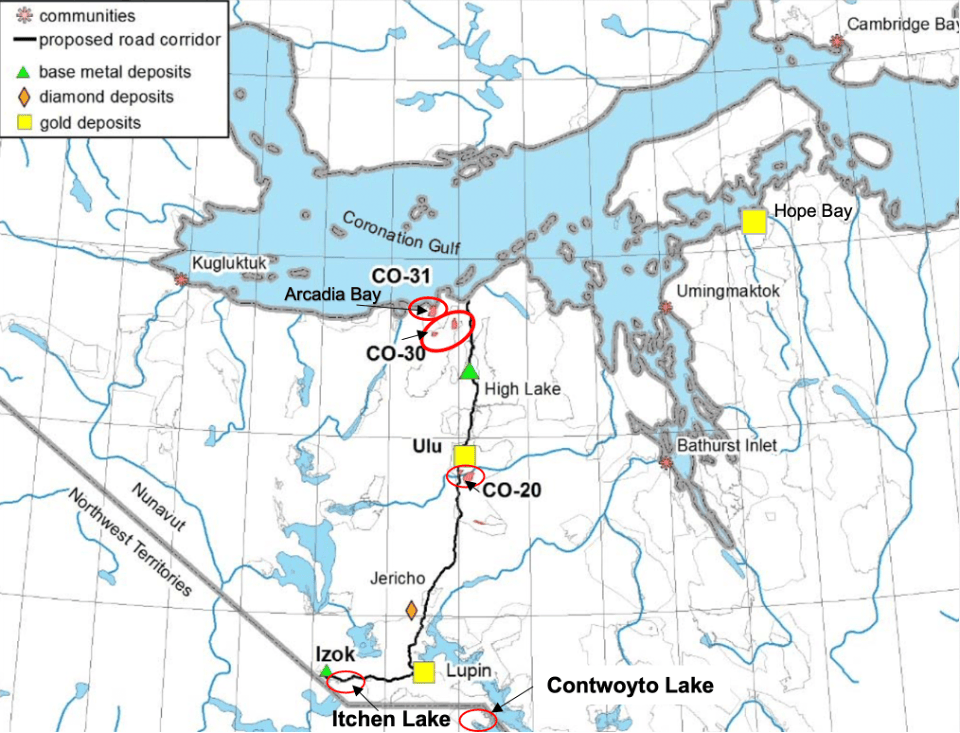
Bell said completion of the Slave Geological Province Corridor – a proposed 413-km two-lane gravel road from Tibbitt Lake in the NWT to Nunavut – is a key part of the project.
“The past couple of NWT governments have seen the Slave Geological Province road as a priority. I’m hopeful that the next government will as well, because ultimately it is the aim to get Gray’s Bay connected into the highway system and into southern Canada,” said Bell, who was a two-term MLA in the NWT between 1999 and 2007. He was also a senior executive at the Ekati diamond mine when it was owned by Dominion.
The NWT has always been “bullish on the need for the project,” he added. “I hope that continues.”
While the Slave Geological Province Corridor has received tens of millions of dollars in federal funding for pre-construction work, more is needed to complete the road, which was estimated in 2019 to cost $1.1 billion.

Beyond Arctic security and unlocking critical minerals wealth, Bell said the Gray’s Bay project has potential community benefits. He said it could allow for a small harbour to support traditional activities, and fibre infrastructure to improve connectivity in Kugluktuk and Cambridge Bay.
“It’s early days,” he said. “There are a multitude of potential stakeholders and users.”
Bell said next steps will include completing a scoping exercise to understand the full extent of users and purposes for the port. Then he said the project will require an application to the Nunavut Impact Review Board. Bell expects permitting and engineering to take three years before the project is shovel-ready.
In the longer term, West Kitikmeot Gold – which plans to change its name to West Kitikmeot Resources – wants to develop mineral resources in the Kitikmeot region with a focus on benefiting Inuit. The company currently holds mineral exploration rights to five properties along the proposed Gray’s Bay corridor.
“My experience in the diamond industry with Dominion and at Ekati, we had great relationships with Indigenous communities,” Bell said. “But you know, we were too far down a track to really contemplate Indigenous equity in the projects in a meaningful way.
“So, early stage, we have hefty, large Inuit ownership in this project, and we can build together from the ground up. And it’s just a much more workable way to achieve that.”
