


Advertisement.
Generations of Dene in Kakisa have known the thunderous sound of Náįlįcho, or Big Falls. Today, there’s silence. In early April, it’s not normally like that.
For the past 80 years, Margaret Leishman has lived along the Kakisa River. She begins every day in front of her house, listening to the rushing water, birds calling, gusts of wind and rustling bush animals.
She’s noticing changes.
Elder Margaret says the shoreline by the river is creeping in as water levels descend. She no longer sees the otters that would visit the point where Kakisa Lake meets the river.
Advertisement.
Advertisement.
Growing up, Margaret was taught that water is everything – it feeds the plants and medicines, which then feed the animals, which feed the people.
“Animals come to the shore for drinking water,” said Margaret. “When water is low, too, their food is scarce. Not many plants will grow.”
She also notices a different smell in the woods by the river.
“This is a decaying smell of plants,” said Margaret. “Not the fresh smell that I’m used to when I was growing up.”
Advertisement.
Advertisement.
For the first time in her life, Margaret says she doesn’t hear the sound of the waterfall Náįlįcho, or Lady Evelyn Falls.
“That’s the first thing we hear, is the water running, the rapids. And that is no longer there. It all froze over. It’s sounds that I’m missing,” said Margaret.
“All winter, it was silence. Not even a sound when I went out for my walk.”
A photograph of the waterfall taken in late March appears to show barely any of the ice frozen in mid-plunge that photos from other years capture.
This has been troubling Margaret, who says the Elders of her youth never spoke to her about waters dropping this low.
A few weeks ago, she decided to investigate the silence, describing a sense of dread that built as she snowshoed a five-kilometre path from her home to the falls.
“When I got there, I was in total shock. All I saw was the rock wall and little icicles at the top,” said Margaret.
“My heart dropped. I was really emotional, because this is Náįlįcho. It’s something that I’ve known all my life and today, it’s not there.
Advertisement.
Advertisement.
“That’s when I yelled, I screamed, I cried, and I talked to my ancestors really loud.”
Breaking records
Water levels on the Kakisa River are the lowest Margaret has seen in her life. According to data collected across the NWT, this isn’t an isolated case.
In partnership with the Water Survey of Canada, the NWT’s Department of Environment and Climate Change monitors water levels and flow rates at 106 stations across the territory, according to territorial government hydrologist Ryan Connon.
“Across the southern part of the Northwest Territories – in the South Slave, in the southern Dehcho regions – most, if not almost all of those watersheds are showing water levels that are either at record low or are very, very close to record low,” said Connon.
Connon says less rainfall and hot temperatures over the past two years have caused large amounts of water to evaporate, affecting water quantity in lakes, rivers, wetlands, streams and soil.
As a result, Connon says, the landscape is changing.
The GNWT’s latest water monitoring bulletin which reports results from 20 stations across the territory, states that six broke records for low water levels and another six were near the record low.
Three stations showed average levels for the time of year and two showed above-average levels. (Spring data for three stations was not included in the report.)
Advertisement.
Advertisement.
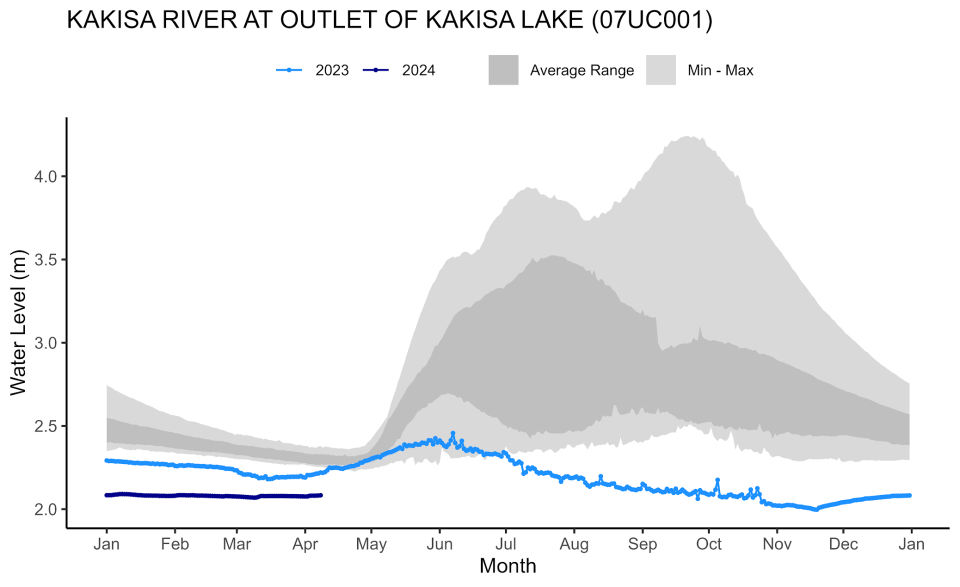
This time last year, the Kakisa River had broken its record for low water at 2.192 metres. This year, that record was surpassed at 2.085 metres.
Connon said a few centimetres on a graph may not seem like a huge difference, but, in some cases, can represent a shift in the water’s edge “by a large margin.”
These are the impacts of climate change as extreme and varying weather conditions become more frequent, according to Connon, who uses the data to research how climate change may affect hydrology – the scientific study of water movement and composition.
“We’re seeing extreme variability that we haven’t seen in the past, so it’s not just water levels getting lower and things drying up,” said Connon.
“The water level on Great Slave Lake was the highest it’s ever been, in the 88-year record, between 2020 and 2022,” said Connon. “Now, in 2024, it’s the lowest it’s ever been.”
Because so much is weather-dependent, it’s difficult for climate scientists to predict which way the pendulum will swing. Still, there is a general consensus more extreme events like those we’ve seen are on the way.
Connon says the likelihood is “a wetting trend” for this region over the next 40 to 50 years.
“We’ll see more rain, more precipitation, more water moving through lakes and rivers,” he said.
Advertisement.
Advertisement.
“The real question is: how will these extreme events and this variability interplay with those larger, long-term projections that we’re seeing?
“What will these extreme events look like, and how frequently will these extreme events happen?”
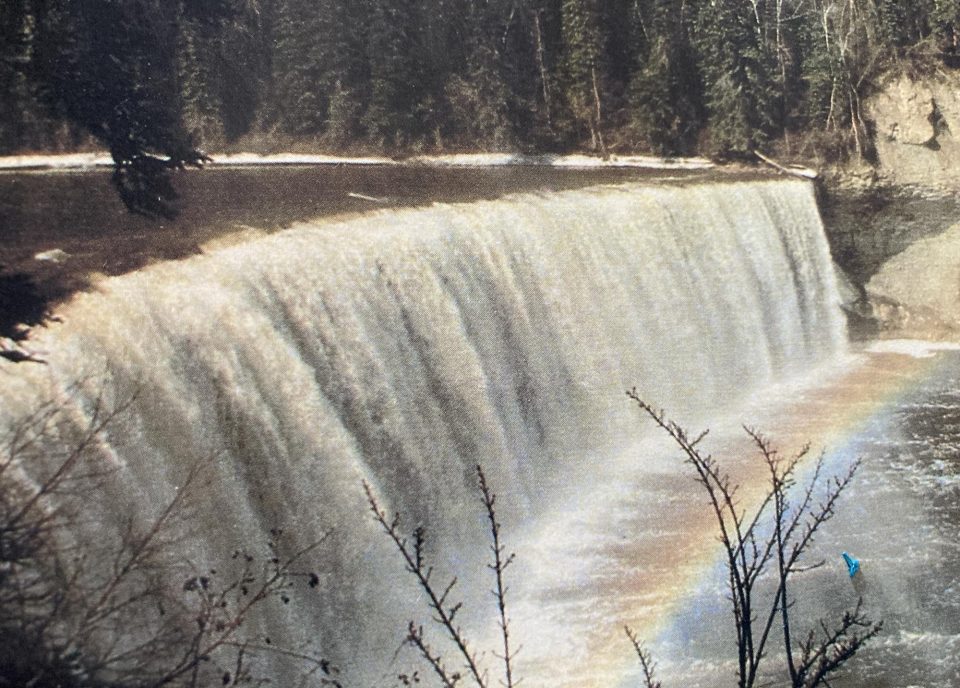
As a child, Margaret Leishman says her community would leave for a spring hunt at this time of year, returning at the beginning of June. She recalls travelling the Kakisa River toward Beaver Lake by boat.
When they would reach Náįlįcho, Margaret says the group would empty its boats and portage past the falls. The sound of the rapids would excite her as she carried small packs down the slope next to the falls.
“I used to just stand there and listen. It’s like it’s talking to me,” she recalled. “It was something that was real beautiful, that all my people from this area – my ancestors way back – experienced all their lives.”
Before the falls, there’s a big rock that Dene would use to gauge water levels and flow while boating. They would also use the rock to determine whether their boats were too heavy after the hunt.
To this day, Margaret says the rock is her guide.
She says Náįlįcho is more than a landmark for her people. It is a place of refuge, spiritual connection and healing.
Advertisement.
Advertisement.
The area around Náįlįcho is now a territorially run campground called the Lady Evelyn Falls Territorial Park. The park advertises the area for its pristine waters, ideal for swimming and fishing.
Margaret is bothered by the campground’s fenced-in area. She says the government doesn’t recognize the significance of the falls to Dene and, over time, their trails are disappearing because of disruption on the land.
“There’s development there because of the camp, so it’s hard to see the trails,” she said.
“The path and the teachings were put there by my ancestors, and this is the route that they followed all their lives.”
Meanwhile, Margaret is campaigning for the name Náįlįcho to be more broadly recognized for the waterfall.
“It’s really important that spiritual sites of local people should be highly respected,” she said.
“The falls is named after somebody that we don’t even know. Who is Lady Evelyn?
“I have talked to my community to get it changed back to our traditional name for it, all our lives. All we know the falls as is Náįlįcho, and it’s going to become Náįlįcho again.”
