



Advertisement.
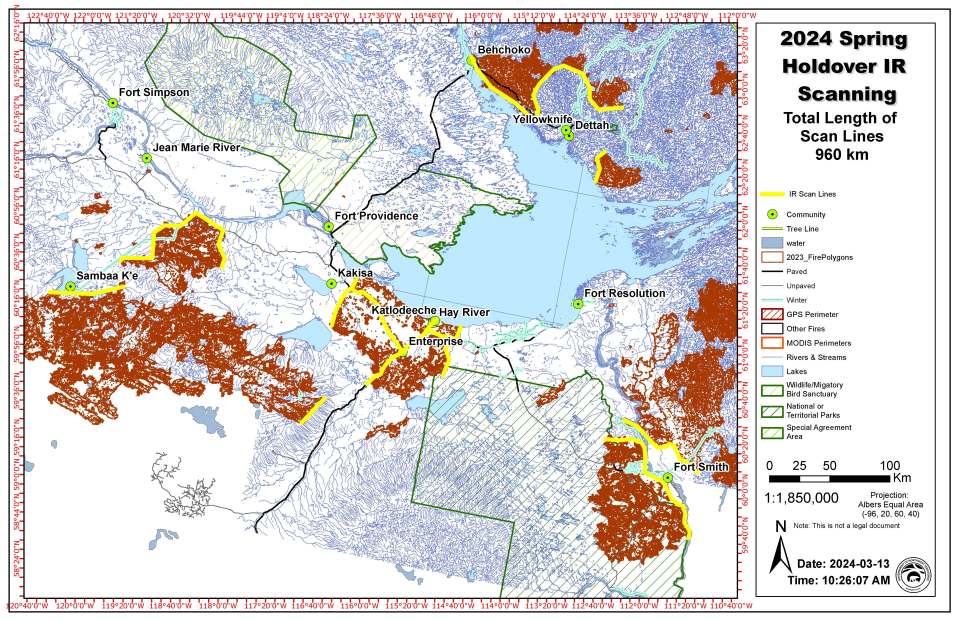
Infrared scans from the air are among the tools being used by the NWT’s wildfire agency to detect fires that have continued to burn since last summer.
Overwintering fires, sometimes referred to as zombie fires, are fires that smoulder deep underground throughout the winter before re-emerging in the spring.
“When you have a year of intense wildfire activity like we did last year, and significant wildfire activity, you can generally expect to see some more overwinter activity,” said wildfire information officer Mike Westwick.
The territory had its worst wildfire season on record in 2023, with 303 fires burning more than 4.1 million hectares of land and destroying dozens of homes and cabins.
Advertisement.
Advertisement.
Prior to last year, the NWT’s record wildfire season was 2014. The year after that, Westwick said, more than a dozen overwintering fires popped back up in the spring.
The infrared work will “scan the edges of the fires – where there could be paths towards communities – to target any heat that exists there, find that heat and respond quickly as necessary,” Westwick explained.
NWT Fire is asking people to report any smoke or early fires they may spot to their regional wildlife and forestry office. The agency recommends people take a photo and drop a pin of the location with their phone if possible, or take note of any surrounding landmarks to help identify the site.
“It’s really just about using every tool in the toolkit,” Westwick said.
Advertisement.
Advertisement.
There’s also a fresh push for residents to firesmart homes and cabins through activities like cleaning gutters, pruning trees, clearing debris from roofs, and moving firewood inside or away from structures.
“When a wildfire approaches, it’s usually not a wall of flame that damages your home. It’s usually ember showers,” Westwick said. “Taking these steps can make a really big difference.”
The territorial government has also been holding wildfire engagement sessions and planning firefighting fitness tests.
2024 will ‘start sooner, end later’
Federal ministers said Canada faces another potentially “catastrophic” wildfire season at a press conference in Ottawa on Wednesday morning.
Harjit Sajjan, Canada’s emergency preparedness minister, said western Canada, eastern Ontario and southern Quebec are particularly at risk of early wildfire activity this spring.
“We can expect that the wildfire season will start sooner and end later, and potentially be more explosive,” he said.
Sajjan said the long-range outlook is more difficult to predict.
“What is clear is that wildfires will represent a significant challenge for Canada into the future as the impacts of climate change continue to intensify,” he said.
Advertisement.
Advertisement.
The NWT government has reported that water levels across the territory remain at record lows, and Premier RJ Simpson has cautioned residents to be prepared for another difficult fire season.
Federal leaders on Wednesday said they are working to prepare by training firefighters and Indigenous fire guardians. Ministers have promised investments in emergency preparedness, while a pilot project in BC and the NWT is aimed at better coordinating emergency supports.
Ministers also revealed plans to double tax credits for volunteer firefighters and search-and-rescue volunteers.
