



Advertisement.
A new audit criticizes federal management of contaminated sites in the North, citing increasingly high remediation costs and failure to meet reconciliation goals.
The report was one of five tabled by Commissioner of the Environment and Sustainable Development Jerry DeMarco in Parliament on Tuesday.
“After 20 years, much work is still needed to reduce the financial liability related to contaminated sites and to lower environmental and human health risks for current and future generations,” he said at a press conference.
“As well, the government needs to take urgent action to advance socio-economic benefits, including employment opportunities and to support reconciliation with Indigenous peoples whose lands are often affected by contaminated sites.”
Advertisement.
Advertisement.
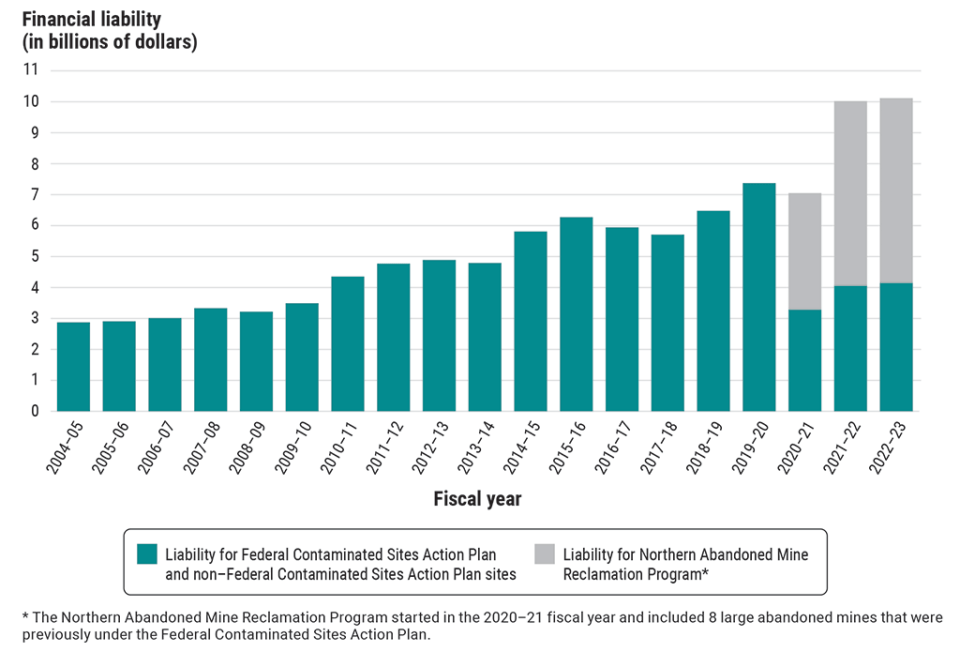
According to the report, the cost of remediating known contaminated sites has increased from $2.9 billion to $10.1 billion since a federal action plan was launched in 2005.
The report states that while only 11 percent of Canada’s 24,109 federal contaminated sites are in the North, they account for more than 60 percent of the total estimated cleanup cost.
In particular, the report said the cost to remediate the eight largest and highest-risk abandoned mines in the North has increased by 95 percent since they were grouped under a single federal umbrella in 2020-21.
“This is an enormous financial burden on taxpayers and represents a failure to properly implement the polluter-pays principle, because many private-sector sites had to be taken over by the federal government,” DeMarco said.
Advertisement.
Advertisement.
The report specifically pointed to the Faro Mine in Yukon and Giant Mine in the Northwest Territories as complex sites with long-term risks to the environment and human health.
In November 2022, the Treasury Board of Canada approved a new $4.38-billion cost estimate for the remediation of Giant Mine, a figure more than four times the original estimate. Remediation work on the mine is projected to be complete by 2038, though some parts of the site, including 237,000 tonnes of highly toxic arsenic trioxide dust stored underground, will require perpetual care and maintenance.
The audit further found the Federal Contaminated Sites Action Plan does not include realistic targets for climate adaptation and is missing targets for Indigenous engagement and socio-economic benefits to support reconciliation.
DeMarco’s office pointed to the Giant Mine Remediation Project, which has failed to meet northern and Indigenous hiring targets.
The report also described Crown-Indigenous Relations and Northern Affairs Canada’s reporting on climate change for the project as “weak,” adding the closure plan for Giant Mine was lacking in its approach to climate change adaptations and the department had not developed a complete estimate of annual greenhouse gas emissions during remediation.

The audit’s recommendations include developing more accurate liability estimates, directly measuring environmental and human health risk reduction, and developing a consistent approach for documenting and reporting on program priorities.
It also recommends clear reporting on program commitments and progress made toward them, as well as leveraging opportunities for Indigenous people to participate in and benefit from the management of northern contaminated sites.
Specific to Giant Mine, the report recommended updating the remediation project’s climate change risk assessment, developing or improving strategies to reduce on-site emissions, and completing the project’s perpetual care plan, which has been delayed.
Advertisement.
Advertisement.
The federal government agreed to all of the recommendations.
In a statement responding to the audit, environment minister Steven Guilbeault said the increasing cost estimates reflect that more sites have been reassessed, resulting in more accurate cleanup costs.
“The ongoing assessment and remediation activities throughout Canada help the government understand the true scope and scale of contamination. Contamination at many of the sites is the result of historic activities, spanning decades,” he said.
The minister said that since 2005, more than 75 percent of federal contaminated sites have been successfully closed.
“The Government of Canada is committed to taking the necessary actions to clean up federal contaminated sites for the health of the environment and Canadians,” he said. “We are investing to identify sites, assess risks, estimate costs and record liabilities, and remediate and close these sites.”
Northern affairs minister Dan Vandal said the report would help his department to improve the effectiveness of the Northern Contaminated Sites Program, which covers the eight highest-risk projects in the North.
“Protecting the health and safety of Indigenous and northern communities and the environment is a key component of the Arctic and Northern Policy Framework, as we work to advance reconciliation and renew relationships with Indigenous peoples based on respect, partnership, and recognition of rights,” he said in a statement.
