


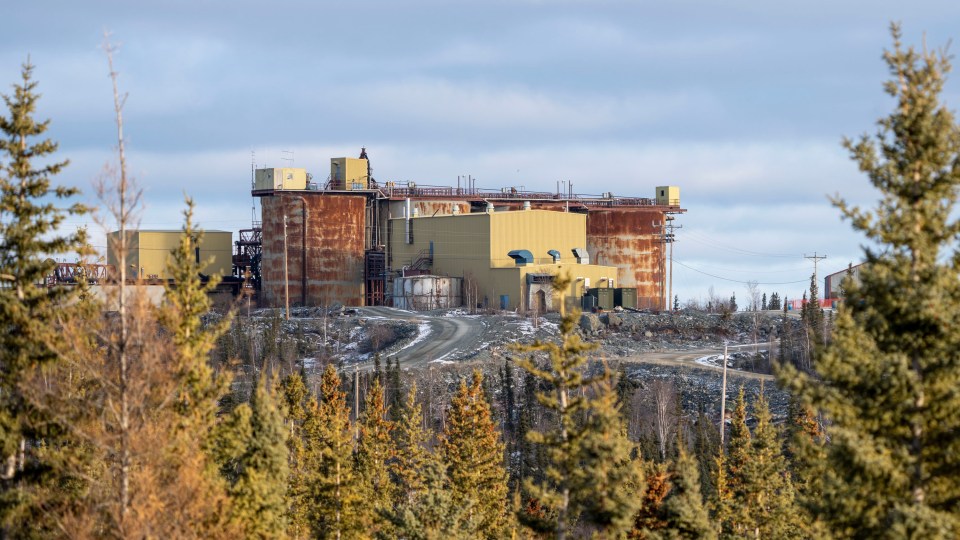
We’ve known for a while that new solutions for Giant Mine’s toxic waste are being studied. Now, they may be almost within our grasp.
That’s the view of David Livingstone, who chairs the Giant Mine Oversight Board – an independent and expert watchdog that scrutinizes the federally led $4-billion remediation project at the former gold mine on the edge of Yellowknife.
The oversight board’s annual public meeting takes place at Ndılǫ’s K’àlemì Dene School from 7pm on Thursday.
Its recent annual report criticized the Giant Mine remediation team for its approach to last year’s wildfire and evacuation, saying better preparation was needed. The remediation team has since rejected the suggestion that the situation could have been better handled.
But the board doesn’t only exist to inspect the remediation team’s work. It also carries out research of its own into solutions for Giant’s 237,000 tonnes of arsenic trioxide buried underground.
Advertisement.
Advertisement.
That dust is lethal and the current plan is to keep the land around it frozen until such time as a better plan can be thought up. In the recent past, experts have talked in terms of decades or even centuries before there’ll be a better way to treat the dust without any fear of it escaping into the air or water.
Some new approaches being considered include turning the arsenic trioxide into glass or stable arsenic sulfide.
Livingstone says research is now moving quickly enough that the wait may not be that long.
“It’s looking promising – promising enough that I think we need to start to think about changing gears and starting to look at more of the extraction technologies because I think the solution is within reach,” he told Cabin Radio in an interview earlier this month. (The Giant Mine Oversight Board sponsored the publication of the interview, which was primarily about the findings of its annual report, but had no editorial input on the questions asked or the final product.)
Advertisement.
Advertisement.
“It’s not 99 years, it’s not 50 years, it’s conceivably within 20 that we could be, if not complete, certainly well on the way of eliminating this toxic inheritance,” he said.
Below, read Livingstone’s full interview about how Giant’s toxic problem could be tackled in future, how the mine remediation is performing environmentally and economically, and how its wildfire and evacuation response could have been better in the oversight board’s eyes.
This interview was recorded on May 10, 2024. The transcript has been lightly edited for clarity.
Ollie Williams: We’re talking about 237,000 tonnes of toxic arsenic trioxide dust from the gold mining process that is buried underground at Giant. The current plan is essentially to make that as safe as possible, keep it in place and essentially freeze it there, right? There’s no real change, year on year, in how that plan is looking?
David Livingstone: Well, that’s the temporary solution to the risks posed by the dust. But the environmental review panel recognized that was a temporary solution, not a permanent one.
But temporary on a grand old scale. Aren’t we talking decades?
I’m not so sure.
I’ve been cautiously optimistic on our ability to find a solution that will eliminate the toxic problem – and I think we’re close. We’ve got three or four different methods that will all work. We can turn it into an arsenic sulfide, which is a very stable compound – you can mix it with cement. That’s maybe a little less promising. We can it into glass, vitrify it. That’s very promising. And that’s a technology that’s proven, it’s being used to treat arsenic wastes in Africa and in Quebec, or at least soon in Quebec.
Advertisement.
Advertisement.
We’ve been working with a company to get samples of the vitrified arsenic dust from underground and have those samples tested in university labs. So far, it’s looking promising – promising enough that I think we need to start to think about changing gears and starting to look at more of the extraction technologies because I think the solution is within reach, say another five years to prove that out and then another five years of regulatory steps, and another couple years of construction of a facility. Depending how large the facility is, another, say, 10 years of treatment.
So you know, it’s not 99 years, it’s not 50 years, it’s conceivably within 20 that we could be, if not complete, certainly well on the way of eliminating this toxic inheritance.
This research is work the Giant Mine Oversight Board is leading, and the federal project team is not. The federal project team remains very focused on the remediation plan we have, which involves this frozen block method. Do you think there’s a lot of agreement on that side that, actually, there are different approaches that are reaching the point where we can start selecting some?
We had a public open house that the project team attended last fall. I think people were genuinely pleased – surprised – at how far the research has gone and how promising it is.
There’s still a lot of work to do. Obviously, this is bench-scale stuff. We’ve got to scale it up. The whole engineering side is is going to be complicated, ensuring safety at all steps, moving that dust from presumably underground to surface for treatment. Complicated. But none of those involve unproven technologies. You know, there are plenty of ways to mine remotely underground. There are plenty of ways to move dusty materials. We can put together the package and see what it looks like. But I think the project team is like everybody else. It has a job to do but most people would prefer to see that problem eliminated.
There was grave concern in August last year that a wildfire was going to reach Yellowknife. And if it did, maybe one of the first things it was going to reach was Giant Mine. Then there was an evacuation that brought with it fresh concerns around who stays, who goes, what condition do you leave the site in, when you go. This is a very large toxic remediation site. Who stays behind to deal with that? What do you need to do to make it safe if everybody’s leaving? There are lots of different complexities and concerns and everyone had to make very, very fast decisions last year. Now that a little time has passed and the oversight body has scrutinized this, what does the report say about that?
Basically, it says you’ve got to do a better job.
The site was essentially left abandoned, the gates were unlocked, virtually all the heavy equipment was moved off site to fight the fires. We’ve got to do better than that. For sure, first time around, everybody learns. In our report, we’ve recommended that they take a very comprehensive look at emergency management. They’ve got lots of plans for smaller things like cleaning up a spill or dealing with an arsenic dust outbreak underground, all those relatively minor things that can go wrong in any industrial site. But I don’t know that they yet have a comprehensive plan to shut the site down in a systematic way, leave it secure, and ensure that everything is good when they get back. They left the underground pumps running and fortunately, the pumps ran and kept the water level low.
Advertisement.
Advertisement.
Just explain why that’s key.
We don’t want the mine to flood. We don’t want the arsenic chambers to flood because that creates a whole other problem. They pump and treat the water that’s in the mine workings and keep it below the arsenic chambers so it doesn’t flood the chambers and create other issues. So they need to keep those pumps running, and the pumps ran, but there was nobody on site. The gates were unlocked. There may have been periodic inspections, but most people who were still left in town had other things to do.
They weren’t the only organization – by a long shot – that didn’t really have a plan, or at least didn’t appear to last summer. Have you had the sense from their side that yes, this is a weakness? And yes, this is a gap that does urgently need to be addressed?
I think they understand that – they and hopefully the city and GNWT and feds all understand that things need to be done better if this happens again. It’s certainly within the realm of possibility that it’s going to happen again this summer. So let’s get ready.
How much do we know about what would happen if a wildfire actually got to the site?
Certainly the infrastructure would go. The power to run the sub-surface pumps would go. There would be a lot of damage – all those containers that are holding contaminated waste on site would likely be damaged. So there’d be release of contaminants. And the other issue of what does fire do to contaminated soils? Does it lift up the arsenic contaminated dust and spread it more broadly? There wasn’t any indication of that happening with the fires last summer, but that may well be because the fires were far enough away that the trees and soil weren’t contaminated too much with arsenic dust.
By the standard measuring sticks that we have, how is the remediation team performing? Are they meeting environmental targets? Are there environmental concerns? Do enough northern and Indigenous people have jobs and get work at the site?
From an environmental and engineering standpoint, I think we’re fairly comfortable. We’re not aware of any major issues.
Advertisement.
Advertisement.
On the economic side, in broad terms, a lot of northern companies – Indigenous, in particular – are getting contracts. We understand that a lot of money is being spent, but we don’t fully understand where that money is going and who in the North is actually benefiting on an individual and an organizational basis.
We hear from Yellowknives Dene individuals that they don’t see much in the way of a benefit flowing to individuals in the community. But Det’on Cho’s getting the lion’s share of the contracts. So what’s happening?
We also hear from non-Indigenous companies that they’re not getting much work and, in fact, it’s a hassle for the smaller companies to even be considered. The bonding requirements are enormous. There’s a bit of an irony in that many of the non-Indigenous-owned companies employ Indigenous people and yet their employees are not seeing the benefit from this project, this immense project.
The implications for other remediation projects in the territory shouldn’t be ignored either. You know, we’ve got Norman Wells, how is that going to be managed? The abandoned mines mostly around Great Bear Lake, are we going to be able to ensure that Délı̨nę gets the lion’s share of the work?
I know there have been bigger audits taking place recently around this sort of thing. Have you paid close attention to that and understood some of the comments that different auditors have about the same kinds of things that you’re scrutinizing?
The Auditor General for the Office of Sustainable Development reported on the way the government has been implementing the contaminated sites policy in the North, and essentially gave them a failing grade.
We met with the audit team at least once back last summer and explained some of our concerns, and we see those reflected in the audit. That was kind-of gratifying that we’d been heard and we weren’t the only ones making those points. Ensuring that northerners benefit to the maximum degree possible from these projects – the auditor has pointed out that that wasn’t happening and it wasn’t being tracked properly. The perpetual care plan, which we’ve been really annoyed about with the project team, is three years overdue now.
The perpetual care plan, as I understand it, is the plan that sets out – once all the active work is done to get that site to the best condition it can be in, and everything has been remediated to the best possible degree and everything is in place – what happens next. How do we maintain the site from that point forward? Who’s doing it? What does it cost? What does it look like? Is that the essence of that plan?
Advertisement.
Advertisement.
Essentially, but we don’t know yet because we haven’t seen any response to the request for proposals that went out. We’ll see what people come up with.
We’re talking about a plan that can go off in many different directions. There’s simple things like who’s keeping the record of everything that’s happened? How is the water treatment plant going to be maintained? It’s going to be pumping in perpetuity. Where’s the money coming from? Is government guaranteeing that there will be money in place? Another forest fire, where’s the contingency plan? How much money is it going to cost to recover that site? And again, where is it coming from?
All those things need to be addressed in a perpetual care plan. And as I said, we’re three years behind and it’ll be two years before we see something of substance, I suspect. It’s frustrating, and the auditor general picked up on that as well.
I wanted to close by asking about next steps. The next steps for the site, there are so many steps still to go through. What about for the oversight body? What are your next steps, particularly around things like when you say, “Hey, we might actually have a solution here?” How do you advance that now?
We need to be able to prove to ourselves that the research option we favour is actually one that will work in every measure.
We need to continue to communicate the challenges that the project team faces and the opportunities the project presents.
We’re going to be cognizant that what happens at Giant may set the stage for what happens in other major remediation opportunities or challenges, however you want to look at it.
We’re going to advocate for a northern lens. The standards, the risk assessment, the risk management, methodology is all based on kind-of a technocratic, scientific approach. It’s numbers-based. You know, if it’s five parts per million then you don’t have to worry about it. Well, that’s not the way northern communities think about the land and safety and risk.
Advertisement.
Advertisement.
I’ve worked with the folks in Délı̨nę and they describe loss of trust in the land. For a community and people who rely on the land so deeply to lose trust in the land is a huge thing. It takes a lot to recover that trust, and it’s not going to work for them if it’s just numbers. “It’s five parts per million, you’re safe. You can go there and use it.” It doesn’t fly. It’s qualitative, not quantitative. It’s cultural. It’s a different way of looking at the land and the value of the land and how it should be respected and restored.
Burying waste at a mine site is not going to restore trust and it’s certainly not going to eliminate the liability. We live here and it’s not good enough to just walk away from it.
This article appears as part of a paid partnership between Cabin Radio and the Giant Mine Oversight Board.
