


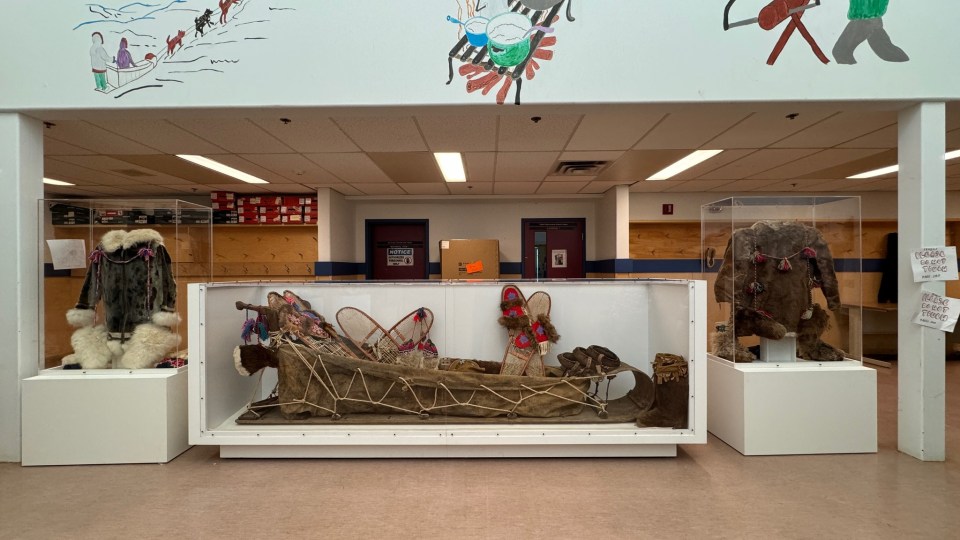
An exhibition called “Fifty Years Ago” is being staged at Chief Julius School, displaying tools and garments made by residents of Fort McPherson in the 1970s.
Students at the school travelled to Ottawa last spring to interview John and Judy Osborne, who donated some of the items in the exhibition.
The students are now developing a 10-minute documentary film from those interviews, which will launch on October 21, along with a virtual exhibition.
The Osbornes lived in Fort McPherson from 1974 to 1976. At the time, they commissioned elaborate tools and garments from residents of the community. They kept those items for the past 50 years.
“They had the collection of traditional clothing and tools made by our people in the community,” said Sharon Snowshoe, director of the Gwich’in Tribal Council’s Department of Culture and Heritage.
Advertisement.
Advertisement.
“We started a conversation of taking them back to Fort McPherson, because they lived here and they made friends here, and they wanted to give these artifacts back to the community.”
In 2023, the Gwich’in Tribal Council won the Arctic Inspiration Prize, which helped to fund the project. Funding also came from the Beaufort Delta Divisional Education Council and Indigenous and Northern Affairs Canada.
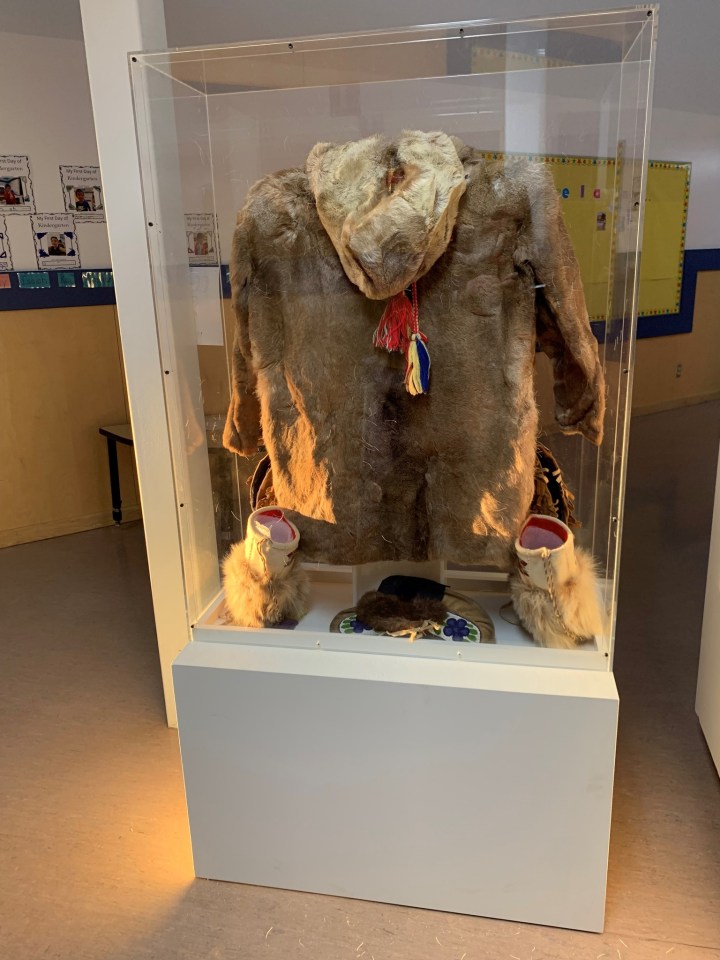
The core collection is comprised of a caribou skin parka, a seal skin outfit, a child-sized rabbit skin outfit, multiple pairs of snowshoes, a dog sled with dog harnesses attached, multiple pairs of mitts, and moccasins and slippers.
Artists include Christie Thompson, Jimmy Thompson, former chief Johnny Charlie, and Effie Blake.
Advertisement.
Advertisement.
The exhibition opened last Thursday with a feast at Chief Julius School.
Research from students was on display, as was a film about the late Wally Firth, the first Indigenous MP for the Northwest Territories.
“The Elders were really happy that we had a resource like that to show the children,” said Snowshoe, referring to the film.
“There’s one part that talks about when land claims began …. It had to do with land and occupancy,” Snowshoe added.
“One student that did a project on this was trying to document the trails of Christopher Colin, of how many miles he walked on the land, and where he travelled, as part of this exhibit too – it has many different parts to it.”
Snowshoe hopes to expand the initiative to reach more communities and educate youth on Gwich’in culture and history.
“Some of these items you don’t see now in the community, like the caribou skin parka or the rabbit skin outfit, or the dog sled. You don’t see those today,” said Snowshoe.
“I think it’s good for our students to learn about these items that our Elders used to use out on the land … that are made from the land and used on the land at that time.”
