


Whether it be the weekly translation at church or a quick reference in the dictionary, some Fort Simpson residents are devoting their lives to strengthening Dene Zhatıe.
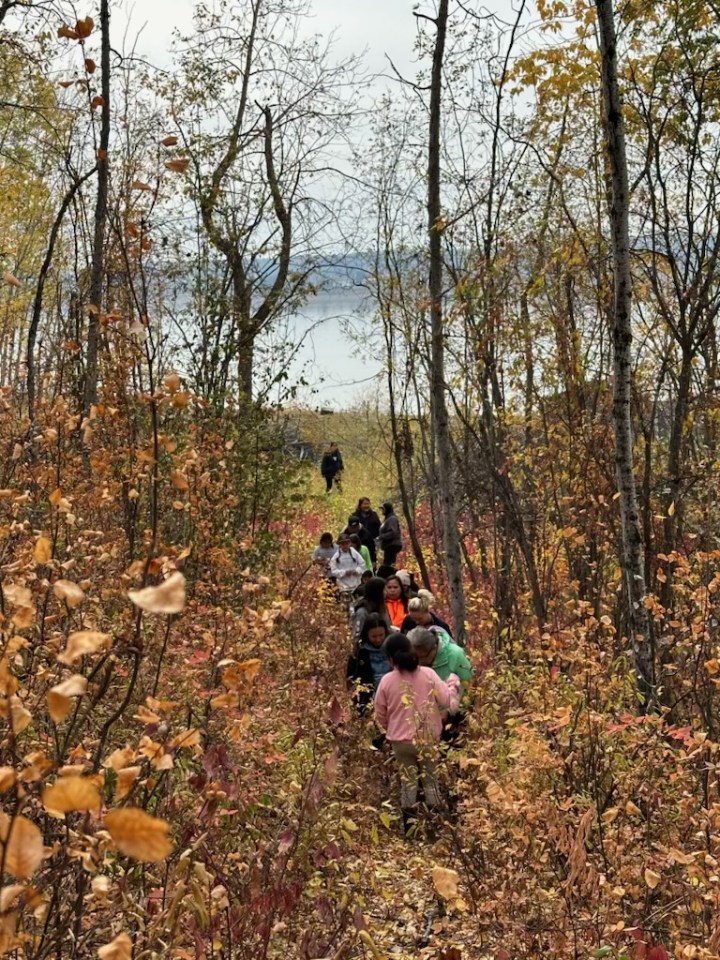
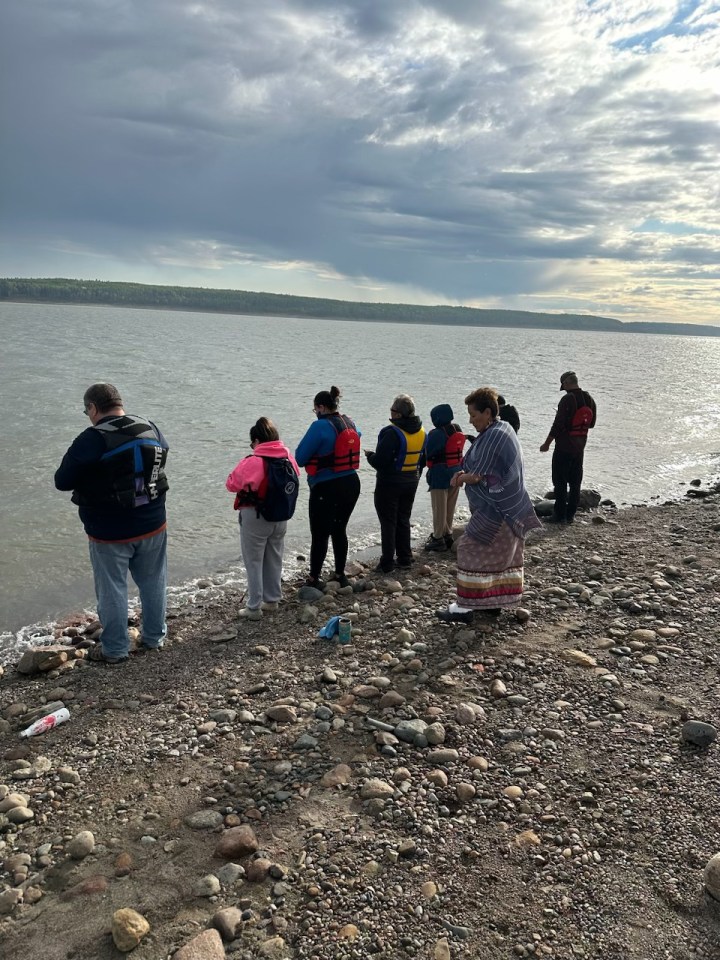
Mary Jane and Gilbert Cazon have led on-the-land programs with youth since 1972. While on the land, Mary Jane would share her traditional language and much more.
“Being on the land, for our community and for ourselves, is humbling. It provides you a chance to humble yourself and start from the ground up,” Gilbert told Cabin Radio.
“Being on the land, everything that you want to talk about is there, is visible. You have situations that come up each day that you could use Dene Zhatie, and teach them the way that the Dene have dealt with these things.”
Dene Zhatıe is a dialect spoken by the Dehcho Dene people. In 2019, just under 1,500 Indigenous people said they spoke Dene Zhatıe – predominantly in Fort Simpson, Fort Liard and Fort Providence – and around 3,000 Indigenous residents said they could understand at least some of the language.
Advertisement.
Advertisement.
Mary Jane is fluent in Dene Zhatie. While her siblings went to residential school, Mary Jane says she was kept home by her parents, who wanted her to be immersed in the language and culture.
“When I was growing up, we had a lot of Elders that lived in our area and out on the land that only spoke the language,” Mary Jane said.
“That’s how I was taught when I was very young. The language wasn’t only taught by my parents. It was taught by my aunties, my uncles, the grandmothers of the community.”
Gilbert was also raised with the language, but says he lost his fluency when he attended residential school. It was only when he met Mary Jane’s family that he began to reconnect with Dene Zhatie, as it was the only way to communicate with her parents.
Advertisement.
Advertisement.
“I had to relearn and, through my wife’s patience, she was able to teach me the basics,” Gilbert said. “From there, I started learning how to speak it better.”
After recent proposals to fund more camps on the land were turned down, the Cazons have made the language their new focus.
Every week, they offer a beginner-level Dene Zhatie course in collaboration with Łı́ı́dlı̨ı̨ Kų́ę́ First Nation. They upload Facebook Live videos of Mary Jane teaching, so residents can learn from home.
Meanwhile, Mary Jane has been translating between English and Dene Zhatie at leadership meetings and land negotiations for more than 30 years, according to Gilbert.
“We knew that the message wasn’t getting to the Elders, especially when it came down to land negotiations with the government. That the message wasn’t delivered clearly so that the Elders could understand,” Gilbert said, adding that input from Elders directed negotiations with the government because they knew the original agreements.
“It’s the Elders that have the wisdom and asked us to continue to hang on to the original treaty and not to renew that or negotiate that,” he said. “With our background and experiences, my wife was able to speak to that in a very clear way that the Elders understood.”
Now, Mary Jane translates sermons for Elders at Sacred Heart Parish Church in Fort Simpson.
“Every Sunday, I alternate with Andy Norwegian, and we would do the gospel all in the language, which is very good because you need to start exposing the language throughout your community,” said Mary Jane.
Advertisement.
Advertisement.
“The more we do that, the more people get exposure to it. Hopefully, at the end, they’ll be able to understand. They’ll be able to be fluent speakers.”
Like Mary Jane, Andy Norwegian offers translations for Elders at church. He sees it as a way of giving back to his community, and has learned a lot along the way.
“During the Pope’s visit in 1987, I tutored the Pope because he wanted to say a few words in the Dene language,” Norwegian said, referring to Pope John Paul II’s visit to Fort Simpson more than 35 years ago.
“I’ve gained a lot of information from a lot of Elders over the years.”
Norwegian began his career as a teacher in his home community, Jean Marie River. With a background in linguistics, he moved to Fort Simpson to continue teaching, where he began developing a language curriculum and offering translations.
“If anything positive could come out of residential school, I think it’s the pure stubbornness on my part. You’re not going to take my language away,” Norwegian said.
“It’s something that is important to me. This continued after I left residential school and became a motivation for me to really preserve the language and work in that area.”
Norwegian has been involved in writing two editions of a Dene Zhatie dictionary, with more than 10,000 words included.
Advertisement.
Advertisement.
“I’m just hoping that in the future, people will be taking this dictionary and looking at the original way of saying some of these words, and maintaining the way of speaking the way the Elders spoke,” Norwegian said.
“We really need to train some of our youth so that the language gets documented even more.”
Randy Sibbeston has been building a collection of northern books inherited from his father. In the collection, Sibbeston has an original 1876 French-Dene dictionary, a resource that was printed only 200 times.
Sibbeston has reprinted 100 copies of the dictionary, saying he hopes to fill a “dearth of information” on Dene life, language and culture. Reprints are open for purchase privately.
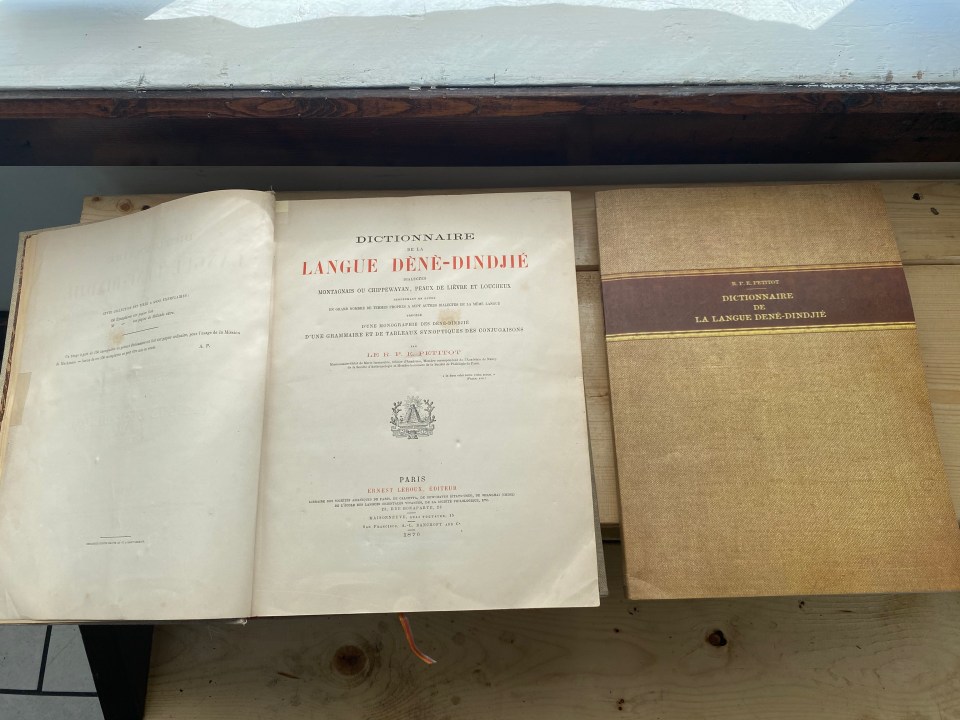
Sibbeston considers the information in the dictionary extremely valuable for his people.
“That’s such an early age. It’s a national treasure,” said Sibbeston. “The number of vowels and nouns that it literally restores to the linguistic tapestry of this region is substantial.”
He says the documents he has compiled demonstrate a clearer picture of complex Dene society.
“They basically make people think that they’re from a primitive society when in fact they aren’t,” said Sibbeston.
Advertisement.
Advertisement.
Through this work studying Dene history, Sibbeston says he’s been inspired to paint, write stories, and create action scenes about his people.
“There were some tears of sadness and tears of joy and all kinds of different emotions that come with self-discovery after, for instance, surviving a residential school era, and now working on the truth part of the entire equation,” said Sibbeston.
“Put Humpty Dumpty back together again, nurse him back to health, and then listen to his story … it’s an enlightenment process.”
Mary Jane and Gilbert have no plans to slow down. They continue to offer language classes three times a week and enjoy participating in cultural activities throughout the community. Gilbert says they are motivated by the young adults they taught years ago, “to see the faces on these youth that we have taught over the previous years, how happy and how much they became good adults because of being with us.”
“I’m really making an effort to be able to share my knowledge and to be able to share my Dene Zhatie with the youth,” Mary Jane continued.
“When you have your culture, background, and your language, you’re strong as two people. That is what our Elders stated and that’s so true.”
