



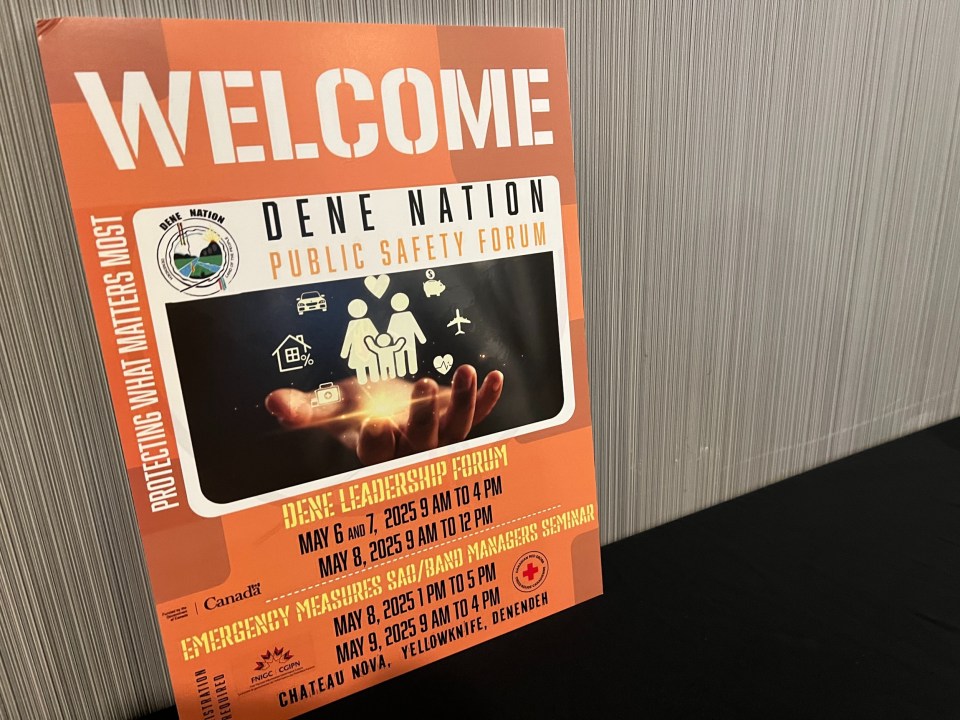
Dene leaders are gathered in Yellowknife for a three-day public safety forum aimed at addressing drugs, crime and violence in NWT communities.
“There is nothing more serious, dangerous than the drug problem we have today,” Dene National Chief George Mackenzie said during opening remarks on Tuesday morning.
“The statistics we are seeing are not just numbers. They represent our families, friends and children whose lives are affected by substance abuse and crime. These realities have an impact on the fabric of our communities, the well-being of our communities,” he continued.
“It is important that we take ownership of this issue with … a Dene Nation approach, one that respects our cultural values and unique experience.”
At the forum, Indigenous leaders stressed the need for actionable solutions and more resources to combat the drug crisis affecting every community in the territory.
Advertisement.
Advertisement.
Documents shared as part of the forum state that the current structure and programs established through the NWT government are failing to address violence and drug-related crime in Dene communities and there is an urgent need for change and community-led solutions.
‘We can wait no longer’
Mackenzie said “the meat of the whole meeting” will be the establishment of a Dene-led task force on drugs and community crime prevention.
Leaders are expected to determine the composition of that task force and its priorities before the end of the forum.
Mackenzie said all Dene communities will contribute to the task force’s work plan. He told Dene leaders they are best positioned to come up with a plan because they know the day-to-day realities their communities are facing.
Advertisement.
Advertisement.
“We’ve had enough of other people doing the plan for us,” he said.
“Today, while young lives are being taken, we can wait no longer.”
Priorities leaders identified at previous meetings include screening at airports and checkpoints on roads, canine units, empowering leaders to remove people causing harm from communities, and youth education.
Chief Collin Pierrot of the K’asho Got’ine Dene Band in Fort Good Hope said on Tuesday it is important for leaders to speak with youth about the challenges they are facing.
“We’re going to have to take action and move with this … and make sure that we take our young people along when we’re doing this task force,” he said.
Other leaders spoke about prevention efforts and the need for healing and wellness programs, as well as addressing the barriers preventing people from getting addictions treatment quickly.
Joachim Bonnetrouge, former chief of the Deh Gáh Got’îê First Nation in Fort Providence, highlighted recreation, going out on the land, and sharing Dene culture and values between youth and Elders.
“I think we’re fortunate our land is still here and our culture is still very strong, and we also have very good Elders that can train,” he said.
Advertisement.
Advertisement.
Indigenous policing
Dene leaders also discussed the possibility of implementing an Indigenous policing system.
“It is crucial that we explore opportunities to take over responsibility for policing in our communities. In doing so, we reclaim our authority,” Mackenzie said, adding there are models across Canada where First Nations have taken the lead in policing.
Dale Cox, former chief of police for Lakeshore Regional Police Service, which polices five First Nations in northern Alberta, gave a presentation on Indigenous policing.
He said communities in Canada have the right to determine how they want to be policed but any police force would still be required to follow Canadian laws, meet certain qualifications and follow due process.
“You have a choice. It doesn’t mean you’re going to get it right away or it’s going to happen, but it is a choice,” he said.
“If you can show a viable and professional and properly trained police agency, you have the right to have that.”
Cox said establishing a self-administered First Nation police service in the NWT would require development of a Police Act, legislation which exists in the provinces. Currently, policing in the territory is governed under the RCMP Act.
Cox said a Police Act would outline requirements for a First Nations police service, including training and how to address public complaints.
Advertisement.
Advertisement.
Cox also spoke about the need for oversight and governance of policing, highlighting the importance of relationships, community input and community-led solutions.
He said his philosophy is that policing should not just be about enforcement but also preventing crime.
“Just putting people in jail is that old revolving door,” he said.
“Instead of that, and especially dealing with First Nations when I talk to them because such strong culture and tradition exists: What did your Elders tell you? How did you fix this before? How did you get it stopped? And that’s where you want to go.”
Chief Eugene Hope of Acho Dene Koe First Nation in Fort Liard expressed support for developing a First Nations police force in NWT communities. He worried about potential roadblocks from the RCMP and and NWT government to funding such a service.
“If you look at the increase of funding that the justice department received in the NWT … and what the money is divided to, I have a hard time thinking that the RCMP and GNWT are going to allow us to cut into those dollars,” he said.
“I really hope they don’t because we need to get this thing off the ground and moving forward – this task force and eventually, down the road, a tribal service for policing service.”
Bonnetrouge said it will take time to establish an Indigenous police service in the NWT. He suggested training a crisis team that could work closely with the RCMP as an immediate solution to help address pressing issues.
Advertisement.
Advertisement.
“That’s the sense of urgency that we are feeling in our communities,” he said.
State of emergency
This week’s forum comes after the Dene Nation declared a state of emergency related to the drug crisis in Denendeh at the Dene National Assembly in July 2024. Fort Good Hope further declared a state of emergency of its own in March 2025.
According to the NWT government, there were 31 confirmed opioid-related deaths and seven stimulant-related deaths in the territory between 2016 and 2024.
The estimated overall cost of substance use in the NWT in 2020 was $5,080 per person including the cost of lost productivity, healthcare and criminal justice.
A presentation prepared by the NWT’s chief public health officer, which was shared on Tuesday, states members of organized crime groups are targeting young mothers and youth to support distribution in the territory, setting up distribution hubs in public housing, and threatening community members with retaliation.
Over the next two days, Dene leaders gathered in Yellowknife are set to further discuss the proposed task force and review the current policing agreement between the RCMP and NWT government.
The forum is being streamed live on the Dene Nation’s YouTube page.
Following the public forum, band managers and senior administrative officers are set to attend a seminar on emergency measures on Thursday and Friday.
