



Advertisement.
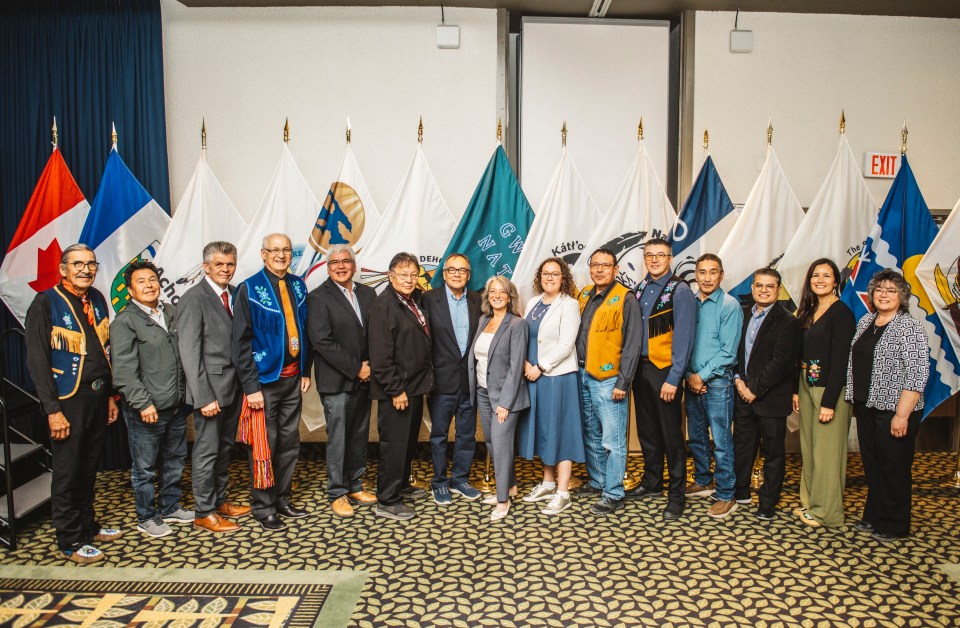
Representatives from the federal government and an NWT Indigenous-led conservation trust signed a grant agreement for $300 million in federal funding on Monday.
The signing, which took place at the Explorer Hotel in Yellowknife, marks the final step in transferring federal funds committed last fall as part of a major Indigenous-led conservation deal – the NWT: Our Land for the Future agreement – to a trust set up as part of that deal.
“This is the final milestone of actually the money coming to us,” Danny Yakeleya, inaugural chair of the NWT: Our Land for the Future Trust, told Cabin Radio.
In a speech at Monday’s event, Yakeleya said the funding is “the largest investment in Indigenous-led conservation and stewardship in the NWT” and the benefits expected to come out of the initiative are “huge.”
Advertisement.
Advertisement.
NWT: Our Land for the Future is one of the largest Indigenous-led land conservation initiatives in the world. It was signed in November 2024 by 21 Indigenous governments, as well as federal and territorial governments and private donors. It represents a rare level of collaboration between leaders.
The deal committed $375 million to support Indigenous-led conservation and
stewardship in the territory. The funds can be put toward Guardians programs, the management and establishment of protected and conserved areas, climate monitoring and on-the-land programming, among other activities. The money is expected to be made available over the next decade, if not longer.
The initiative has the potential to help preserve 380,000 square kilometres of land and water – roughly 30 percent of the territory. It is also anticipated to bolster an economy around conservation and support community development.
“This isn’t just a conservation announcement, but a global milestone,” Julie Dabrusin, federal minister of environment and climate change, said at Monday’s event.
Advertisement.
Advertisement.
“With today’s agreement, we move from vision to action, from planning to progress, and from intention to impact,” she added.
To reach the agreement, signatories used an innovative approach for conservation finance known as Project Finance for Permanence, or PFP, which draws on Wall Street practices for financing large-scale projects. The PFP model leverages private and public dollars to finance major conservation goals.
In the deal signed last fall, the federal government committed $300 million toward the initiative. The remaining $75 million is expected to come from private donors.
Despite these commitments, after the signing last fall, several conditions needed to be met for the committed funds to flow, according to Dahti Tsetso, deputy director of the Indigenous Leadership Initiative.
Tsetso played a key role in facilitating negotiations leading up to the agreement’s signing and has since served as interim secretariat for the trust. She is now transitioning into a role as the trust’s chief executive.
“Once we signed the Our Land for the Future agreement in November, it was like a key to go on a whole number of commitments embedded within the agreement,” she told Cabin Radio.
That included things like establishing a partners table to provide guidance on the overall implementation of the agreement, setting up a trust to hold the funds, and appointing a board of directors to oversee the management of that trust.
For the Government of Canada to be in a position to flow funding, Tsetso added, the partners had to have all the mechanisms and machinery in place for there to be an entity called Our Land for the Future Trust, with bank accounts, staff, directors and oversight.
Advertisement.
Advertisement.
Setting all this up has involved a tremendous amount of work and collaboration, she
said.
According to Yakeleya, various milestones also had to be met within a short period of time and, with the recent federal election, there were some concerns timelines might slip.
Having the federal grant agreement signed is a “huge relief,” he said. “The Indigenous governments that we’re working with are very excited to be at the stage, very excited to start seeing the money flow to the communities.”
Tsetso described the transfer of funds as bringing life to the initiative.
“Personally, I think I may have cried a few tears of joy,” she said. “For me, it’s always been so deeply moving and meaningful to think how these resources will be invested within our communities over the next 10 years, and to imagine the hopeful future that it will bring.”
With the federal grant agreement finalized, the next step will be signing grant agreements with the private donors. According to Tsetso, work is ongoing to ensure those agreements are concluded by the end of the summer.
There is also still more work to be done to get Our Land for the Future up and running, according to Yakeleya – including developing policies to guide the distribution of funds, investments and application procedures.
Yakeleya said the board of directors is close to finalizing documents outlining those policies and processes, which will be presented to the partners table in September.
Advertisement.
Advertisement.
If they are approved, he said, the hope is to have money start flowing to communities shortly after.
At Monday’s event, several leaders spoke about the significance of the funds.
“This trust is about securing our ability to care for our territory in our own way, on our terms, for generations to come,” said Frederick Blake Jr, Grand Chief of the Gwich’in Tribal Council.
Looking ahead, Northwest Territory Métis Nation President Garry Bailey said: “I think it’s going to be a great 10 years coming for all of our people.”
