



Yellowknifers used a town hall with a federal defence official to stress the uniqueness of doing business in the North.
Ravi SK Singh, director general of defence industrial strategy at the Department of National Defence, hosted the meeting with local businesses to discuss a new federal strategy that aims to grow Canada’s domestic defence industry.
The event, which took place at Joint Task Force North headquarters last Thursday, was also attended by representatives of the city and territorial governments and the Yellowknives Dene First Nation.
Prime Minister Mark Carney released Canada’s first defence industrial strategy last month, which includes explicit mention of the importance of the North and Arctic.
The strategy sets ambitious goals over the next 10 years including awarding 70 percent of federal defence contracts to Canadian companies, increasing defence exports by 50 percent, and creating 125,000 new jobs.
Advertisement.
Advertisement.
The strategy is backed by $6.6 billion in spending in the 2025 federal budget, including $2.1 billion in 2025-26. The federal government has said the investments will “help Canadian companies innovate, strengthen supply chains and build the industrial base needed to better equip and sustain the Canadian Armed Forces and our Allies and partners.”
“It’s great to have a nice announcement but, as a humble bureaucrat, it falls on us to actually figure out what the tangible things are going to be for communities, such as here in Yellowknife,” Singh told those gathered at last week’s meeting.
“It was important for me as one of my first engagements after the announcement to come to the North,” Singh continued.
“This land is not peripheral in our defence thinking and it is also something where I think we’ve neglected, simply in terms of our ability to understand its importance, but also the investments in it as well.”
Advertisement.
Advertisement.
Singh said the new strategy signals a change in Canada’s approach to defence that means looking at industrial development as a driver.
He said the federal government wants to hear from businesses to understand the regional context and how different communities can benefit from investments.
‘The deficit is too big’
During the town hall, several attendees spoke about the uniqueness of doing business in the North.
They highlighted differences from southern Canada such as:
- the small market;
- infrastructure deficit, including ageing and inadequate transportation, housing and energy infrastructure;
- limited land that can be developed; and
- a need to develop the local workforce.
Some attendees considered it a missed opportunity for Singh to try to meet with leaders from across the territory while the NWT Association of Communities was holding its annual general meeting nearby.
Singh said the federal government is looking to identify gaps that need addressing and pledged to continue engaging with businesses and communities in the North. He said he was not aware of the NWTAC meeting but would not miss such an opportunity again.
Singh said Canada recognizes the need to think about the societal and health impacts of defence investments and the need to be holistic when investing in the North.
He said development of the defence industrial strategy highlighted a deep gap in Canada’s ability to contribute to its allies and protect sovereignty in the North.
Advertisement.
Advertisement.
“This is not something that is going to be dictated by the news. It’s about Canada’s sovereignty. It’s about Canada’s communities and its ability to respond 110 percent to protect Canadians,” he said, adding the federal government is planning for investments in the North to be sustainable and long-term rather than an “ebb and flow.”
“We have no other choice. The deficit is too big at this point,” he said.
Exactly how much money may be invested in the North, what projects may be given the green light and when northerners can expect to see money flow remains unclear.
Singh said multiple federal departments are involved in making those decisions but the new strategy gives government bureaucracy “a coherent vision and direction” to work together.
Northern leaders prepare for investment
Northern leaders have been preparing for an expected influx of federal defence spending.
The Canadian government designated Yellowknife, Inuvik and Iqaluit as operational support hubs last year. Meanwhile, a more recent advanced procurement notice suggests defence spending in Yellowknife and Inuvik could exceed $10 billion over the next 15 years, though further details have yet to be released.
Before unveiling the NWT’s draft operating budget for 2026-27, finance minister Caroline Wawzonek told reporters she is “expecting a lot” in the coming year.
“I do think 2026 is going to be a big year and, frankly, has to be a big year,” she said.
Advertisement.
Advertisement.
Mayors from Whitehorse, Yellowknife and Iqaluit recently signed a memorandum of understanding to strengthen collaboration among northern capitals on priorities related to infrastructure resilience, community capacity and Arctic security and defence operations.
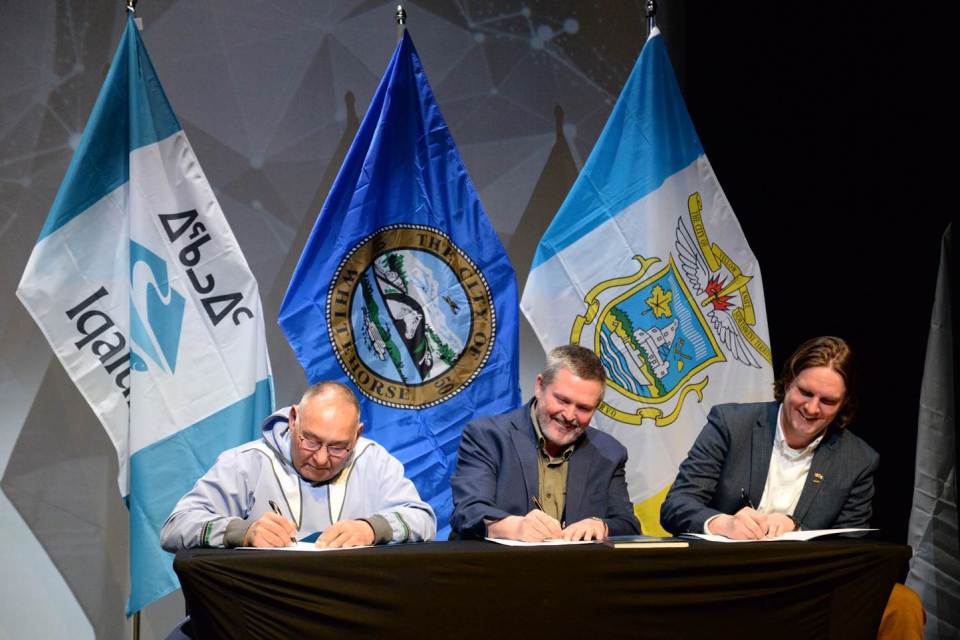
Yellowknife Mayor Ben Hendriksen said northern mayors had decided to work together more closely to ensure the federal government has a northern lens when it comes to potential investments.
He said as far as he is aware, this is the first time that Whitehorse, Yellowknife and Iqaluit have signed such an agreement and agreed to work together strategically.
“This is all very new for everybody, from the federal government to the armed forces to the territorial governments to the municipalities,” he said.
“Right now, communication is open, the [federal government] is interested, it wants to understand more about northern municipal needs and requirements that we have. Part of the reason for the MOU is to make sure we keep that going.”
