


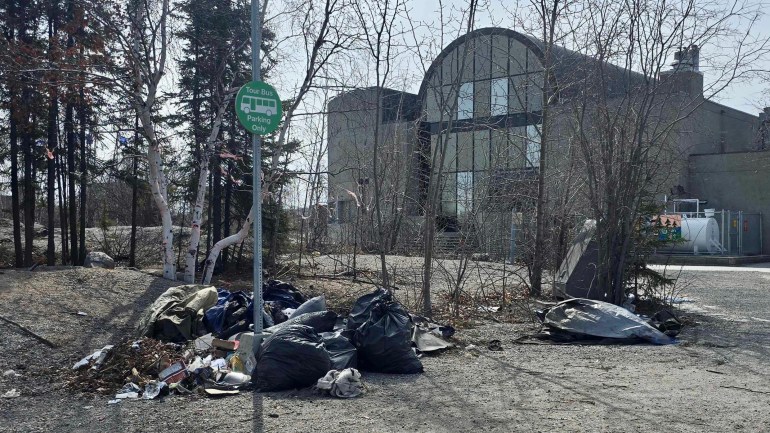
Some city councillors want the NWT government to do more to clean up property the territory controls in Yellowknife.
Rob Warburton raised the issue during a discussion at City Hall on Wednesday about developing a policy that would prohibit homeless encampments on municipal land.
Warburton said he feels the issue is more that commissioner’s land in Yellowknife – which is the responsibility of the territorial government – is not being cleaned up.
“I need to see landowners writ large, but the territorial government in particular, clean up the excessive garbage that is all over my city,” he said.
“People have been reporting it for years, talking about it for years and we’re effectively doing nothing. We’re doing nothing, it’s just getting worse.”
Advertisement.
Advertisement.
Warburton said the conversation about homeless encampments was different, but around some encampment locations the land is “a mess” and “disgusting.”
Councillor Stacie Arden Smith agreed.
“My town is disgusting,” she said.
Following the meeting, Yellowknife Centre MLA Robert Hawkins emailed a complaint to the city, which was shared with the NWT government and reporters, requesting the cleanup of garbage around an encampment site on commissioner’s land near the Prince of Wales Northern Heritage Centre.
Advertisement.
Advertisement.
Hawkins, who has been a vocal critic of encampments, wrote that the site “has been in gross disarray for months and as such has been detracting from the overall community.”
City working with GNWT to address issue
City manager Stephen Van Dine told councillors at Wednesday’s meeting that the city has been working with the territorial government to address violations of the municipal unsightly land bylaw on commissioner’s land.
He said there have been times the GNWT has “made efforts to clean up property” and in other cases, the city is still working with the territory to “encourage them to do so.”
“We are now finding that we are needing to step up the notification process and we are working to do that,” he said.
The city estimates that just one encampment in Yellowknife, which it said is currently abandoned, is located on municipal land.
Van Dine said the city has cleaned up previous encampments that have been abandoned on municipal land. Between June and September 2025, the city said, it spent $3,672 hiring contractors to do so.
“This is something that we’ve been taking very seriously,” he said.
Mayor Ben Hendriksen noted that not all of the garbage in the city is related to encampments and the city needs to address the issue “in all scenarios.”
Advertisement.
Advertisement.
He said there are ways for the city to ensure compliance with bylaws by working with property owners before enforcement, and called on the city be more proactive in addressing violations of its unsightly lands bylaw.
Warburton encouraged the city to issue the NWT government fines for non-compliance.
“If our only tool is to fine them, then let’s start doing that because maybe a bill will make them pay attention, because they’re not doing anything,” he said.
Legislation on encampments in Yellowknife
The discussion at Wednesday’s meeting was prompted by a motion city staff presented to councillors that would formally endorse the municipality’s current approach to encampments.
Van Dine said that approach has prioritized the health and safety of encampment residents and the general public.
Since councillors passed another motion related to encampments last June, Van Dine said staff with the city’s municipal enforcement and fire divisions have been regularly visiting encampment sites and addressing issues such as fire risk.
According to the city meeting agenda, Housing NWT has been funding encampment fire safety packages that include a fire extinguisher and a fire retardant blanket. The territory had previously denied requests from some encampment residents to provide access to potable water, fire extinguishers, and fire-retardant tarps and tents.
On Wednesday, city staff also asked councillors for direction on making policy changes that would prohibit camping on municipal land.
Advertisement.
Advertisement.
Under territorial regulations, camping is permitted on commissioner’s land for up to 100 days. City bylaws do not prohibit “temporary abodes” in public spaces save for parks.
The meeting agenda highlighted that experiences in other Canadian cities have “made clear” that municipal actions related to encampments in cities that lack appropriate housing options must consider residents’ Charter right to life, liberty and security of the person.
The city noted people have struggled with a lack of housing options in Yellowknife for years and homelessness is increasing. In the absence of adequate alternatives, the city said its focus should be ensuring encampments are as safe as possible.
Warbarton said the territorial government has not been enforcing the 100-day limit for encampments and called for stronger action.
“We’ve reached a point where I think the general public wants the government to take a risk and help solve the problem. They might get sued. That’s your job as a government, is to do things the private sector cannot do,” he said.
“So to sit there and say ‘Well, we might get sued so we’re going to let it just be the Wild West’ – it’s not a good choice for the public.”
The city’s agenda acknowledged that the majority of people experiencing homelessness in Yellowknife are Indigenous.
A briefing note for councillors stated the United Nations Declaration on the Rights of Indigenous Peoples, which Yellowknife adopted in 2015, supports that the municipality “should not be unilaterally adopting policies of forced relocation on Indigenous people who are sheltering outside.”
“Council should be aware of and acknowledge the historical context of colonization when considering issues of land use and relocation of individuals,” the briefing note stated, adding the Canadian government has previously forced Indigenous people to relocate.
