


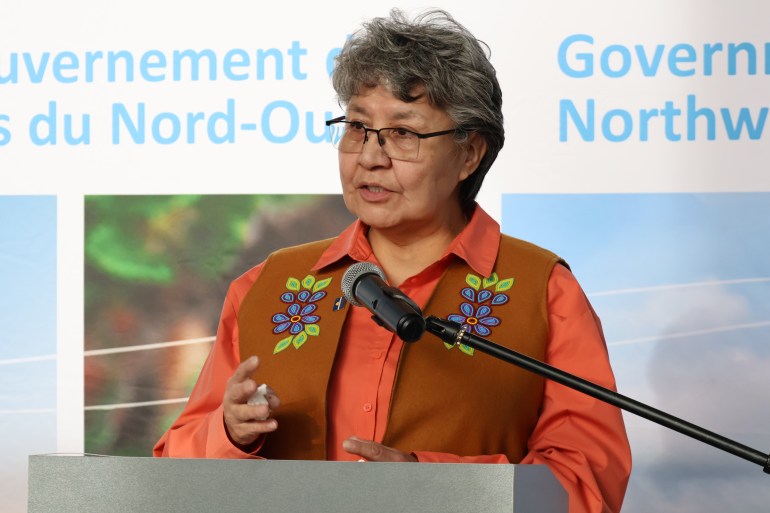
Jane Weyallon Armstrong wants former Chief Jimmy Bruneau School students to be recognized as residential school survivors.
“The experience of former Chief Jimmy Bruneau School students have been overlooked for too long,” the Monfwi MLA said in the NWT Legislative Assembly on Thursday.
“They should not have to keep fighting to prove that their residential school experience mattered.”
Weyallon Armstrong said students who attended the school and lived in its residence from 1971 to 2006 should be entitled to compensation and support as residential school survivors.
According to a report on the history of educational facilities in the NWT, Chief Jimmu Bruneau School opened in Behchokǫ̀ in 1971. It included a 100-bed residence for Tłı̨chǫ students from outside the community, which was run by the Rae-Edzo School Society formed by the local band council.
Advertisement.
Advertisement.
An agreement signed in 1982 gave the society increased control over the school’s operations, the report said.
Today the Tłı̨chǫ Community Services Agency manages the school, which no longer operates a residence.
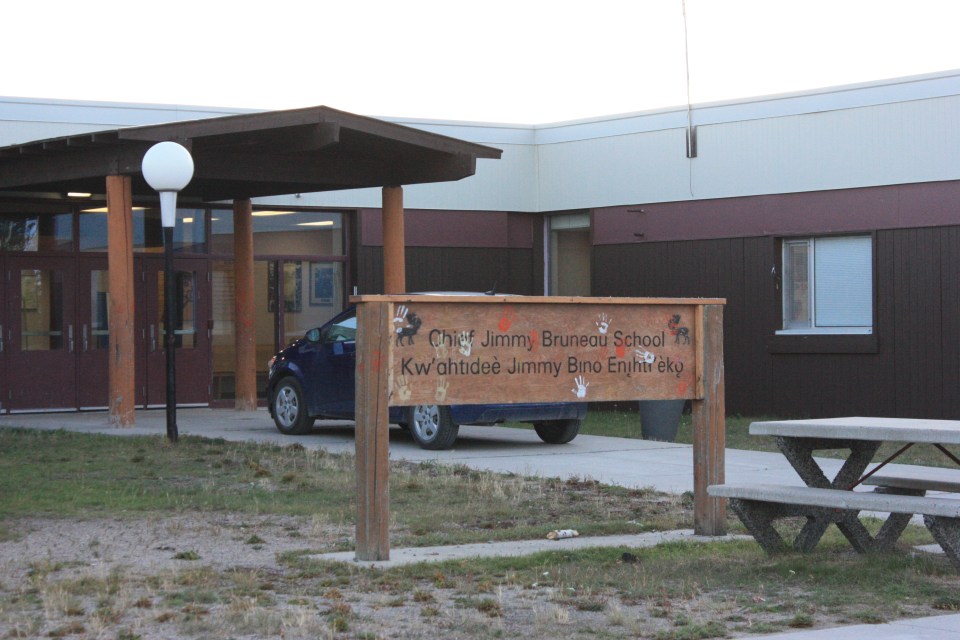
Weyallon Armstrong said Thursday that while the school may have operated under an Indigenous school board, students were “still taught under a colonial curriculum” by teachers from down south.
“The racism, violence, displacement and vulnerability were real and they followed many young people for life,” she said.
Advertisement.
Advertisement.
“This government must stop dismissing this as a technical issue and start treating it as a matter of justice.”
CBC has previously reported on some former students’ efforts to be recognized and compensated as residential school survivors.
Premier RJ Simpson told Weyallon Armstrong on Thursday that he recognized Chief Jimmy Bruneau School as a residential school because it had a student residence, and that he has visited the school and parts of its former residence.
He said he was not familiar with the day-to-day operations of the school while the student residence was open and did not “want to paint every residential school experience with the same brush.”
Regarding compensation, the premier said he could not make a commitment, but would discuss the matter with Weyallon Armstrong further. He noted the Indian Residential Schools Settlement Agreement was “hashed out over many years” between the federal government, churches and residential school survivors.
“I can’t stand here and say that we’re going to do something similar because that is a significant process,” he said.
“That’s not the kind-of thing you just stand up and say yes to in the house here without any sort of discussion or things like that.”
Fourteen recognized residential schools in the NWT were included in the 2007 settlement agreement. The schools were funded by the federal government and largely operated by the Roman Catholic or Anglican church.
Advertisement.
Advertisement.
Requests to add Chief Jimmy Bruneau School to the agreement were denied because the school was “territorially operated.”
Simpson said residential schools are “a big part of the reason that we’re in the situation that we’re in in the territory.”
“The effects of trauma, we see that every single day, and I attribute that to the history of colonialism and residential school,” he said.
Mental health and emotional support is available to former residential school students and their families through the 24 Hour Residential School Crisis Line at 1-866-925-4419.
NWT residents can access free counselling through the territory’s community counselling program and residents can speak with a registered nurse about mental wellness concerns by calling 8-1-1.
