


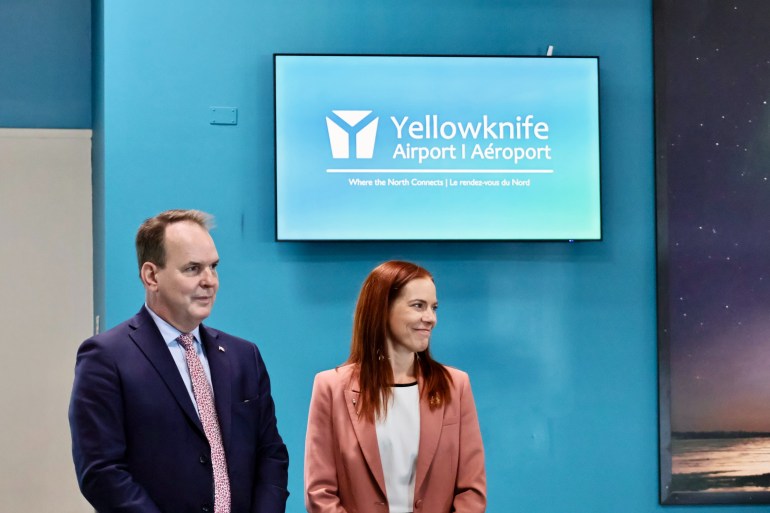
The federal government has announced it will provide $1.2 million to help with the design and installation of a runway end safety area at Yellowknife Airport.
“This is a targeted and important safety enhancement,” deputy premier Caroline Wawzonek told reporters at the airport on Wednesday afternoon.
“These areas are designed to reduce the risk of damage to aircrafts, improve safety outcomes for passengers and crews.”
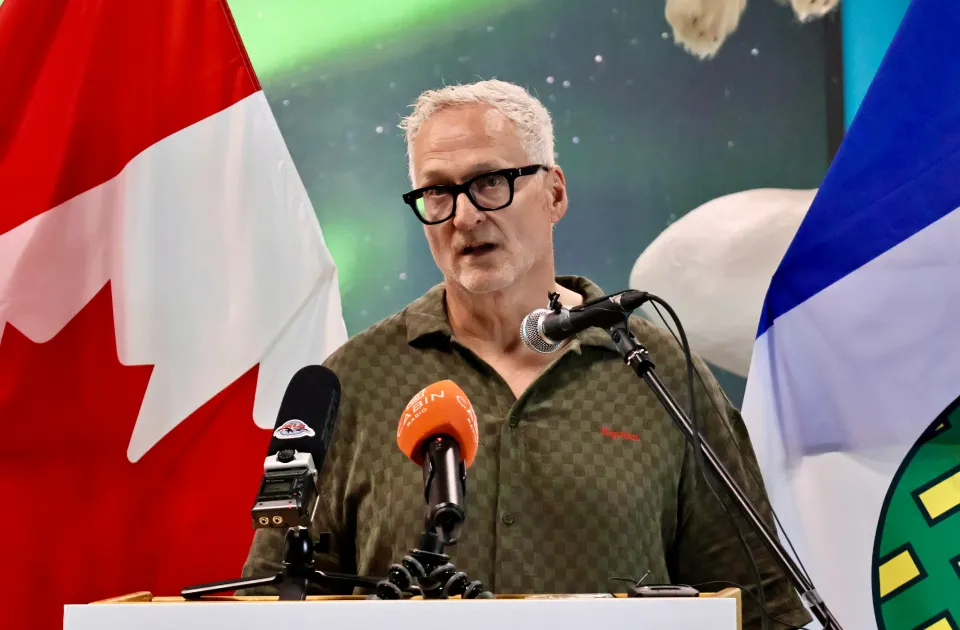
According to Randy Straker, the airport’s manager, a runway end safety area – or RESA – is designed to provide a safe space for an aircraft to slow down in the event of an overrun or undershoot.
Canadian aviation regulations require airports that move more than 375,000 passengers a year for two consecutive years to establish a RESA. According to the NWT government, annual traffic at the Yellowknife Airport reached more than 618,000 passengers in 2025, up from 604,330 in 2024.
Advertisement.
Advertisement.
Federal and territorial officials said Wednesday that having a RESA will enhance safety for passengers, air crews and airport workers, while supporting continuity of operations at Yellowknife Airport.
The area will be installed at the end of Runway 16, Yellowknife’s main runway.
Straker said doing so will not interfere with existing plans to extend that runway, as the runway will be extended at the opposite end of the RESA, where space is not constrained by Long Lake. He said Runway 10/28, the airport’s shorter runway, is set to be extended at both ends.
While the federal government has not yet confirmed the length of the extensions, territorial officials have said they expect the improvements will put Yellowknife’s main runway among the top 10 in the country.
Advertisement.
Advertisement.
Straker said the design for the RESA is complete and construction could begin in August.
The RESA is among several improvements planned for Yellowknife’s ageing airport.
The territorial government has applied to the Canadian Air Transport Security Authority for improvements to double security throughput.
Straker said while the airport was hoping for that to be approved this year, there is a backlog across Canada for airports to move to new CT X-ray technology. He said Yellowknife Airport is on a priority waiting list and hopes to get the new technology next year.
The NWT government is also planning to build a new airport terminal in Yellowknife and has applied for federal funding for the next phase of design work. Wawzonek said a design could be ready in the next year to 18 months if funding is secured.
Federal transport minister Steven MacKinnon, who took a tour of the airport ahead of Wednesday’s announcement, said it was “obvious” the airport had “squeezed every last square centimetre of space” available. He said he planned to “more intensely familiarize” himself with work that has been completed so far on studying potential alternatives to the current terminal, which was built in 1963.
“With the kind of growth that we’ve seen, the kind of growth that we anticipate in Yellowknife, it is quite clear that this facility does not have a lot of life cycle left in it,” he said.
MacKinnon said the terminal is “a strategic piece of air infrastructure for Canada” and “one that deserves and is going to get some attention from us, in terms of taking a close look at what the options are.”
