



Advertisement.
One three-page piece of legislation is central to the NWT’s big debate right now: whether or not to hold an independent public inquiry into the handling of 2023’s wildfires.
The Public Inquiries Act, which hasn’t been updated since the late 1980s, sets out how an inquiry in the NWT is supposed to unfold.
Premier RJ Simpson says the legislation is outdated and using it could open the way for what he fears would be an unnecessarily lengthy, costly process.
On Wednesday, he told the CBC that could mean grinding departments “to a halt” for months.
Advertisement.
Advertisement.
“We could be looking at an inquiry worth tens of millions of dollars. It would require hundreds or thousands of people to testify,” he told the broadcaster.
The MLAs proposing a public inquiry under the act, Kieron Testart and Sheryl Yakeleya, say a full inquiry will “bring accountability” to the territory rather than relying solely on reviews commissioned by GNWT departments, even if those reviews are carried out by third parties.
Other advocates say a separate inquiry is needed to investigate how different levels of government – and agencies like Parks Canada – interacted with each other during the wildfire season and where gaps emerged.
Some MLAs say government reviews and a public inquiry aren’t the only two options, and there could be a compromise available: a commission or review of some form that isn’t as formal and rigid as an inquiry, but takes the process fully out of government hands.
Advertisement.
Advertisement.
On this page, we look at the text of the Public Inquiries Act itself. What do its three pages say? (You can find the full document here.) We’ll look at the sections that appear to be giving the premier some concern, and we’ll look at how Testart proposes to solve the premier’s problems.
The first, brief section of the act deals with simple definitions, which we can skip. The act then starts setting out how any inquiry would work.

These opening sections set out that a public inquiry can investigate pretty-much anything that could reasonably be termed a “matter of public concern,” and an inquiry is intended to be overseen by a board. (Testart has proposed a board of four people: two chosen by cabinet, two by regular MLAs.)
The board can summon anyone as a witness and require the production of any document.
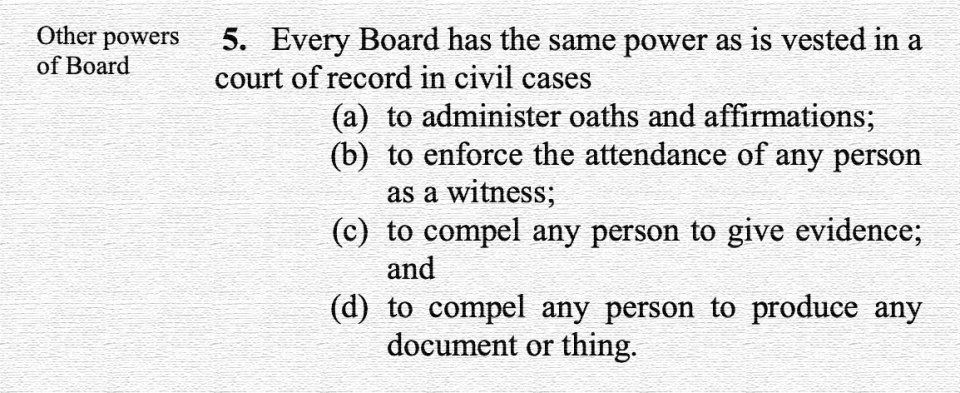
The board has the same power as a civil court, meaning it has considerable authority to force anyone to appear and hand over anything relevant to the inquiry.
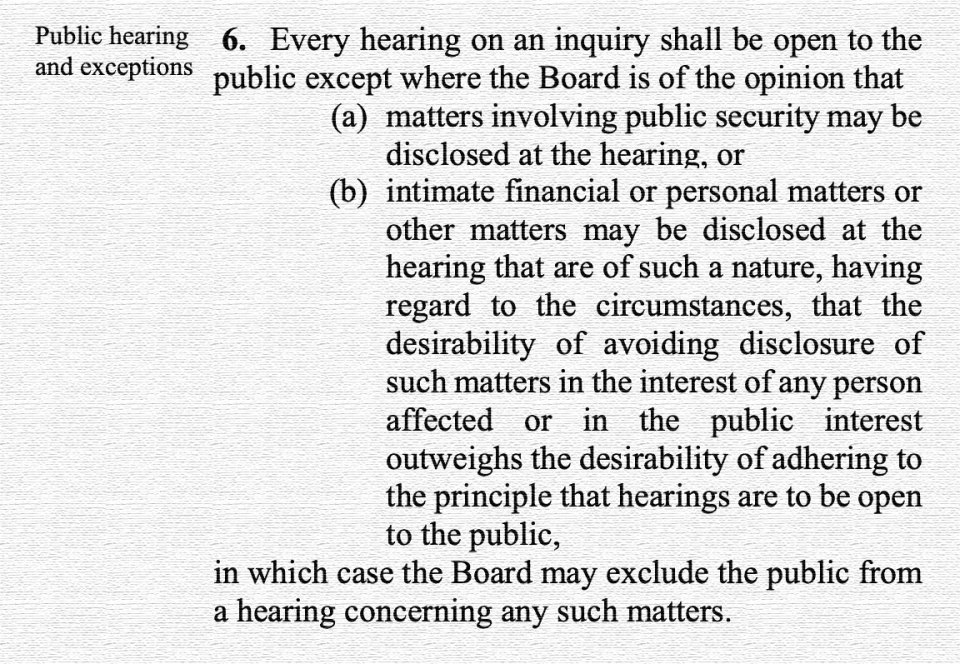
The board can hold hearings behind closed doors if it’s a public security issue (possible but not likely for most of a wildfire inquiry) or if the right to privacy or secrecy outweighs the public’s right to know, in the board’s view.
Premier Simpson has argued that a public inquiry would not allow evidence to be given anonymously. The Public Inquiries Act, indeed, does not expressly provide for anonymous testimony. But this section appears to allow some people to testify in private, without their identities necessarily ever being disclosed beyond the board, if the board agreed.
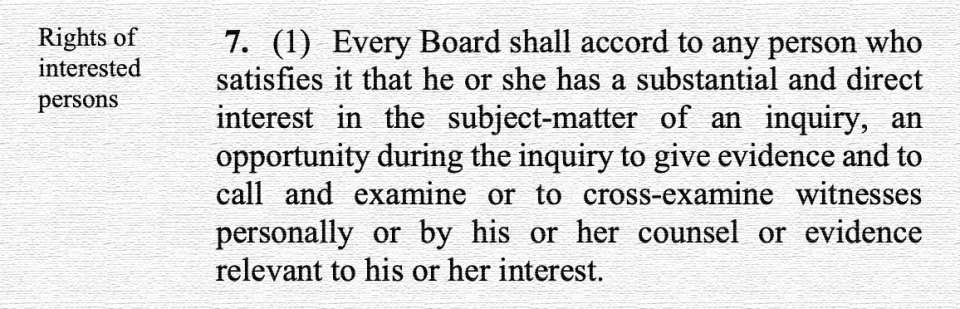
This is another section that worries Simpson.
Advertisement.
Advertisement.
“We could have a situation where we have tens of thousands of people able to testify and call witnesses and it could turn into a circus very quickly,” he told the CBC.
This section sets out that anyone who has “a substantial and direct interest” in what happened last year can give evidence to the inquiry. They can also call their own witnesses and evidence.
The one caveat is that “substantial and direct interest” is defined by the board. In the context of last year’s fires, what does that mean? Anyone who was evacuated? Anyone who lost property? Anyone in a position of responsibility?
How a board chooses to define “substantial and direct interest” would have a significant bearing on the number of people able to testify.
After this section, there’s about a page of the act left. That page mostly deals with issues like ensuring witnesses can’t incriminate themselves and forbidding the inquiry to accuse anyone of misconduct without trying to hear from them.
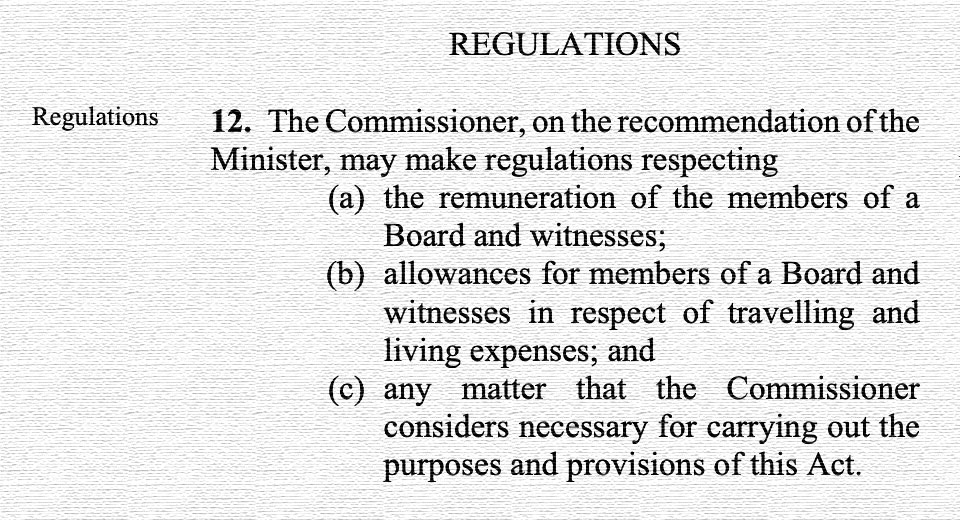
The very last section is important. This section deals with regulations, which are detailed instructions governments can introduce to help interpret and refine what’s written in acts.
In this case, the act allows the creation of regulations about “any matter … necessary” for holding an inquiry.
Testart’s solution
The ability to create regulations is critically important to solving the premier’s problems with an inquiry, says Testart.
Advertisement.
Advertisement.
In 2016, the Public Inquiries Act was used to help facilitate the National Inquiry into Missing and Murdered Indigenous Women and Girls’ work in the Northwest Territories.
At the time, an establishment order was issued declaring that an inquiry would be set up – and including a list of regulations that defined the inquiry’s scope and timeline.
Among the establishment order’s regulations were instructions such as what the board should inquire into and report on, when hearings should last until, and a requirement to provide counselling to participants.
“Regulations can be applied to set a budget for the board of inquiry and set a timeline where the board would have to report back,” Testart told Cabin Radio on Wednesday evening, explaining how he envisages this kind of establishment order being used to narrow down an inquiry and avoid the sort of sprawling monster Simpson describes.
Testart said he wants Indigenous governments, regular MLAs and cabinet to jointly agree on the regulations in a wildfire inquiry establishment order. Then the appointed board would be set on their way and the inquiry would roll out without further interference from any governments.
He wants to let the government after-action reviews that are already starting conclude first, reporting to the inquiry’s board, with the inquiry then providing opportunities for residents to speak and filling in gaps.
“Allow the inquiry to hold public engagement sessions in each of the affected communities – Yellowknife, Hay River, Fort Smith, Kakisa, particularly Enterprise, Fort Providence, the entire South Slave. Make room for appearances virtually, and written submissions as well,” Testart said.
“We can scope this all out in the regulations and give some shape to how this would look, so it doesn’t go off the rails.
“The premier’s describing this nightmarish boondoggle that drags on until the end of time. I think that’s an unfair characterization of what can be done with this act.”
A formal debate in the legislature – and a vote on what to do next – is due to take place on February 22.
