

The Transportation Safety Board of Canada has issued four recommendations to improve helicopter safety following a fatal 2021 crash in Nunavut.
The board on Thursday released its investigation report into the April 2021 crash of an Airbus AS350 helicopter operated by Great Slave Helicopters.
The aircraft was returning to Resolute Bay from a 12-day polar bear research trip when it collided with terrain on Griffith Island, killing all three people on board – the pilot, an aircraft maintenance engineer and a biologist.
The Transportation Safety Board of Canada, or TSB, said a lack of regulations mitigating the risks of flying in reduced visibility led to the crash.
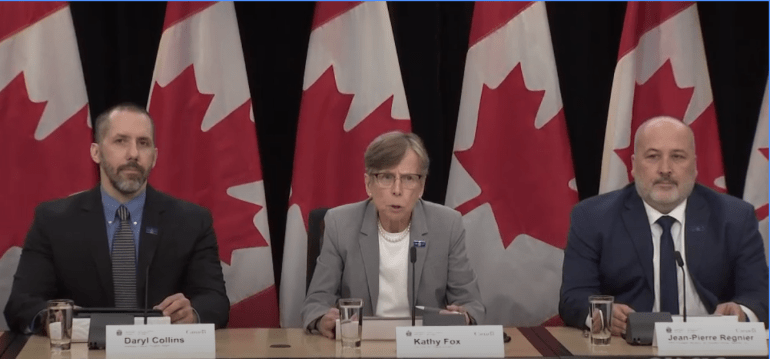
The board is recommending that Transport Canada make changes to prevent future related accidents – changes Kathy Fox, chair of the TSB, said the board has been seeking for more than 30 years.
Advertisement.
Advertisement.
“Enough lives have been lost. It’s time for Transport Canada to take action,” she said at a press conference in Ottawa.
According to the investigation report, the helicopter departed from a remote camp on Russell Island toward Resolute Bay airport on April 25, 2021. The flight was being conducted under visual flight rules, which meant the pilot was required to maintain visual reference to the ground and navigate the helicopter using external references.
When the aircraft reached the highest elevation on Griffith Island, the TSB said, the snow-covered terrain, overcast sky and snow squalls likely created flat light and whiteout conditions. The TSB believes that resulted in an unexpected loss of visual references, also known as inadvertent flight into instrument meteorological conditions, or IMC.
While the pilot was trying to visually manoeuvre the helicopter in response to the inadvertent IMC, the aircraft unintentionally descended and collided with the terrain.
Advertisement.
Advertisement.
The TSB said the pilot lacked the skills necessary to recover solely by using flight instruments, and the helicopter was not equipped with technology capable of alerting him to the aircraft’s height above the ground or rate of descent. That meant he had no advance warning of the impending collision.
The board said at the time of the crash, Great Slave Helicopters had adopted an approach consistent with regulations that solely relied on a pilot’s ability to avoid such conditions, known as the “avoid-at-all-costs approach.”
“No one plans to find themselves flying in inadvertent IMC. Its very name, inadvertent, means unplanned,” said investigator in charge Daryl Collins. “You can’t expect an avoid-at-all-costs approach to be effective against something you never planned to happen. So there need to be additional potentially life-saving defences in place for pilots.”
Following the 2021 accident, the TSB said Great Slave Helicopters implemented a range of safety measures. The company amended its operating procedures, updated pilot training and held quarterly safety management meetings.
The TSB said there is currently no regulatory requirement, however, for commercial helicopter operators to ensure pilots have the necessary training and technology to recover from inadvertent IMC. Single-pilot operators are also not required to have standard operating procedures, which would include how to successfully recover from inadvertent IMC.
The board added while loss of visual reference accidents are more than twice as likely to involve helicopters than fixed-wing aircraft, requirements for helicopters are more lax. The TSB said that means helicopter pilots are permitted to fly at half the visibility but without the same safeguards.
“While some operators have voluntarily implemented safety initiatives that go beyond the regulatory requirements, the cost of proactively implementing additional training and technology in a highly competitive industry deters many companies from doing so,” Fox said.
Advertisement.
Advertisement.
She said implementing regulations would “level the playing field,” adding that more operators purchasing equipment and offering training would likely bring those costs down.
To prevent future accidents, the TSB recommended that:
- commercial helicopter operators be required to ensure pilots have the skills necessary to recover from inadvertent flight into IMC;
- commercial helicopter operators be required to implement technology to assist pilots with avoidance of and recovery from inadvertent flight into IMC;
- commercial and private operators conducting single-pilot operations be required to develop standard operating procedures based on corporate knowledge and industry best practices; and
- requirements be enhanced for helicopter operators that conduct reduced-visibility operations in uncontrolled airspace, to ensure pilots have an acceptable level of protection against inadvertent flight into IMC accidents.
The TSB said it has identified loss of spatial awareness in 13 flights involving commercial helicopters between 2010 and 2018, and has previously issued 10 recommendations to Transport Canada to prevent inadvertent IMC accidents.
Under federal legislation, the federal transportation minister has 90 days to respond to the TSB’s recommendations.
