


“It’s really skinny, the boat, eh? Hopefully I don’t fall over and capsize. We’ll find out.”
That was one Yellowknifer’s initial assessment on turning up at a free come-try-rowing day near the end of May.
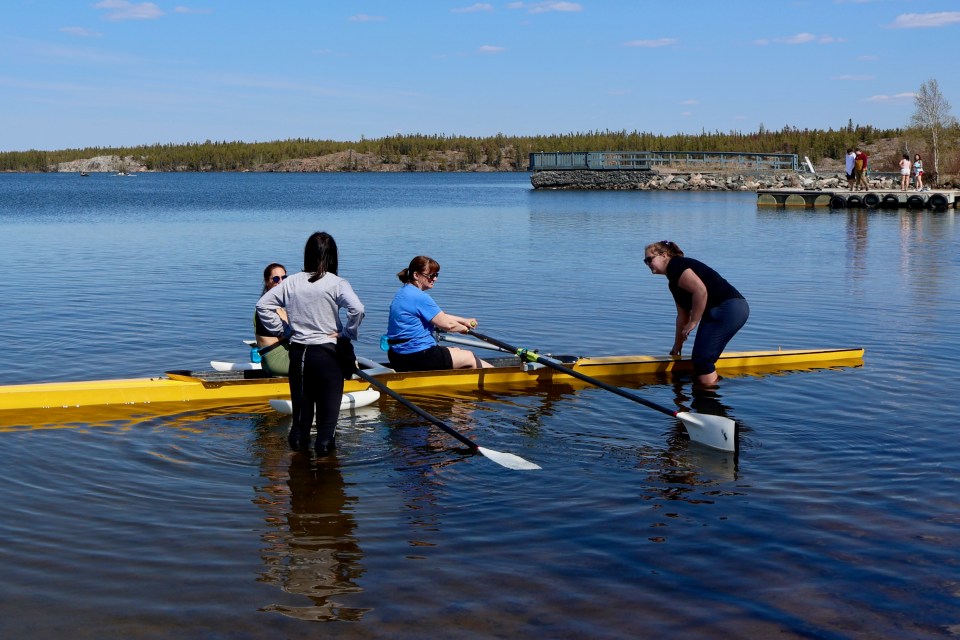
Somba K’e Paddling Club has become the northernmost rowing club in Canada in recent years, offering residents of Yellowknife the chance to hit the water in both directions: facing forward in a canoe or kayak, or backward in a rowing shell.
At Saturday’s free trial day, few if any participants tipped over, despite the slimline characteristics of the racing shells.
“I grew up doing a lot of canoeing, so it was really fun to be in a boat again. Definitely different,” said Aven Elliott.
Advertisement.
Advertisement.
“Doing the rowing machine at the gym is very different than on the water,” said Kelly Slack. “It didn’t feel tippy at all, that was great.”
Yellowknife composer Carmen Braden was impressed.
“I’ve done a fair amount of canoeing and kayaking up here, but I’ve never done rowing. You’re in a skinny boat but you’re looking backwards, that’s different,” she told Cabin Radio.
“I like the appeal of doing it with a group but it’s not a competitive sport where you’re throwing balls at each other or running really hard, that’s not my style. And you’re on the water but it’s not super crazy rough water. It’s a really crazy-satisfying feeling.”
Advertisement.
Advertisement.
Braden, like most participants trying rowing for the first time, was paired up with an experienced masters rower who took the extra seat and helped navigate, balance and explore the bay.
“We did it together and we went so fast. He knew what he was doing,” said Braden.
“That was a bit addictive. I was in the water for, like, 12 minutes and I want to do it again.”
Gifts of the water
In 2009, a year after winning Olympic gold in the men’s eight in Beijing, rower Adam Kreek paid a visit to Yellowknife to support KidSport programming.
Fifteen years later, he came back to visit the Somba K’e Paddling Club and help out as new rowers got a taste for the sport he conquered.
“Rowing is just another way to get out there and get active. It’s a special sport, there’s a lot of Canadian history involved in it and we’ve had a lot of success but, more than that, it’s an activity that’s incredibly healthy,” Kreek said.
“Rowing teaches you how to look after yourself, the right nutrition you need to put into your body, and how to connect with yourself, with nature and with others. That’s one of the gifts of the water, it gets you closer to the wild.”

There is a good-natured but only-half-joking rivalry between canoe-kayak and rowing, in which each insists their sport is just slightly the better one. Kreek slipped into that mode at times, noting politely that rowing works some muscle groups a little more than canoeing or kayaking, and that rowing’s racing shells are a shade more stable for a rookie.
Advertisement.
Advertisement.
He also enthused about the bonds you form while rowing in a boat occupied by multiple people.
“You’re in a boat with other people, so you have to adjust the way you row so you can row better as a crew. Not only do you build a community, you learn resiliency skills and how to navigate the inevitable conflict,” he said.
The try-out day was mercifully conflict-free.
Abby Schelew, a volunteer helping out the club, said she found rowing made any summer “that much sweeter” as she guided participants through some basics.
Gillian Waugh, who co-founded with Lauren Hogan the club’s rowing movement, said the day had been “amazing.”
“Turnout has been beyond what we expected, the weather has been on our side. Everything has worked out fantastic,” Waugh said.
Schelew added that even if the boat does look tippy… so what?
“I would say don’t hold back,” she said.
“There’s life jackets. And a little swimming never did anybody any harm.”
