



George expected his son, who was travelling from Alberta to attend a funeral, to arrive in Yellowknife on the morning of Thursday, June 27.
Instead, the man driving with his son showed up at his door alone. That was when George – not his real name – learned his son had been arrested during a traffic stop and taken to the RCMP detachment in Behchokǫ̀.
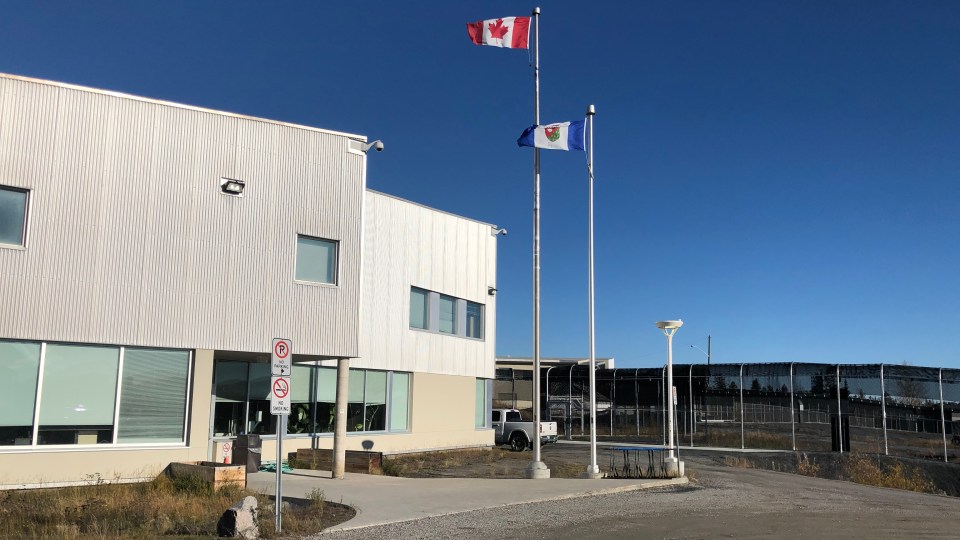
George said it wasn’t until nearly a week later, at 4pm on Wednesday, July 3, that his son was transferred to Yellowknife’s North Slave Correctional Complex, or NSCC.
In general, jails have facilities that RCMP cells do not possess and are operated to a higher standard of care.
“It’s not humane to keep somebody in cells when they are remanded, when it’s an hour away to NSCC,” said George, whose identity Cabin Radio has agreed to protect due to the nature of his employment.
Advertisement.
Advertisement.
“Their process or their system there needs to be changed, and people need to be dealt with like humans.”
Court records indicate George’s 22-year-old son was arrested on June 27 and charged with possessing a controlled substance and failing to comply with a release order.
George said when he called the Behchokǫ̀ detachment, he encountered “a lot of rudeness” from the person who answered the phone and was told his son was only allowed to contact his lawyer.
He said he spoke with his son for the first time since the arrest on Saturday last week, and was concerned about the conditions under which he was being held. He said his son was not given enough food and had not been able to shower.
Advertisement.
Advertisement.
“From Thursday morning until Saturday he hadn’t even been given a cup to drink water with,” said George, “so he had been drinking water out of a tray from his Hungry-Man meal.”
When he spoke to his son again a few days later, George said he still had not been able to shower and on one occasion was denied a request to call his lawyer.
“He obviously is losing his mind,” George told Cabin Radio on Wednesday afternoon. “He doesn’t know why he’s still there.”
‘They need a better system’
George said he was told by RCMP the delay in his son’s transfer to the jail was due to “manpower,” although he does not believe police had no capacity to transport an inmate from Behchokǫ̀ to Yellowknife earlier.
“It’s not just my son. It’s a bigger issue,” he said.
“Even the RCMP confirmed today they need a better system. They understand, but there’s nothing done. It’s crazy.”
RCMP would not confirm to Cabin Radio that someone had been held at the Behchokǫ̀ detachment for six days or explain why their transfer to the Yellowknife jail had been delayed.
In an email, an RCMP spokesperson said no prisoners on remand were being held at the detachment as of Thursday, July 4. He added the “vast majority” of people in RCMP cells are awaiting the outcome of bail hearings.
Advertisement.
Advertisement.
“Each situation is different,” the spokesperson wrote. “The RCMP does not want to hold people in our custody any longer than necessary. This is less comfortable to the detained person, and creates extra work and liability for the RCMP.”
The spokesperson said the RCMP “ensures prisoners’ basic needs are met” including access to food, water, coffee and tea. He said detainees held in detachment cells for more than 24 hours are offered a shower and dental hygiene supplies, while fresh air breaks are “accommodated when feasible.”
The spokesperson said calls to legal counsel are “always afforded in accordance with the legal rights of prisoners” and calls or visits with loved ones are allowed when possible.
Jail standards
Several defence lawyers told Cabin Radio six days is a long time to spend in RCMP holding cells, which are not intended for long-term stays.
They said prolonged stays at community detachments are a growing problem in the NWT.
“There appears to be a greater unwillingness by the state to move prisoners who are awaiting a bail hearing from local RCMP detachments to a proper jail,” said lawyer Tú Pham.
“This is highly concerning as it often results in people – who are presumed to be innocent and entitled to a reasonable bail – being held in the harsh conditions of a police cell for several days at a time.”
Pham said staying at an RCMP detachment means being “locked up” in a windowless cell where the lights are often left on overnight, it can be noisy and there is no scheduled exercise time.
Advertisement.
Advertisement.
“Prisoners are commonly denied access to a shower for days at a time,” he added. “Phone calls, even to legal counsel, are also restricted, making it more difficult to set up a bail plan in a timely fashion.”
Another lawyer, Ryan Clements, noted the NWT’s Corrections Act sets living conditions and standards for inmates at territorial jails – standards that he said are rarely met at the RCMP’s community detachments.
Those standards include access to regular meals, daily exercise, mail and phone, reading materials, personal visits and daily washing or showering facilities, with limits as “reasonable and necessary for the protection of security and the safety of persons at the correctional centre.”
RCMP policy
Clements and two other lawyers, Jessi Casebeer and Jay Bran, said RCMP have adopted a policy of not transporting detainees from community detachments to Yellowknife until their bail status is resolved.
“I think one of the primary reasons they do this is they’re trying to save money, at the expense of someone’s comfort and just their basic human needs, which is a shame,” Bran said.
“Spending any length of time in a detachment is very uncomfortable,” he added. “You’re not getting proper meals, you’re not getting access to proper and regular showers or clean clothes. You don’t have nearly the access you should have to your lawyer, because you don’t have access to a phone. You’re completely dependent on the RCMP to accommodate that.”
Casebeer agreed that RCMP cells “are not a place where anyone wants to spend time.” When she first began practising criminal law in the NWT, she said, RCMP would fly everyone from small communities to Yellowknife to attend bail hearings, rather than waiting for the outcome before transferring them to the jail.
However, she said that practice also caused issues “by removing them from their community and their supports, spending resources bringing them to Yellowknife, only to fly them back to their community again if they are released on bail.”
Advertisement.
Advertisement.
Clements said the RCMP policy, which the NWT adopted around a year ago, is “understandable” as some detainees may shortly be released back to their communities and it can take considerable resources to fly them to Yellowknife.
In practice, though, he said people can spend several days at community detachments as it can take time for lawyers to prepare for bail hearings.
“Everybody is aware that this is a terrible set of circumstances for the person who’s in the detachment cells,” he said.

Clements added that NWT legal aid does not cover legal representation during a detainee’s initial appearance before a justice of the peace, which must be held within 24 hours of their arrest.
While people have a right to speak to a lawyer immediately upon arrest and detention, he has “serious concerns” about how that right has been facilitated in the NWT.
In some cases, he said, lawyers contracted by the NWT government to receive those calls may have limited experience with criminal law, may not be licensed to practice in the territory and rarely, if ever, help detainees prepare for bail hearings.
“It’s a real significant failure in the system resulting in clients not being, in my view, properly served on a systemic basis,” he said.
A police spokesperson told Cabin Radio that “in the spirit of reconciliation” the RCMP “strives to not prematurely transport prisoners to Yellowknife if their release is likely, as they have better supports available within their home communities and releasing them into Yellowknife without those supports can create a risk to public safety.”
Advertisement.
Advertisement.
He added that NWT RCMP are working with justice partners to help shorten the length of time between someone’s arrest and their release from custody or transfer to jail.
There have been previous cases where prolonged stays at NWT RCMP detachments were made public.
In late 2019, a woman was kept in an RCMP holding cell in Yellowknife for 10 nights and 11 days over the Christmas holiday, prompting discussion of the issue in the legislature.
Then-justice minister Caroline Wawzonek, a former defence lawyer, acknowledged that RCMP holding cells are not appropriate for long-term stays.
“The lights are on all the time. You are on a cold slab. There’s not access to a window, there’s not access to outside time,” she said at the time.
In 2016, a territorial court judge reduced another woman’s sentence after finding that her charter rights were violated when she was held at the Yellowknife RCMP detachment for 12 days. That decision was later overturned on appeal.
