



Delegates at the 54th Dene National Assembly called a state of emergency related to the drug crisis in Denendeh.
Trafficking of illicit drugs and its devastating impacts on NWT communities was one of the key issues discussed at the three-day assembly in Dettah last week.
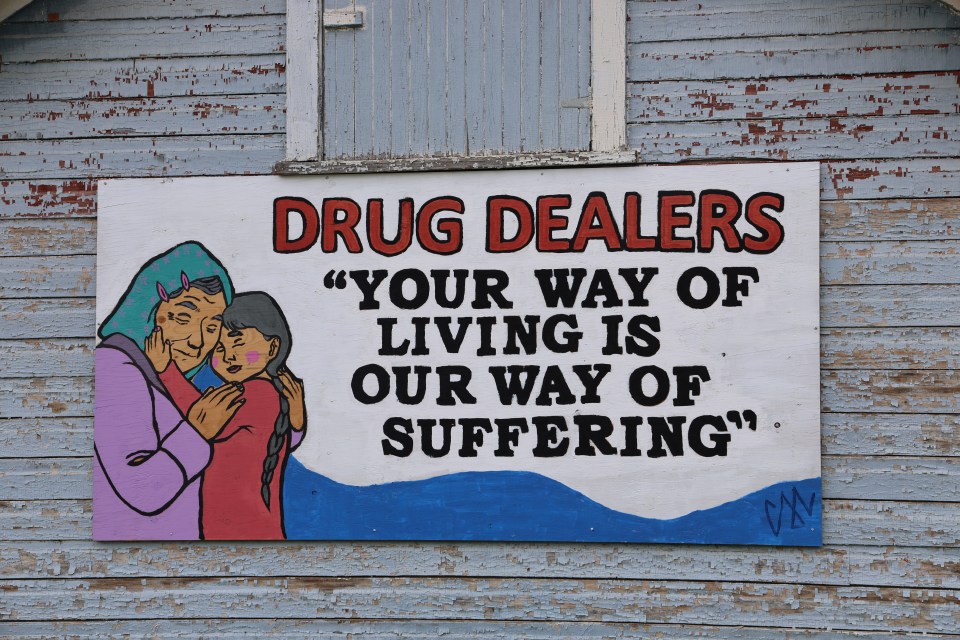
Delegates passed a resolution declaring a state of emergency to address the harmful impacts of alcohol and drugs along with another resolution calling for effective crime prevention strategies and efforts to prevent drug dealers from entering Dene communities. Many leaders highlighted the need for urgency in addressing the widespread issue.
“We all have to come together to fight this. This is a problem that affects every one of us,” said Warren Sikyea, a councillor with the Salt River First Nation.
“This is an epidemic, an emergency,” Danny Gaudet Ɂek’wahtı̨dǝ́ or leader of the Délįnę Got’įnę Government said.
Advertisement.
Advertisement.
“We’re losing too many people in our communities.”
He called for a strategy and massive campaign to address the issue. He suggested uniting people under the symbol of the drum and holding a national drum dance with the slogan “drumming against drugs.”
Chief Kele Antoine of Łı́ı́dlı̨ı̨ Kų́ę́ First Nation said there is a need for not only urgency but compassion in addressing the problem.
“This crisis, it’s not an isolated problem, it’s a symptom of deeper interconnected issues,” he said, highlighting the erosion of Dene family units, trauma and a lack of housing.
Advertisement.
Advertisement.
“We’ve been struggling for a long time, a lot of bad things have happened in our past and it’s up to us,” he said.
“We’ve been trained to look for that authority figure but I want to remind all of our Dene people that it’s them, they are our authority.
“Let’s all come together, let’s talk this out with compassion and love and come up with a good strategy.”
‘We want to take care of our own’
Another big topic at the assembly was the lack of adequate healthcare in NWT communities.
Tim Lennie, former chief of Pehdzéh Kı̨ First Nation, shared an emotional story about his wife’s passing. He said only telehealth was being offered in Wrigley and he sat with his wife for ten hours before a medevac plane was sent to the community. He said she passed away on the tarmac before she could get medical care.
“What is happening today in our community?” he questioned.
“We have been regionalized to the point where we’re dependent on the regional centre for all of the things that we need and we require. We all know that. Everything is centralized … We want to take care of our own.”
Lennie called for serious action to address the issue, sharing concern about losing knowledge holders.
Advertisement.
Advertisement.
‘This is unacceptable’
Ɂek’wahtı̨dǝ́ Gaudet said cancer is “almost a 100-percent death sentence in our communities.”
He shared a story of his father-in law visiting the health centre in Délı̨nę for two years and only being given Tylenol for his pain. He said it was only after his father-in-law paid for his own flight to visit the emergency department at Stanton Territorial Hospital in Yellowknife that doctors found a cancerous tumour the size of a pop can.
“It’s gone on too long. We get substandard health care,” Gaudet said.
“This is unacceptable. We need to change. We need to hold people accountable because if we don’t hold people accountable this will continue with no repercussions.”
Gaudet called for Indigenous governments to develop their own healthcare system.
Several resolutions passed
Delegates at the assembly passed two resolutions related to health care. One called for improvements to health care services in Dene communities and another to investigate the formation of a commission into medical malpractice, negligence and discrimination in the territory’s healthcare system.
Other resolutions passed at the assembly on Friday included calls for:
- Territorial and federal support of Dene Nation’s proposal for a full independent inquiry into the 2023 emergency management and response to NWT wildfires;
- An assessment of the Soviet satellite crash in Łútsël K’é and its potential impacts;
- Fair contribution and benefits to Dene communities from industry;
- Better integration of Gwich’in language and culture into the school system;
- Continued support for Dechinta Centre for Research and Learning;
- Support for communities with Jordan’s Principle coordinators and offices;
- Construction of a winter road to Łútsël K’é;
- Assessment of arsenic release from the Yellowknife area due to wildfires;
- Support for communities impacted by wildfires seeking reimbursement;
- Support for Behdzi Ahda First Nation’s ongoing court case regarding caribou management and conservation on their traditional lands;
- Dust assessment and mitigation in Łútsël K’é; and
- Completion of the MacKenzie Valley Highway.
The Dene Nation plans to hold a special assembly in October to further discuss issues that were touched on at the national assembly.
The 54th Dene National Assembly took place in Dettah from July 24 to 26. During the assembly, George Mackenzie was elected as the new Dene national chief.
