



Advertisement.
Commercial fishers and federal officials say “ghost gear” is a problem after finding dozens of fish and birds trapped in abandoned nets on Great Slave Lake.
Ghost gear refers to nets, rope, floats or traps that have been abandoned, lost or discarded in the water.
Federal fisheries officers say they have removed unmarked, abandoned nets from a commercial fishing area on Great Slave Lake, located 15 to 20 km from Yellowknife Bay, three times since September 25.
“It’s definitely a major concern that we’ve been having,” said James Wood, the NWT detachment supervisor for Fisheries and Oceans Canada.
Advertisement.
Advertisement.
“It is kind-of shocking the amount of fish and loons and everything that … unfortunately died from that.”
On October 7, Wood said, officers found more than 90 dead fish and four live fish in abandoned nets.
He said a joint effort nine days later between Fisheries and Oceans Canada, Parks Canada, and Environment and Climate Change Canada saw officers retrieve nets containing more than 100 dead fish and two dead loons. They released 25 live fish back into the lake.
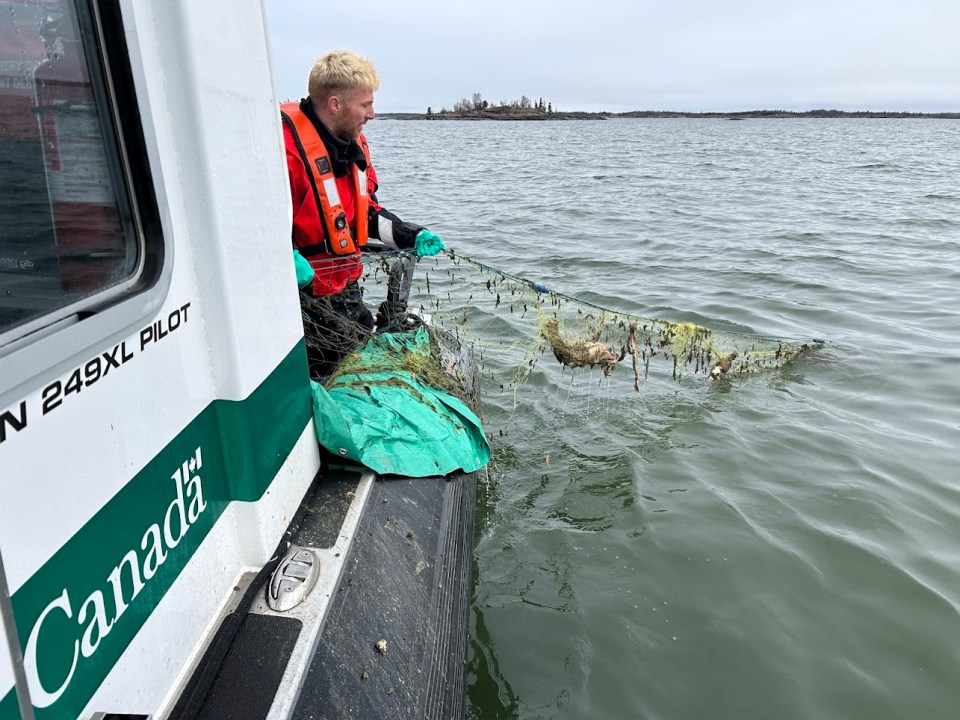

Wood said he does not know how long those nets may have been left in the water but, based on the decomposition of the fish, they were likely there for a long time.
Advertisement.
Advertisement.
Local fishers reported ghost gear
Stephanie Vallaincourt is one of two local commercial fishers who reported the abandoned nets.
She said ghost gear can be a safety hazard, particularly in rough weather.
“They’re quite heavy so they put a lot of toll on the boat,” she said.
“Sometimes they could be cut at the bottom, and so it puts a lot of pressure on the bow and could be pretty risky.”
She added dealing with ghost gear wastes commercial fishers’ time, while having to deal with dead animals tangled in nets is “pretty disgusting.”
Vallaincourt encouraged boaters who see buoys indicating fish nets in the water to steer clear, to avoid the nets becoming damaged and lost.
“The lake is big enough. You don’t have to be a few feet away from them, especially if there’s a boat close to it,” she said, noting her own operation had experienced “some pretty close encounters.”
‘It just continues to fish’
According to Fisheries and Oceans Canada, ghost gear is a leading cause of marine animal deaths every year. The federal agency also says it is a “major source of marine plastic litter.”
Advertisement.
Advertisement.
Wood explained that ghost gear is difficult for wildlife to see and avoid, meaning birds, fish and even land animals – such as caribou – can become caught in it and seriously injured.
Animals can also ingest small pieces of the gear, which can be harmful.
“When ghost gear is lost, it can drift hundreds of kilometres, sink to the bottom and smother vital habitat there,” he said, adding modern fishing gear takes a long time to break down in the environment.
“The issue with ghost gear is it just continues to fish, so it just doesn’t stop fishing.”
Wood said ghost gear can also be a hazard to boaters, for example, if it becomes caught in propellers.
Fishers required to report lost gear
Federal regulations guide how long licensed commercial fishers’ nets can be left in the water.
Those rules also require nets to have identification markers and fishers must report any lost gear.
Not complying with the Fisheries Act or its regulations can result in fines or even time in jail.
Advertisement.
Advertisement.
Wood said the recently seized abandoned nets have been taken to the Fisheries and Oceans Canada detachment and the matter remains under investigation.
He said members of the public can also report sightings of lost or abandoned gear. He recommended taking photos and noting GPS coordinates – or any identifying features and landmarks – to help officers locate the gear.
Correction: October 25, 9:48 MT. When James Wood said the abandoned nets had been taken to the detachment, we initially inadvertently reported this as the RCMP detachment. It’s actually his employer’s detachment, in other words the Fisheries and Oceans Canada base. We’ve amended the article accordingly.
