



Advertisement.
Last summer, the NWT committed to reaching net-zero emissions by 2050. Renewable diesel – a type of biofuel that can be used as a direct replacement for conventional diesel – is emerging as a likely option for helping the territory reach that goal.
In the legislature in October, NWT infrastructure minister Caroline Wawzonek said renewable diesel is “one of the more promising opportunities” for reducing emissions from hard-to-decarbonize sectors such as transportation and industry.
Earlier this year, Shauna Morgan, MLA for Yellowknife North, also called renewable diesel a “game-changer” and said the fuel is a key part of reaching the territory’s net-zero goal, as the CBC previously reported.
A 2023 report prepared for the NWT’s Department of Infrastructure backs up Morgan. In modelled scenarios where the territory achieves net zero, a significant portion of fossil fuel equipment remains but runs on biofuels.
Advertisement.
Advertisement.
Roughly 84 percent of the territory’s emissions come from industry and transportation, according to the GNWT’s figures. Morgan said these two sectors are prohibitively costly and difficult to electrify.
“It’s hard to imagine that we could fully electrify every corner of this territory where the long-haul trucks and transportation needs to go,” she said.
So far, challenges related to the supply of Arctic-grade renewable diesel and concerns about affordability have hindered the fuel’s use in the North.
The renewable diesel market in Canada is changing, however, which might provide new opportunities to overcome these barriers.
Advertisement.
Advertisement.
Five renewable diesel refineries were in the works across the country as of 2023, adding to two refineries that are currently operating in British Columbia and Newfoundland.
The largest renewable diesel refinery in the country is set to open next year. The Imperial Oil project, now under construction near Edmonton, is expected to produce more than one billion litres of renewable diesel annually. The fuel produced will “perform like traditional diesel in Canadian winter climates,” said Keri Scobie, public and government affairs manager with Imperial.
Federal clean fuel regulations have also resulted in a “real jump” in renewable diesel consumption nationally, according to Michael Wolinetz, a partner with Navius Research who wrote a recent report on biofuels in Canada.
The regulations require fuel producers and importers to gradually reduce the carbon intensity of transportation fuels, thereby incentivizing the use of biofuels.
In 2023, the volume of renewable diesel consumed was roughly double that consumed the previous year, according to the Navius report.
As clean fuel regulations get stricter, Wolinetz thinks renewable diesel use will keep increasing.
Given these changes, Morgan thinks it’s high time to act.
“I think we need to get on this now and make sure that these clean fuels are going to work for the North,” she said.
Advertisement.
Advertisement.
A primer on renewable diesel
If you’re a bit fuzzy on what renewable diesel is, you’re not alone.
“There’s still a lot of misunderstandings and a lot of skepticism about what this thing is,” Morgan said.
Renewable diesel falls under the umbrella of biofuels – renewable fuels made from biological sources. Renewable diesel is produced from fats and oils, such as renderings from plants or animals, used cooking oils or vegetable oils. These oils are processed to be chemically identical to conventional diesel, which is typically made from crude oil.
Often, renewable diesel gets confused with biodiesel. Both are produced from the same feedstock, but they are refined in different ways. Unlike biodiesel, any diesel engine can run up to 100 percent renewable diesel. Renewable diesel can also be processed to function at much colder temperatures than biodiesel.
Right now, biodiesel can only work down to -5C, said Ian Thomson, president of Advanced Biofuels Canada, an organization that aims to promote the production and use of biofuels.
“It is like any kind of vegetable oil,” he said. “You stick a jar of olive oil in your fridge, it’s going to go solid.”
But renewable diesel, like conventional diesel, can be processed to remain liquid in cold temperatures.
One type of renewable diesel produced in BC works down to -23C, Thomson said.
Advertisement.
Advertisement.
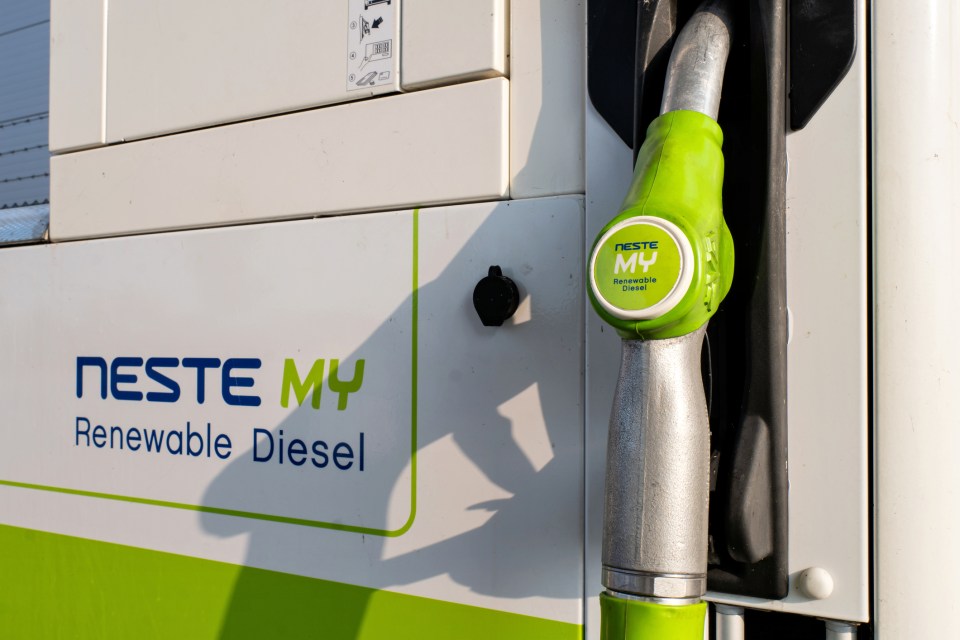
Neste, a company headquartered in Finland, produces an Arctic-grade product that can function down to -40C, according to Matt Leuck, Neste’s technical manager of renewable products for the Americas. The fuel is only available in northern Finland in the winter.
The idea with using biological sources as feedstock is that they tend to cycle carbon over a much shorter period than fossil energy sources, according to Wolinetz. For instance, a canola crop draws down carbon as it grows. That carbon gets transformed into renewable diesel, which gets burned and releases carbon back to the atmosphere, he said.
Over the course of a year, ideally, there’s no net impact on greenhouse gas emissions in the atmosphere.
“You’re creating a fuel that is carbon neutral,” Wolinetz said.
Emissions may be created during renewable diesel’s production, however – for instance during transportation or at a refinery. Because biofuels often require agricultural inputs, they are also associated with the environmental impacts and emissions that come from farming.
Taking these impacts into account, critics have pointed out that biofuels are not as green as they claim to be.
While there have historically been issues accounting for greenhouse gases emitted along biofuels’ supply chain, Wolinetz said, policies now better track these emissions.
On a life cycle basis, he said, renewable diesel typically reduces emissions relative to fossil diesel by roughly 60 to 90 percent.
Advertisement.
Advertisement.
Lachlan MacLean, a mechanical engineer who co-authored a 2020 report that identified renewable diesel as one of the quickest, cheapest ways to reduce emissions in the NWT, said there are good and bad ways to make renewable fuels.
“We can’t afford to not know the details,” he said.
Overcoming barriers of supply and cost
It is technically possible for existing refineries to produce renewable diesel that functions in very cold temperatures, according to Thomson. They currently don’t, however, due to a lack of demand.
So far, renewable diesel producers have catered to the biggest markets. In the US, that’s California. In Canada, the fuel is largely used in BC and Ontario.
An Arctic-grade fuel would also come at a premium, Thomson said – although it’s unclear just how expensive it would be for the NWT.
Leuck said Neste hasn’t yet worked out the cost of the logistics that would be involved in supplying Arctic-grade fuel to North America.
“I don’t think anyone has gone through the exercise yet to even put a guess on it,” he said.
Renewable diesel is generally more expensive than conventional diesel, though. In 2023, the wholesale cost of renewable diesel was about twice that of conventional diesel, according to Thomson. The cost of an Arctic-grade product would likely be even higher.
Advertisement.
Advertisement.
Thomson pointed out that the cost to producers isn’t necessarily the price consumers pay, however. The federal clean fuel regulations and similar policies such as low-carbon fuel standards in BC and California result in renewable diesel sometimes being sold at the same price as conventional diesel or lower, he said.
“It’s a convoluted system of how prices happen,” Morgan said, which is frustrating, but it also provides some leeway. “We can still have some influence over how prices shake out.”
“Addressing the challenges around high price will, I think, very much hinge on creating credit markets that work both for the country and for the North,” she said. “That will require the territory having conversations with the federal government.”
Morgan said the territory also needs to be more proactive about testing renewable diesel in the NWT and working with other northern jurisdictions to create a larger demand for an Arctic-grade product.
She has her eye on the soon-to-open Imperial refinery.
“They will find other places to sell their product,” she said, adding that the territory should make itself known as an interested customer.
MacLean echoed Morgan, saying that governments or organizations in the territory need to get a conversation started with producers to signal interest.
“It’s a matter of when, not if, that we’re going to have to deal with the biofuels question,” he said. “Let’s get started on it now.”
