

Advertisement.
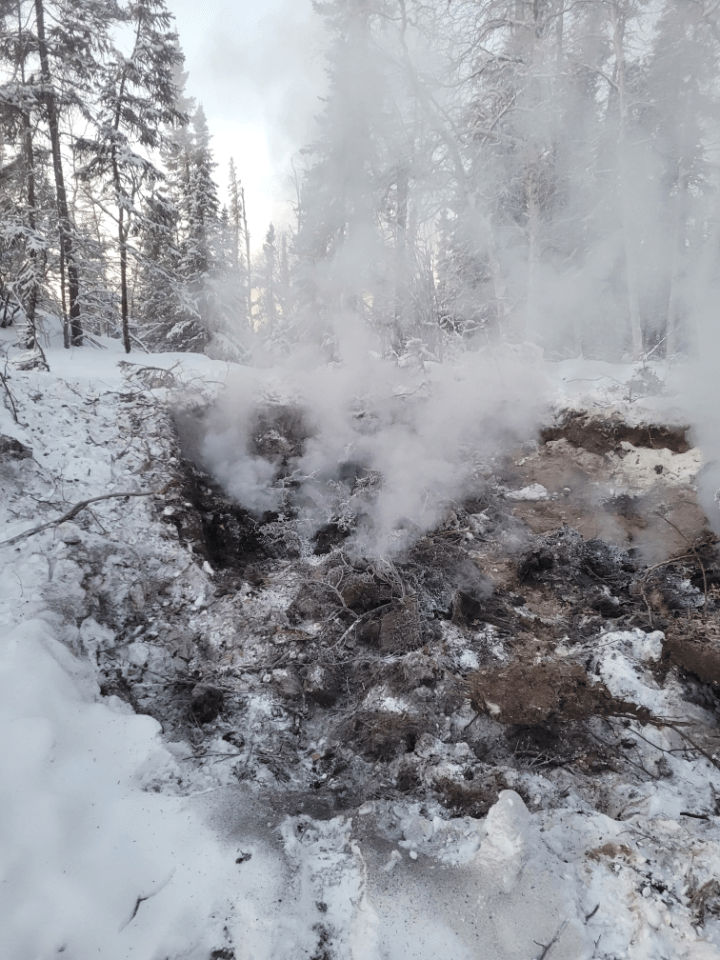
A fire that began close to Norman Wells this month is “suspected to be person-caused” and staff are taking action to contain it, the GNWT says.
According to Department of Environment and Climate Change wildfire information officer Mike Westwick, the fire is located approximately a kilometre northwest of a place called DOT Lake and roughly three kilometres from the town’s airport.
“Most importantly, it is not a threat to the community of Norman Wells,” Westwick told Cabin Radio in an email on Wednesday.
“We are taking action now in order to prevent it potentially becoming an issue down the road when the snow melts and conditions can support meaningful fire growth.”
Advertisement.
Advertisement.
On Monday, residents were notified of a “noticeable smell” in the area as a result of the fire, which was being actively monitored at the time.
In a Facebook post, the town stated while the fire was not a risk, the Department of Environment and Climate Change “will consider other options” if it continues to burn into the new year.
“Residents are asked to stay out of the area as there are ash pits, which are hot and fallen trees,” the town wrote in its notice.
ECC has already taken action, Westwick said, “including sending staff to use hand tools to dig out burning materials, falling trees which could be problematic, and dumping water to tamp down hotspots.”
Advertisement.
Advertisement.
Westwick said the fire continues to smoulder despite efforts to contain it because it is “burning deep in the root system in the area” – which is currently not accessible to heavy equipment.
“We will continue to take what action we can on the fire given its challenging location and the ground conditions in the area. We will be continuing to monitor over the holidays and will consider additional options if the fire remains active in the new year,” he said.
Wildfires in winter are not completely unheard-of in the NWT.
Residents have become more used to the concept after dozens of fires from the severe 2023 summer season became holdover fires – ones that burn beneath the snowpack through the winter – and re-emerged in the spring of 2024.
But winter fires have popped up before that, too. In 2019, for example, person-caused fires were reported near Fort Liard in January.
Westwick said the territory’s drought in the past few years is one reason why such fires are more common. People must use this as a reminder to properly extinguish fires, he said, especially while on the land during the winter.
“If they don’t come to our attention, they can stick around until spring when the snow melts, the ground dries out, and weather heats up,” he said.
“If they’re in the wrong place, they can quickly become a problem for values – like communities, cabins, and infrastructure.
“We urge all land users to stay vigilant with fire over the winter and ensure every fire is completely extinguished before they leave the area.”
