

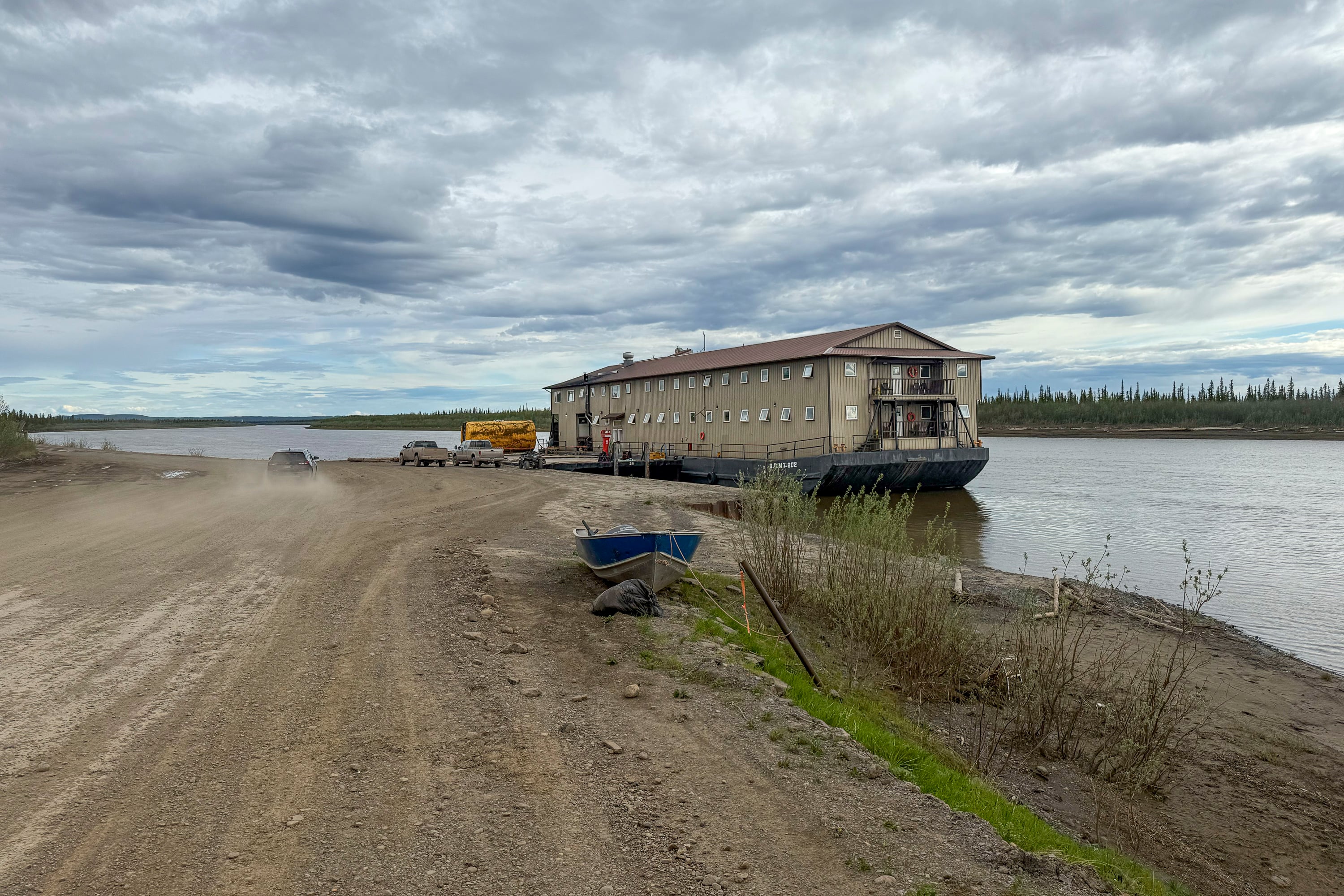

A barge built more than half a century ago is spending the week serving as a microcosm of the challenge facing Inuvik.
Perhaps more importantly, it’s also serving as overflow accommodation.
This year’s Arctic Development Expo, which began on Tuesday and runs until Thursday, is so popular that the barge had to be called in when every other bed in the town was accounted for.
SBMT 802, a 575-ton barge built in 1974, is a floating hotel. On board, expo guests get a small bedroom with a TV and access to shared washrooms.
Reviews so far have been fairly good.
Advertisement.
Advertisement.
“It’s stable,” said one guest with a warmth of tone that made her assessment sound like a five-star rating. “I watched the waves come from a passing boat and my room didn’t move at all.”
The barge’s presence speaks to the bigger issue Inuvik and the NWT are navigating: what happens when everyone suddenly wants what you’ve got?
The Department of National Defence is promising $5 billion or more in spending around Inuvik over the next 15 years, and a similar – perhaps larger – sum in the vicinity of Yellowknife. Meanwhile, a highway connecting Inuvik to the Sahtu and Dehcho regions appears finally set to be built.
This year’s expo is one of the first clear signs of the impact that spending will have.
Advertisement.
Advertisement.
Registrations for the expo have more than doubled in the past two years. Organizers frantically sought extra rooms and bumped up the catering order as more than 350 attendees signed up. The conference layout, inside the town’s Midnight Sun Complex, has been redesigned to fit everything in. (The author of this article is a paid moderator at the conference this week.)
When Mayor Peter Clarkson asked how many people were in Inuvik for the first time, roughly a third of the expo crowd raised their hand.
“I think it’s some good foreshadowing of how can we take on something bigger than what we normally do,” Clarkson told Cabin Radio when asked if the barge spoke to the broader challenges ahead.
He explained how the town had contacted regional firm EGT Northwind, which had been using the barge on its own projects in the area. The company was happy to help, Clarkson said, adding that the expo’s attendance would have been “much, much lower” otherwise.
To the mayor, it shows Inuvik can work together to navigate the 15 years ahead, during which multiple projects may stretch local capacity thin. How to get everyone collaborating was a topic addressed by municipal, territorial and Indigenous leaders throughout the expo’s first day.
“This is a good example of the staff working hard, making it happen, doing whatever they need to do to accommodate as many people as possible,” said Clarkson.
“We brought the catering from 150 to 200, to 225, to 250. It was almost a daily thing, we had to go back and say, ‘Sorry, we’ve now got 350.’ The caterer said, ‘Look, 365 is our maximum we can go.’ We maybe went a little higher because we know some people aren’t going to show up for the food.
“It’s not the time to have naysayers, not the time for negativity, not the time for people to think that we shouldn’t be doing something, shouldn’t be having these conversations. I think the positive energy, you could feel that in the room here today.”
Advertisement.
Advertisement.
‘More oil and gas than most countries’
For most of the past decade, the Arctic Development Expo had been an event where a smaller number of attendees fondly recalled how, in 20th-century boom times, the town’s oil and gas show had brought hundreds of delegates north.
This year’s expo seemed to recapture some of that initial energy, with a focus this year on Arctic security to match the sudden influx of investment and interest.
“I have been looking forward to this event for quite some time now,” said Premier RJ Simpson. In previous years, a premier’s attendance at the expo was not guaranteed.
“Denny Rodgers, MLA for Inuvik Boot Lake, always talks to me about this conference, always talks to me with such enthusiasm and excitement, especially about what the conference used to be. But we’ve turned the corner and we’re getting back to what things used to be,” Simpson continued.
“The North is central to Canada’s sovereignty, security, and future prosperity. That’s not an exaggeration. There’s a reason that people are looking northward. The land is warming, the climate is warming, areas are becoming more accessible, and the modern world is changing as well.”
Quoting global officials expressing their fears of a worldwide energy crisis in 2026, Simpson pointed to oil and gas reserves the territory can offer.
“We have more oil and gas than most countries on Earth. For a long time, we haven’t really developed those resources. Same thing with our minerals,” he said. “One of the reasons we haven’t advanced is, for one thing, we need the attention from southern Canada. Now we have that. We have a focus.”
Positivity was not universal. Some speakers drew attention to what they said were concerns about the wider Arctic geopolitical picture and Canada’s lagging response, while others gave voice to some residents’ fear that the territory’s healthcare, education and other social needs may drop off the radar in favour of building big. (Simpson, in his opening speech, acknowledged the territory had many social problems and said his government was doing what it could to address them.)
Advertisement.
Advertisement.
Inuvialuit Regional Corporation Chair Erwin Elias said his government felt meaningful collaboration with the federal government’s Department of National Defence was lacking.
“A secure Arctic is one where Indigenous rights are respected and Indigenous knowledge is valued, and Inuvialuit have a real say in decisions that shape our future,” Elias told delegates on Tuesday morning.
“We have received last-minute letters asking to consult on procurement plans only weeks before tenders open. The system appears to assume a large southern company will get the contract, while the local Inuvialuit are left with whatever is left over.”
Elias said DND’s approach was “not consistent” with the Inuvialuit Final Agreement.
National defence minister David McGuinty, appearing earlier in the day through a pretaped video message, had said the future of Arctic security would be built in part “by creating opportunities for northern and Indigenous businesses and workers to grow and thrive.”
‘Never lose sight of the people’
Both Simpson and NWT Senator Dawn Anderson, who is from Tuktoyaktuk, drew direct links between the Berger Inquiry of the 1970s and what is happening in the territory today.
Thomas Berger’s Mackenzie Valley Pipeline Inquiry created a new standard of consultation involving Indigenous northerners.
“You go back to the Berger Inquiry, people stood up,” said Simpson. “They said, ‘We’re not going to have things done to our land, done to us.’ And so that development was stopped, and time was taken over the last number of decades to settle land claims and to implement regulatory regimes where Indigenous people of the territory have a say in what happens.
Advertisement.
Advertisement.
“What happens in the North is now being guided by northerners. We have a federal government making investments, wanting to work with us, wanting to work with northerners to ensure that we can take advantage of these opportunities. So right now, this is ours to lose.”
Anderson approached the territory’s collective memory of the Berger Inquiry through a different lens, recalling the testimony of Tuktoyaktuk Elder Bertram Pokiak, who – asked at the inquiry why he did not put his money in a bank to save it for the future – replied, “The North is my bank.”
“To Bertram Pokiak, wealth was not measured by what could be deposited into an account. Wealth was found in healthy wildlife populations. Wealth was found in clean water and healthy oceans. Wealth was found in knowledge passed from the Elders to the youth. Wealth was found in strong families, strong communities, and the certainty that future generations would be able to live from the land as their ancestors had,” Anderson told expo attendees.
“Too often, discussions about the Arctic begin with questions about what is in the Arctic: its resources, its strategic location, its shipping routes, its economic potential. Perhaps we should begin with a different question. Who is in the Arctic?
“Once we answer that question, the conversation changes. The Arctic is no longer simply a place to be secured, developed, invested in or studied. It becomes a homeland. And that understanding changes everything.”
The senator used that example as part of a speech that more broadly called for leaders to “never lose sight of the people whose lives are most directly affected by the decisions we make” as the focus shifts to the North.
Still, the abiding theme of the day was opportunity – the chance to “leave a legacy that extends far beyond any single project,” as Anderson put it.
“I had a mother say to me that for the first time in a long time, she has felt hopeful for her children’s future in the Northwest Territories,” said Simpson. “And that’s the feeling I get.”
