


Advertisement.
Cutting human-driven greenhouse gas emissions is already proving tough in the North. Now, attention is turning to carbon within the land itself – an emissions problem that also needs solving and which could be hugely damaging.
Governments across Canada and the world have spent years trying to bring down the emissions we put out through our use of fossil fuels.
Yet targets are being missed and our world is still warming. As it does that, the likelihood increases that massive stores of carbon contained within our landscape will start to emerge into the air, making the overall problem worse.
Next week, scientists will gather in the Northwest Territories to talk about that.
Advertisement.
Advertisement.
The NWT has some giant carbon sinks – places within the landscape that lock up carbon like the boreal forest, peatland and permafrost. How we keep the carbon in those sinks is a big and increasingly important question, not just for the territory but for humanity as a whole.
“Because we waited longer than we should have, and emissions reduction policies are probably not as aggressive as they could or should be, I think to some extent we lost the luxury of just looking at reductions in fossil fuel emissions,” said Brendan Rogers, a scientist at the Woodwell Climate Research Center who works with models and satellite data to understand climate change impacts on boreal forests and Arctic tundra.
Reducing our own emissions “still has to be the number-one priority,” Rogers said, but given the kinds of changes already happening on (and in) the ground – such as recent severe wildfire seasons – “we need to look at the solution space around us and think about options that can help keep carbon out of the air.”
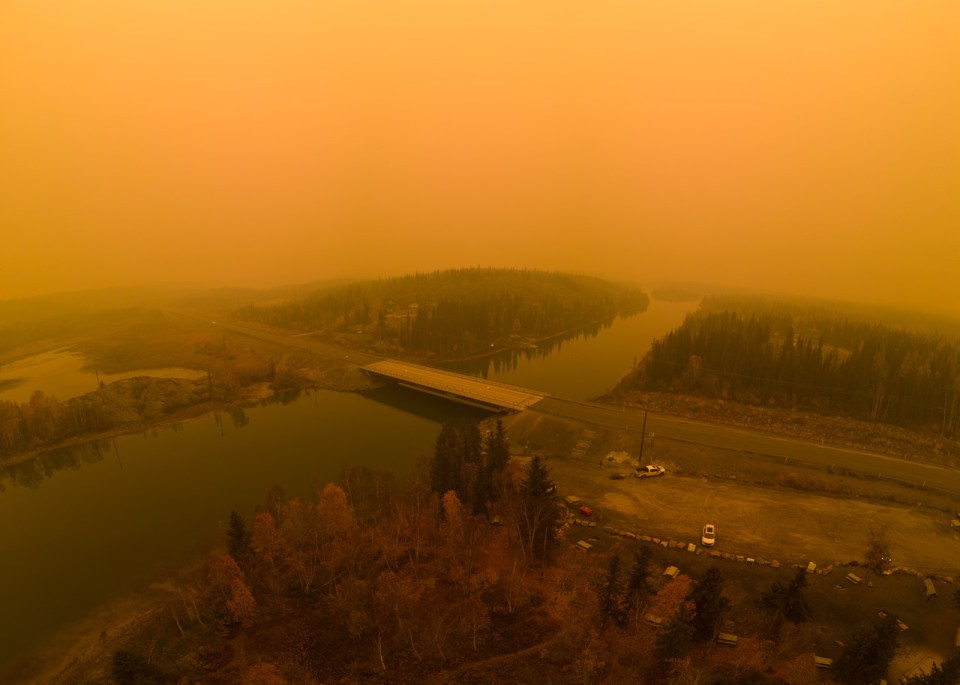
The NWT’s 2023 wildfire season demonstrated the scale of this problem.
Advertisement.
Advertisement.
Residents of the territory had the traumatic and stressful experience of living through the fires’ immediate impact on their homes, livelihoods and the landscape around them.
At the same time, those fires put out carbon emissions that were hundreds of times higher than the total for NWT residential and industrial emissions the previous year.
If that keeps happening, or gets worse, it’ll present a bleak outlook for the climate as we currently experience it.
“The best emissions estimates are that those wildfires emitted more carbon than every country on Earth except for four,” said Rogers.
“The scale of the problem is large, and thus the scale of the solution space, I think, has to be large as well.”
‘What do we do to get ahead of that?’
On Tuesday next week, scientists, governments and other interested parties will gather at Yellowknife’s Chateau Nova Hotel for a Landscape Carbon Workshop that will discuss challenges and solutions.
Wildfires in the boreal forest aren’t the only issue on the table. Permafrost thaw is another major concern and again, the NWT is at the centre of that.

Gradually warming temperatures are thawing permafrost across many areas of the territory. As that happens, organic matter – the likes of old plants, frozen in the permafrost up to this point – starts to decay when its warm up. Microorganisms break down that organic material and carbon is released into the atmosphere.
Advertisement.
Advertisement.
“If we’re projecting larger, more intense wildfires moving forward, that could lead to more GHG emissions. If we are experiencing more warming and permafrost thaw, that could lead to more potential GHG emissions,” said Cory Doll, who manages the climate change unit at the NWT Department of Environment and Climate Change.
“We’re trying to get an understanding of that right now. If that is changing because of climate change, and there are some potential major impacts from that, what can we do to get ahead of that? Maybe there’s something that could lead to local work, that could lead to offset opportunities.”
Other attendees see the workshop as a chance for the rest of the planet to have input into how the North addresses the problem.
“The Northwest Territories has vast stores of carbon that are not just important to the people of the Northwest Territories, but they’re important to the whole world,” said Andrew Tanentzap, the Canada research chair in climate change and northern ecosystems at Trent University. Tanentzap and Rogers are each presenting at the workshop.
“One of the things I think we’re hoping to get out of this meeting is to try and help the Government of the Northwest Territories chart a plan to try and manage that carbon, focusing on building it up in soils and in vegetation and keeping it out of the atmosphere,” Tanentzap said, “and enhancing their ability to monitor what’s happening to the landscape.”
Not included in models
To put the size of the problem in perspective, a recent study found about a third of Arctic wetland, forest and tundra has become an overall source of extra carbon emissions rather than a carbon store keeping it locked up.
Sue Natali, who also works at the Woodwell Climate Research Center and was a co-author of the study, told The Guardian this marked “the first time that we’re seeing this shift at such a large scale, cumulatively across all of the tundra. That’s a pretty big deal.”
Speaking to the same newspaper, lead author Anna Virkkala said: “There is a load of carbon in the Arctic soils. It’s close to half of the Earth’s soil carbon pool. That’s much more than there is in the atmosphere. There’s a huge potential reservoir that should ideally stay in the ground.
Advertisement.
Advertisement.
“As temperatures get warmer, soils get warmer. In the permafrost, most of the soils have been entirely frozen throughout the full year. But now the temperatures are warmer, there’s more organic matter available for decomposition, and carbon gets released into the atmosphere. This is the permafrost-carbon feedback, which is the key driver here.”
“It’s a lot of carbon,” said Rogers, “and we’re not expecting all of that, of course, to be emitted – but even a fraction of that being emitted with climate change and warming is of concern.”
He also noted that emissions from high-latitude wildfires and permafrost thaw are “largely not included in the Earth system models that are projecting climate change,” nor some of the calculations used to figure out whether we’re on track to meet global emissions reduction goals.
“Regardless of the climate target you’re shooting for right now, information about permafrost thaw and wildfires and high-latitude systems is not included,” he said.
“Part of the conversation we’re trying to have is to make people aware of what’s happening in the North and the added emissions coming from these systems. But also, it’s affecting people every day right now. There needs to be a broader conversation and government support and a suite of policies to address the various ways these changes are affecting people.”
‘A journey we’re on’
So if we don’t want the carbon in forests and permafrost to be released, what do we do?
That’ll be a question explored next week.
“We need to reduce fossil fuel emissions. That said, I think we’re at the point where we also need help from other sectors, and that’s where natural resource management comes into play,” said Rogers.
Advertisement.
Advertisement.
“If we think about fire management from the perspective of carbon and climate, as well as other values that are at risk and smoke and human health, I think that could represent an opportunity for carbon and permafrost protection – but it’s not going to be a silver bullet.
“We need to start thinking creatively about the ways we use and manage land, the voices at the table, especially considering voices from Indigenous knowledge-holders, and thinking creatively and holistically about how we want to manage landscapes going into the future.”
Tanentzap said a complicating factor is that carbon isn’t just one thing that looks and acts the same no matter where you find it.
“At a microscopic level, invisible to us, carbon exists in thousands, probably millions of different forms, each with a different function that influences how it interacts with microorganisms and the extent to which it’s going to persist in the landscape, and whether it’s going to be converted into carbon dioxide, methane, these greenhouse gasses that contribute to global warming,” he said.
“There’s carbon in trees, there’s carbon in leaves, there’s carbon in soils, and that’s not all the same thing. The potential for that carbon to stay where it is and not get turned into greenhouse gases by microorganisms very much depends on the type of carbon that you’re talking about.”
That means you can’t really just select one solution, and Tanentzap said we are slowly doing more to adapt our approaches depending on the landscape we’re talking about.
“There’s quite an important role here for Indigenous-led solutions to protect and restore nature in a way that’s going to benefit people and nature at the same time. A nature-based solution to climate change might be tree planting,” he said, giving the Canadian government’s Two Billion Trees initiative as an example.

“We used to think, ‘Well, if we want to keep carbon out of the atmosphere, we just plant trees everywhere we can.’ But actually, that can have some perverse outcomes. For example, if you plant trees on peatlands, the peatlands might actually be better at storing carbon than the trees.
Advertisement.
Advertisement.
“The federal government actually recognizes that it’s about planting the right tree in the right place. I think we are getting better at understanding the interactions in nature that are really crucial to ensuring our interventions succeed.”
The workshop comes months after more than 20 Indigenous governments in the North signed a deal unlocking up to $375 million in private and federal funding to protect the land.
That deal includes lots of ways the money can be spent. How the funds are apportioned among NWT communities is still being determined. Climate monitoring and guardian programs are expressly identified as types of project that the $375 million can fund, and workshops like the one next week might help some communities understand how they can turn landscape carbon into a local economic driver.
For Doll, the workshop can help the territory “start to understand what is going on and what opportunities there might be for the Northwest Territories.”
“There’s a journey we’re on,” he said.
“I think we’re really starting to understand where those areas we need to focus on are, and starting to get more focused on the things we need to be doing that are a bigger priority or have a bigger impact.”
