



Conversations around homelessness and public safety in Yellowknife have often involved finger-pointing between levels of government and public complaints framing the issue as us versus them. Some people are hoping to change that with a more collaborative approach.
The City of Yellowknife and Yellowknife Chamber of Commerce invited business owners to attend a “brainstorming session” at City Hall last month. They discussed potential strategies to enhance public and employee safety.
“We all play a part in this,” Kerry Thistle, Yellowknife’s director of economic development and strategy, told the 41 people who gathered for the meeting.
“We’re all dealing with it anyway.”
Thistle said no one entity can solve the problem and that, as a collective, business owners and city staff could come up with some creative solutions.
Advertisement.
Advertisement.
She pointed out that Yellowknife’s annual pumpkin lane, where residents are invited to decorate the Frame Lake Trail with jack-o-lanterns each November, started as a community initiative to attract more people to the trail and make it safer.
“Today is really just about, what can we as a business community come together and come up with? A few little things that we could try,” Matt Halliday, executive director of the chamber of commerce, told Cabin Radio at the start of the session.
“If it moves the needle a lot, fantastic. If it moves the needle a little bit and we just regroup … let’s try that.
“If that doesn’t work, come back together as a group and let’s figure out what else we can do, and kind-of move the needle at least a little bit as a business community and be part of the solution.”
Advertisement.
Advertisement.
Thistle said the city plans to create a summary report from the session and move forward on some short-term solutions this summer.
She said the city is planning a follow-up meeting for the fall.
Ambassadors, a business association and a cafe
Cabin Radio was allowed to sit in on the brainstorming session but asked by the city not to identify any of the business owners that attended nor quote them directly, unless from separate interviews.
Areas of concern business owners highlighted included harassment, public intoxication and alcohol and drug use, garbage, theft, vandalism and violence.
Many questioned whether the city envisions the downtown as a revitalized economic hub or a hub for social services, saying they believe the two cannot co-exist.
Popular ideas business owners suggested to improve public safety and increase foot traffic downtown included having downtown ambassadors – similar to a program in Calgary – as well as holding more festivals and events in the area.
The Yellowknife Chamber of Commerce said it is seeking federal funding to start a business improvement association, or district, as a pilot project that could support things like beautification or security for downtown businesses.
Another idea voiced at the meeting – inspired by a Calgary-based initiative – was having a non-profit run a low-barrier cafe, where people from all walks of life could spend time.
Advertisement.
Advertisement.
Eric Binion, owner of the Barren Ground and Birchwood coffee shops, told Cabin Radio he came across the idea while considering how to address concerns from staff about some incidents requiring de-escalation, as well people asking customers to buy them food.
“My role is to provide service to customers and to generate revenue and to be a capitalist and have sales,” he said.
“At the same time, I feel like a business downtown has a greater role that I need to tap into, which is providing kind-of a more community-oriented approach to doing work downtown and focusing outside of just my business area.”
Binion said there’s a need for more places in Yellowknife beyond the day shelter where unhoused people can gather during the day, access washrooms and internet, and enjoy coffee, tea and food. He said that could reduce existing pressure on downtown businesses, emergency services and city facilities, such as the library.
“We have the day shelter and then kind-of Barren Ground Coffee. I want to create something in the middle of that,” he said.
“It’s not meant to replace existing supports, but to complement them by filling a noticeable daytime gap for people who currently have nowhere to go.”
Binion stressed that the low-barrier cafe is currently just a seed of an idea and he does not have the capacity to run it himself. He said Home Base Yellowknife has agreed to partner on the concept. (Cabin Radio was unable to secure an interview with the executive director of Home Base prior to publication.)
Beyond the Spiderman meme
At last month’s meeting at City Hall, business owners spoke about the need for more garbage receptacles, public washrooms and wraparound supports. They called for greater enforcement of existing bylaws as well as increased patrols of the downtown.
Advertisement.
Advertisement.
RCMP have said they will attempt to increase their presence downtown amid staff vacancies at the Yellowknife detachment. City council has made one of municipal enforcement’s two priorities engagement and visibility in the downtown core, with a focus on litter, unsightly lands and safety.
While several business owners suggested solutions to addressing public safety concerns, not everyone was on board. One business owner left the meeting early, expressing that they felt it was a waste of time. Others showed frustration at being asked to address issues they felt are not their responsibility.
City staff said the meeting was not intended to place the burden of public safety on businesses, but rather to collaboratively come up with some solutions as part of broader efforts.

Yellowknife Mayor Ben Hendriksen said he has empathy for business owners that feel public safety is not their responsibility. He said the session was an opportunity for community members and the city to collaborate on some innovative ideas.
He described the meeting as part of moving beyond the pointing Spiderman meme – where different levels of government and organizations point fingers at one another – to a more collaborative approach.
“Today’s event shows that we are ready and willing to work with others … all those different pieces coming together, that’s what it’s ultimately about,” he said.
“Ultimately, you get nothing done if you don’t collaborate with people.”
Talking to, not about people
One group of people spoken about – but not included – in the session were members of Yellowknife’s street-involved community.
Advertisement.
Advertisement.
Hendriksen said he had hoped a community roundtable on homelessness the city hosted last year would be a space where more unhoused people could share their perspectives.
“The challenge is always, do people feel safe to be able to speak, to be able to be heard, to be compensated for their voice?” he said, adding that listening to people without taking action is not helpful.
Tony Brushett, executive director of the Salvation Army in Yellowknife, said officials need to do more to connect with people who are living in tents to understand their needs.
“There has to be a better way,” he said.
“I don’t think it’s rocket science for us to find out who each of these individuals are and to see what we can do.”
Brushett said he was not aware of the brainstorming session at City Hall but would have liked to attend. He said there’s a need for people from various levels of government, non-governmental organizations and businesses to come together to have a bigger conversation about homelessness and public safety.
Encampment conversations
Homelessness and public safety in Yellowknife have received renewed attention in recent weeks since a homeless encampment popped up downtown. The encampment has since moved to an area on commissioner’s land near the Prince of Wales Northern Heritage Centre.
Brushett said the reasons why people may be living in tents rather than using emergency shelters can be complex, including being banned from shelters, wanting more freedom, and not wanting to be separated from a partner at night.
Advertisement.
Advertisement.
“I want everybody to have somewhere safe to sleep tonight, whatever that looks like, and for some that’s going to mean a tent,” he said.
“My fear is there’s people sleeping in tents who are in desperate situations because they don’t know how to wrangle the system here in Yellowknife.”
Peter Adourian is a lawyer representing residents of the encampment in discussions with the city and territorial governments.
“The work has really been about trying to find collaborative approaches to supporting a homeless encampment,” he said.
“It just makes more sense for us to work together rather than to fight in public and so far, that’s been working quite well.”
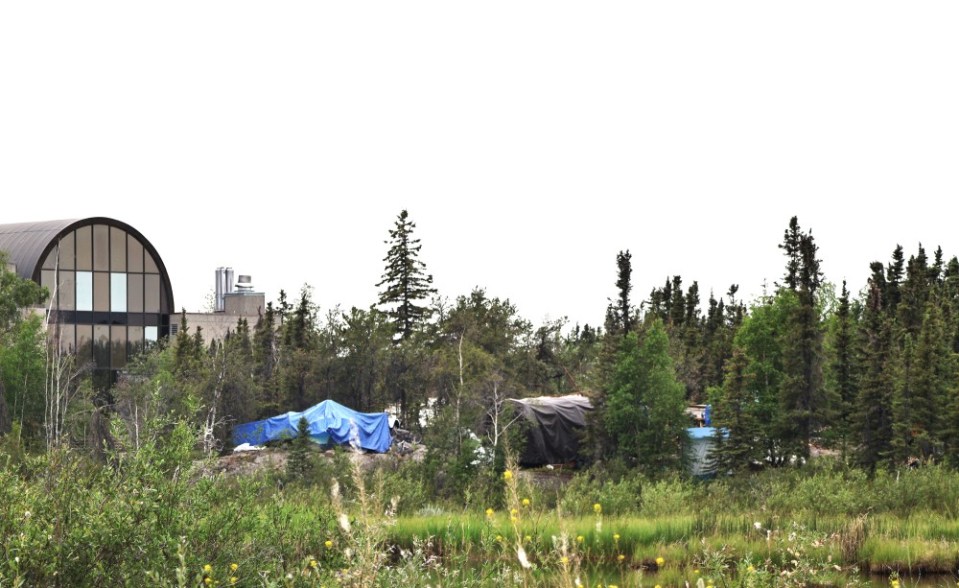
Adourian said a more collaborative approach begins with identifying a suitable location for an encampment that does not impact downtown residents and businesses. He said the current location of the encampment fits that bill.
“My clients, the ones who were in the encampment last year, felt like they were quite a burden on the nearby residents. They didn’t mean to be, they didn’t want to be, but that’s how it shook out last year,” he said.
“This year, they’re feeling a lot more comfortable that they know they’re not interfering with anybody’s life.”
Advertisement.
Advertisement.
Adourian expressed disappointment, however, that the NWT government has declined to provide portable toilets and garbage disposal for the encampment, as it did last year. He said that places an unnecessary burden on businesses.
The city had said it would provide solid waste and sewage collection at an encampment – if requested and paid for by the territorial government.
Asked whether the territory would consider providing portable toilets, Lucy Kuptana, the NWT minister responsible for housing, told Cabin Radio the territorial government is not promoting the encampment but people are allowed to camp on commissioner’s land.
‘Seeing homeless people as your neighbours’
Adourian said ways residents can support unhoused people include providing donations and lobbying MLAs and city councillors to work with, rather than for, unhoused people.
“I think it also means a small change in perspective, seeing homeless people as your neighbours as opposed to the many stereotypes that we cast upon the homeless,” he said.
“Once we start to make that change in perspective, we can see how to work collaboratively with each other. Otherwise, it will always be an us and them dynamic.”
Responding to questions about the encampment in the legislature in May, Premier RJ Simpson said businesses, housed residents and people experiencing homelessness “all have to get along.”
The NWT government has said it is trying to take a “compassionate and respectful” approach while addressing concerns and not normalizing encampments.
Advertisement.
Advertisement.
Cabinet communications denied Cabin Radio’s request for an interview with the premier, saying Kuptana was best placed to speak to the matter.
Kuptana said the NWT government has collaborated with other organizations and levels of government on the encampment issue.
She pointed to a Yellowknife community partnerships committee that includes the city, RCMP, YWCA, Salvation Army and Yellowknife Women’s Society.
“It’s really important that we communicate,” she said.
“Everyone is communicating well with each other, understanding viewpoints, understanding of neighbourhood concerns, understanding the concerns from businesses, but also understanding that people have a right to do what they want to do – as long as they’re following municipal bylaws and legislation and the Public Lands Act.”
