
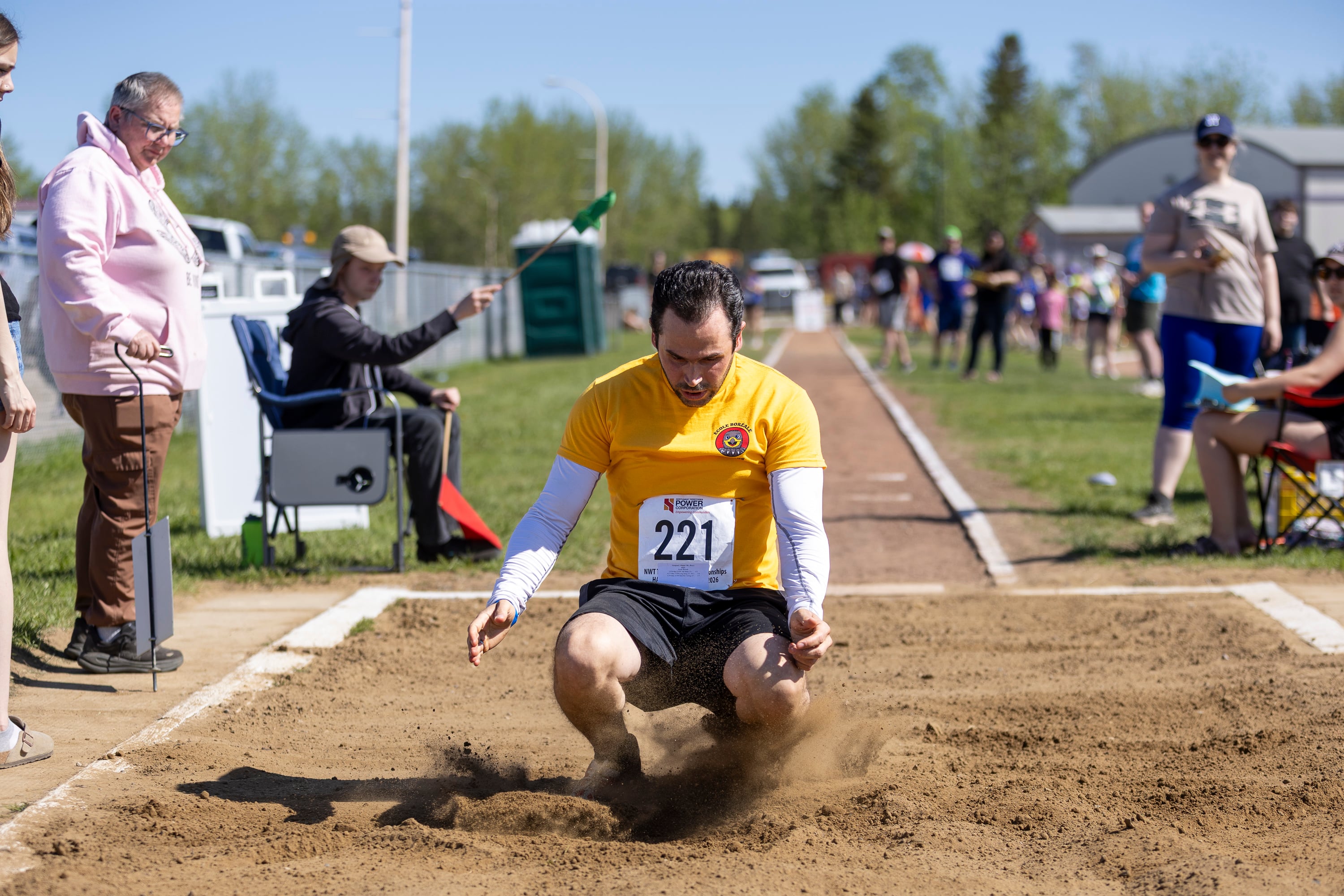

The Northwest Territories’ track and field championship exists for the hundreds of youth who participate – but many of the events have nothing to do with them.
Organizers in Hay River devote significant chunks of each year’s schedule to adult events, meaning coaches and parents can be seen taking to the track right after – and sometimes alongside – students.
What’s motivating adults in their 20s, 30s, 40s or 50s and beyond to show up and try to look graceful in the long jump pit or composed on the track?
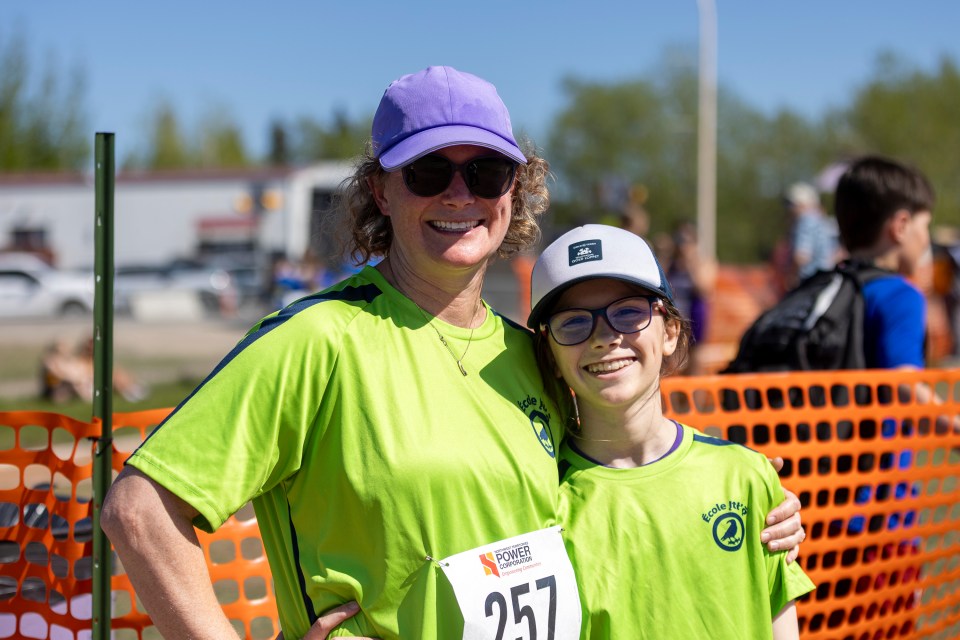
“It’s a lot of fun to be part of the event instead of just a spectator, to get out there and have the kids cheering for you,” said Annie Casson after completing a 3,000m race on Wednesday.
Representing Yellowknife’s École Įtłʼǫ̀ – all adults are, like the kids, assigned a team – Casson finished second in a time of 15:17.28.
Advertisement.
Advertisement.
Explaining what compelled her to select 3,000m instead of a less punishing 100-metre dash, Casson described 100 metres as “a guaranteed hamstring pull when you’re over 35.”
“You can just cruise on in with the 3,000m,” she laughed, “with no injuries.”
At that moment, Casson’s daughter Maggie showed up.
Asked what it was like to watch her mom complete a 3,000m race, Maggie said with a note of skepticism: “Hmm.”
Advertisement.
Advertisement.
Maggie herself is sticking to the 200m, 400m, 800m and long jump.
Same faces
Speaking of long jump, Daniel Melanson was tracked down by Cabin Radio having just taken provisional adult gold in the pit for the Kátł’odeeche First Nation’s Chief Sunrise School.
Melanson, now 27, is a Track and Field veteran who attended every year as a student.
“I always did track growing up and it seems like a shame just to let it go,” he said.
“I put a lot of years into it, had a lot of good memories, and it’s something the town supports – we’re all very active in the community. Why not get out there and show the kids how it’s done?”
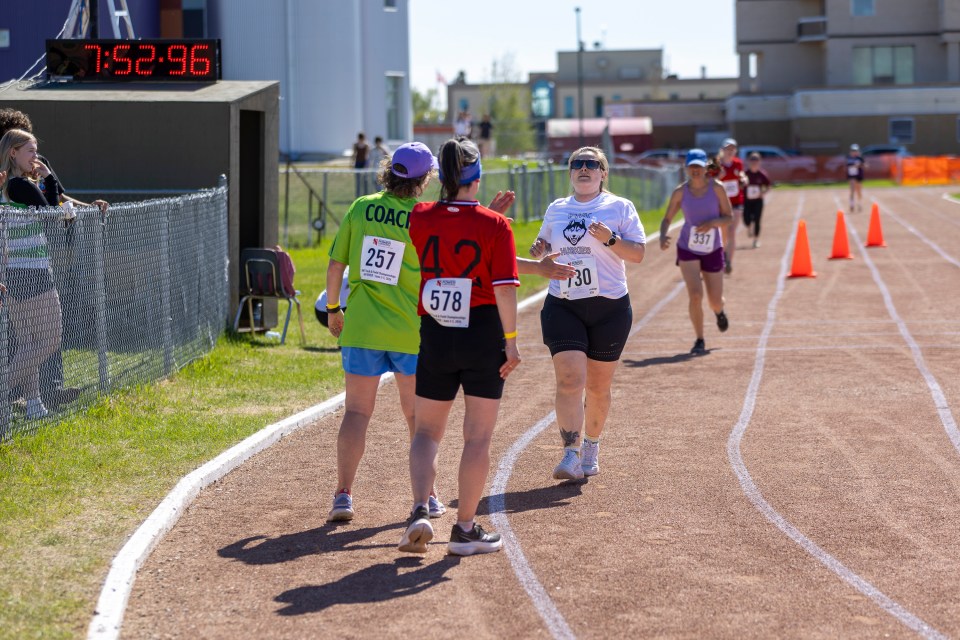
For people who took part in Track and Field as kids, there’s the added dimension of renewing rivalries that stretch back decades.
“You see a lot of the same faces,” said Melanson, who added he was up against one contender in the long jump against whom he remembered competing as a child.
Was that a grudge match?
Advertisement.
Advertisement.
“No, no, a friendly competition. It’s like, good to see you again. Glad you’re still at it, you know?” Melanson said. “Keeps it friendly.”
Race against the past
As a 17-year-old speed skater, Keith Sulzer once ran a 5K on a whim.
More than 20 years later, having taken up running as a hobby, he signed up for Track and Field to see if he could outpace his younger self.
“Seventeen-year-old me won,” he said, comparing the two times, “but I wasn’t that far off.”
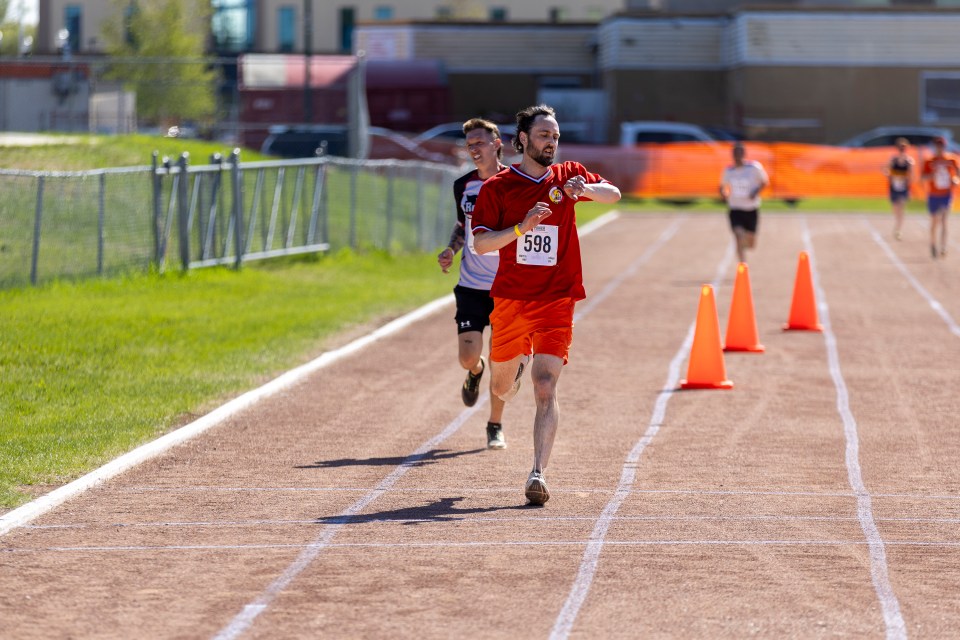
Sulzer won the men’s masters 5,000m race in a time of 19:03.70. He thinks that’s about 20 seconds off the pace he was setting in the early 2000s.
“It’s so amazing to see,” he said of Track and Field and its ability to accommodate adult athletes.
“I haven’t been here before. It’s amazing that the community comes together and puts this on, just incredible – and fun that they let us masters do it too.”
“I think it helps with age,” added Casson. “You’re a lot less self-conscious, plus you’re setting a good example for the next generation.”
Advertisement.
Advertisement.
Melanson has only one regret: that he won.
“I actually like losing a little bit more,” he said.
“It gets the fire going, you know? ‘I’m coming back next year. You beat me, I’m gonna see you next year.'”
