



“Asking for people to be rounded up – we’re not the US. We’re still Canada, right?”
That’s a question a newly formed Yellowknife non-profit posed during its first meeting on Saturday, where members spoke with residents about solutions to address racism against South Asians in the city.
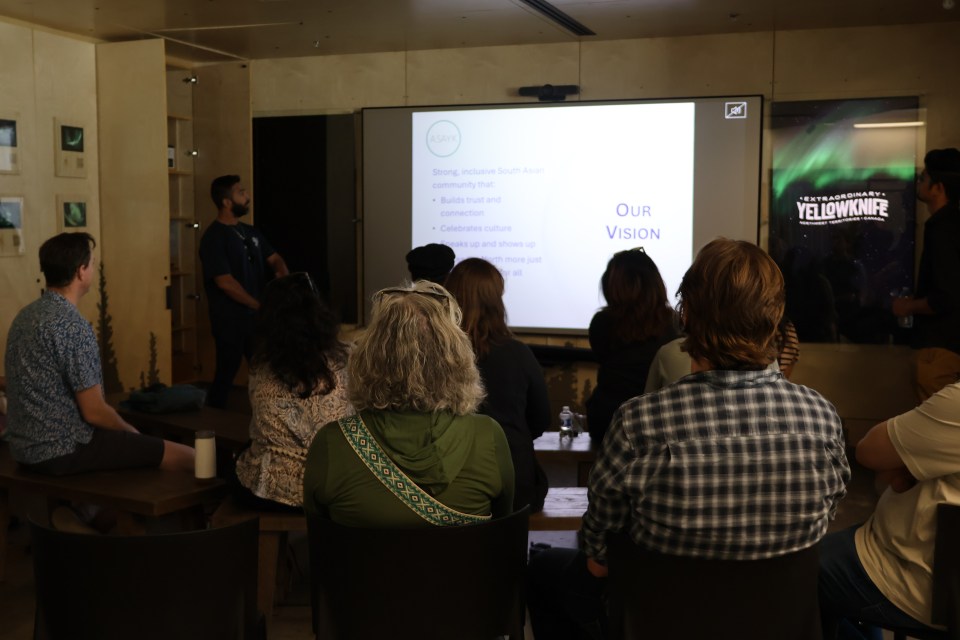
The Association of South Asians in Yellowknife, or ASAYK, was launched in May in response to a rise in online hate toward members of the community. On Saturday, locals gathered at the Yellowknife Visitor Centre to learn more about the association and hear concerns from those in attendance.
The organization recently condemned an anonymous post made on a Yellowknife “rant and rave” Facebook group. That became part of the conversation at last weekend’s meeting.
While some called for Indigenous cultural awareness programs specifically designed for South Asian newcomers, others emphasized the need for stronger advocacy against racism.
Advertisement.
Advertisement.
Silal Shafqat, the new group’s president, said he has observed the South Asian population grow rapidly since moving to Yellowknife two years ago. Despite living in the city for a brief time, he said it already feels like home and he has no desire to leave.
He believes racism and discrimination cannot be justified.
Shafqat called hate toward the community “infuriating” and said it must stop. He envisions ASAYK playing a role in advocating for greater cultural awareness.
“I understand that people might be a little apprehensive because of the number of ‘foreigners’ they may be seeing. But at the end of the day, they’re contributing members of your society. They work tough jobs that nobody else is working and they’re paying taxes,” he told Cabin Radio.
Advertisement.
Advertisement.
“South Asians are generally very hardworking people. Their work ethic is amazing, which was raised in the meeting a couple of times too, and that’s true … They’ve been through a lot. They’ve been through a lot in their own countries. A lot of them are not just looking for economic options, they’re fleeing discrimination back home.”
The NWT government receives federal funding based on its population through a system known as Territorial Formula Financing. Shafqat said backing immigration policies made “economic sense” to him.
Shafqat said he wants to engage with the city’s newcomer program to help South Asian members assimilate with the culture and people. ASAYK is working to secure funding for its operations.
‘Education important on both sides’
Shafqat works as the director of economic development at the Yellowknives Dene First Nation. Putting on that hat, he noted that though there are differences, South Asians – like Indigenous people – also share a long history of colonization and the racism that Indigenous communities face.
“From their perspective, obviously their land was taken away from them by settlers and, in their perception, it’s happening again. They feel like they are losing jobs. I think we all need to address these issues together,” he said.
Shafqat said he wants the South Asian community to be more welcoming of Indigenous people, interact with them, and learn more about their culture and their way of thinking.
“We want South Asians to be humanized because right now they’re not. They’re treated as the other, as someone from the outside, when Yellowknife is not like that. Yellowknife accepts people. Yellowknife has been really accepting towards all of us over here, so we want to make sure that others are part of that,” he said.
“We want to change minds. We want to bridge gaps and try to make this a better community for everyone … Education on issues is also important on both sides.”
Advertisement.
Advertisement.
Sayak Dirghangi, originally from Kolkata, India, moved to Yellowknife in 2017 to complete a year of high school before spending four years in Edmonton for university.
Dirghangi, a board member of ASAYK, returned to Yellowknife for work after graduating. While he personally has not faced discrimination for his ethnicity, he said the same cannot be said for other community members in the city.
“I’ve never seen it this bad before. I’d say in the past couple of years or so it has started becoming worse and worse,” he said. “It’s one of the main reasons we started this organization, to address this issue.”
Dirghangi said employer involvement in providing training to help South Asians become familiar with the North could be a significant step forward in combating racism.
Mozaffar Ahmad, an imam with the Ontario-based Ahmadiyya Muslim Jama’at Canada, said he often struggled to fit in as an Ahmadi Muslim in his home country of Pakistan, where members of his faith face widespread discrimination.
Ahmad said he was encouraged to attend the weekend meeting after being invited by Shafqat, who is also from Pakistan – a gesture that stood out to him and sparked his interest in learning more about the association.
He said racist remarks targeting newcomers have become more apparent as Yellowknife’s South Asian population has expanded, even though the city is generally welcoming.
“The way people that have been living here for the last 10 to 15 years were so nice to me when I got here – that’s something we can learn to do amongst each other, and share with the new people that move up to Yellowknife as well,” he said.
Advertisement.
Advertisement.
“This community is very good. It’s hasn’t been as diverse as it has been in the last few years so that’s a new challenge. But this diversity in Yellowknife is actually an asset and a plus, not something we have to ‘overcome.'”
Yellowknife Mayor Ben Hendriksen said the city remains committed to supporting cultural events and creating a welcoming environment for newcomers.
Hendriksen previously spoke in support of the Northwest Territories Nominee Program – a key immigration stream – following the federal government’s decision to cut the NWT’s cap through that stream by 50 percent, noting his own family settled in the territory through the program.
On the issue of racism, Hendriksen said platforms like ASAYK provide an opportunity for communities to voice their experiences and he looks forward to seeing how the association’s work develops over time.
For now, he urged people to refrain from using social media groups that encourage hate speech.
“I don’t think I’ve ever seen a good conversation online,” he said.
“When you speak with people in person, you actually connect with somebody – as opposed to hiding behind a keyboard.”
