



Inuvik Boot Lake MLA Denny Rodgers says the NWT government’s three most coveted infrastructure megaprojects have made a shortlist of 25 being discussed at a national level.
Addressing the opening day of the 2025 Arctic Development Expo in Inuvik, Rodgers said Premier RJ Simpson had told regular MLAs the Taltson hydro expansion, Mackenzie Valley Highway and Arctic Security Corridor had advanced from a list of many possible projects.
“They had the premiers’ meetings in Ottawa last week. Everyone brought their infrastructure list. From what I understand, there’s about 500 projects brought forward to Ottawa from each premier,” Rodgers told expo delegates.
“From those, I think it was whittled down to likely about 25 projects. I can tell you from the premier that our three major ones are included in the 25.”
The GNWT says expanding the Taltson hydro plant to serve the Yellowknife region, as well as building all-season roads to Nunavut’s Arctic coast and up through the Mackenzie Valley, will provide major economic benefits to the territory while serving as nation-building and Arctic sovereignty projects – terms closely associated with Mark Carney’s new administration in Ottawa.
Advertisement.
Advertisement.
The Mackenzie Valley Highway is seen as critical by communities who would be on the route, given the recent failure of the barge resupply on which they rely in the absence of a year-round road. The other projects have more critics, who say customers don’t exist for a Taltson hydro expansion and the economics of the road to Nunavut are hard to justify.
Seven or eight years ago, the combined cost of building all three was put at about $3 billion to $4 billion. Now, according to recent statements by ministers and associated officials, it’s looking like the cost to complete all of them could be up to $9 billion or more. Almost all of that money would be expected to come from the federal government, which routinely makes positive noises about all three projects but has not fully committed itself to any of them.
Even being on the new shortlist of 25 “doesn’t mean we’re going to get funding for them,” Rodgers acknowledged. “But it certainly means that they’re of interest, obviously, to Ottawa, when you take 500 and you pare it down and we stay on the list.”
The Mackenzie Valley Highway appears the most likely to advance first. That project is further along the regulatory process and work could begin in the next few years, ministers have said lately, if stars were to dramatically align.
Advertisement.
Advertisement.
The highway, which would run from Wrigley through the Sahtu to Norman Wells, is being pitched by the NWT government as an Arctic sovereignty project. In theory, a future expansion would connect the highway to Inuvik and allow more direct road travel between military installations in Yellowknife and Inuvik. (At the moment, the road trip from Yellowknife to Inuvik goes through BC and Yukon.)
Both Rodgers and Inuvik’s mayor, Peter Clarkson, said this year’s Operation Nanook military exercise – partly held in the Beaufort Delta – had made the case for major infrastructure upgrades.
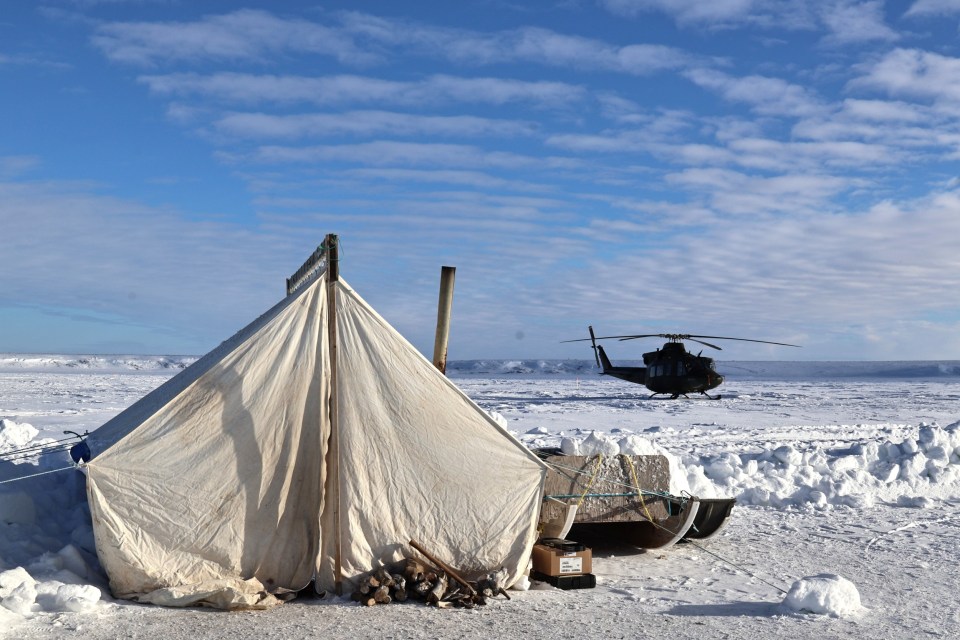
“If you look at the military exercise that was just here, we had an opportunity to tour that and meet with the personnel, and that was a bit of an eye-opener logistically, getting equipment and things here,” said Rodgers.
“Having gone through Operation Nanook for six weeks, it identified some facilities that DND could use,” said Clarkson as the two politicians discussed the idea of dual-use infrastructure – buildings from which both Canada’s military and Inuvik’s residents could benefit.
“They took over this entire complex – except the skating rink, curling rink and pool – for six weeks as an operations centre,” he continued, referring to the Midnight Sun Complex that hosts the three-day expo this week.
“They need to have an operations centre here so they don’t have to basically take over our facilities. Maybe that’s an operations centre slash fieldhouse slash meeting area. I mean, who knows at this point, but I think there’s some infrastructure that could be used.”
Yellowknife and Inuvik were both recently named as future northern operational support hubs, a designation that gives the communities access to huge sums in coming Department of National Defence investment.
The details of that investment remain vague, though it runs to the hundreds of millions of dollars spread across an unspecified number of eventual hubs. The initial financial commitment in the next five years is far smaller, at $18 million, though Carney’s government may change that.
Advertisement.
Advertisement.
Clarkson said the Town of Inuvik, conscious of the large investment Ottawa has promised, is “trying to identify some potential projects that could be shared facilities, shared infrastructure.”
“I was just in discussions with the mayor from Yellowknife, and we plan on inviting the new minister, Minister McGuinty of DND, up for a summer tour to at least get to Inuvik, get to Yellowknife, and to have those discussions,” he said.
“DND just had a meeting in Whitehorse the end of May to have that discussion and we weren’t at the table, but I’ve talked with the mayor of Yellowknife and we’re going to make sure that’s the last meeting about shared infrastructure that we’re not at the table.
“We will be at the table at those next meetings. If they’re talking about our communities, they need to involve us.”
The Arctic Development Expo has adapted this year’s schedule to thread defence and security discussion throughout the agenda.
The expo began life decades ago as a conference dedicated to oil and gas. While it has expanded its horizons as the local oil and gas economy contracts, some attendees still envisage a Beaufort Delta economy powered by resource extraction. Occasional new projects, like the M-18 well, south of Tuktoyaktuk, are being pursued.
“This show started around Arctic oil and gas. It started around the Mackenzie Valley Pipeline project, which was an Aboriginal-led project. We’re still sitting on 18, 19 trillion cubic feet of natural gas in this region,” Rodgers told the audience on Tuesday.
“I know it’s not renewable energy, but it’s not diesel and certainly not coal. I still think prosperity can be found through that as well. Imagine all the homes and all the facilities we can build with revenues from that oil and gas industry.
“I hope, certainly in my lifetime – I’ve been here for over 30 years, now – that we’re going to eventually see that development, that export of gas and the prosperity that comes from that as well.”
