



Requiring apartments to collect compost and identifying climate risks faced by vulnerable people are among proposed actions in the City of Yellowknife’s plan to address climate change.
The city released draft actions for its upcoming climate action plan, which will cover 2026 to 2036, last week.
The draft includes 25 climate change mitigation and adaptation actions under six themes: sustainable transportation, waste management, resilient and efficient buildings and infrastructure, responsible land use planning, governance and accountability, and community preparedness and emergency response.
Grace Schaan, the city’s environment and climate coordinator, updated Yellowknife councillors about the draft actions on Tuesday afternoon.
She said the city will need to significantly reduce its greenhouse gas emissions to support the NWT’s target of reaching net zero emissions by 2050.
Advertisement.
Standard Banners

Advertisement.
She added Yellowknife is expected to see more extreme heat events, wildfires, drought, snow storms, high winds, freeze-thaw cycles and permafrost thaw in the future.
“What’s maybe most important is the impact this is going to have on our community wellbeing, on people’s livelihoods and on people’s physical and mental health,” she said.
“The good news is there are things that we can do to build our community resilience and reduce our emissions, and that’s why we are working on the climate action plan.”

Proposed actions include partnering with local organizations and other levels of government to provide incentives for active transportation; working with utilities and the NWT government to develop a community electric vehicle charging infrastructure strategy; and identifying and contracting a service provider to operate a re-sale store for used furniture, building materials and other items not accepted at existing re-sale stores.
Advertisement.
Advertisement.
The city is also looking at providing regulatory and zoning relief for new net-zero ready buildings, developing a plan and exploring funding to transition city buildings to renewable energy, and funding the actions set out in Yellowknife’s food and agriculture strategy.
Mayor Ben Hendriksen and councillor Rob Warburton said they liked that the actions focus on what is within the city’s control.
“I appreciate that residents want us to sort-of broaden the scope, but that’s one of the challenges with our current plan,” Hendriksen said. “We had so many targets on things that the city itself didn’t have control of and so it became really hard … in terms of what do we actually have an impact on.”
Councillor Tom McLennan stressed the need for support and resources for the city to execute the actions.
Many residents concerned about climate change
Consulting firm Stantec developed the proposed actions based in part on feedback the city received from residents between January and March.
That included a survey completed by 149 people, a roundtable attended by eight people and meetings with Naka Power, local organizations and the Yellowknives Dene First Nation.
According to a report on the results of the survey, 77 percent of respondents said they were concerned or very concerned about the impacts of climate change, five percent were neutral, and 12 percent said they were not at all concerned.
The top three actions respondents said they had taken – or planned to take – to prepare for climate change impacts were developing an emergency plan and kit, firesmarting their property, and installing energy-efficient windows.
Advertisement.
Advertisement.
The top actions respondents chose to reduce energy consumption were recycling, switching to LED light bulbs and doing laundry in cold water.
More broadly, the report states engagement with residents revealed the climate action plan is an opportunity for the city to lead by example. Residents are looking to the city for guidance on preparing for emergencies and strong emergency management planning, the report asserts.
The city said its main takeaways were that communication, education and engagement are key to creating an effective climate action plan.
Climate vulnerability and emissions
Stantec also produced a climate vulnerability assessment and a greenhouse gas emissions inventory and forecast report for the city.
The climate vulnerability assessment found that Yellowknife infrastructure highly vulnerable to climate hazards includes:
- transportation networks;
- water treatment collection and distribution;
- the wastewater treatment network;
- parks;
- residential buildings;
- the hospital;
- North Slave Correctional Complex;
- recreational facilities;
- the airport;
- power supply;
- the fire hall; and
- telecommunications and IT networks.
Infrastructure assessed to have medium vulnerability included cemeteries, stormwater systems, the solid waste facility, city administrative and operational buildings, and commercial and industrial buildings.
The emissions report estimated that corporate greenhouse gas emissions from Yellowknife in 2023 – in other words, emissions from the city’s vehicle fleet and city-managed facilities – totalled 26,472 tonnes of carbon dioxide equivalent. The report said that accounted for 10 percent of all emissions produced within Yellowknife that year.
Solid waste and wastewater facilities made up 87 percent of the city’s corporate emissions, largely attributed to methane emissions from the buildup of waste at the landfill.
Advertisement.
Advertisement.
The draft climate actions include a recommendation to implement an improved methodology for measuring those emissions in future.
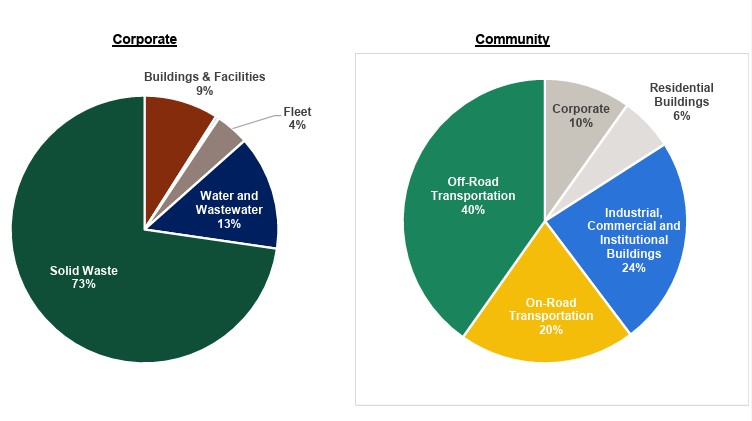
“Community off-road transportation” – mainly aviation fuel – accounted for the largest share of total community emissions in Yellowknife in 2023, followed by industrial, commercial and institutional buildings, and on-road transportation.
The city is now asking residents for their input on the draft actions through an online survey – which is open until July 4 – and an in-person roundtable set to take place at City Hall on Wednesday from 6:30-8pm.
The city said it expects that a full draft plan will be presented to council for review in mid-October.
Clarification: June 25, 2025 – 9:34 MT. Following publication of this article, the city clarified that a full draft of the climate action plan has not been publicly released. Rather, the city is asking for public input on draft actions for the climate action plan.
