



Advertisement.
In July 2023, a report to the NWT’s spill line indicated a suspected fuel spill in Yellowknife Bay.
What some people thought was a spill – due to the funny colour and foul smell – was actually a cyanobacteria bloom, also known as a blue-green algae bloom.
At that time, the NWT government issued its first public bulletin warning of algal blooms in Great Slave Lake.
The territory warned again of blue-green algae in the water near Yellowknife’s Old Town and Latham Island in August 2024.
Advertisement.
Advertisement.
“It got us, I guess, questioning about how new is this phenomenon,” Jeffrey Cederwall told Cabin Radio, “and what’s the change that’s being going on in the lake to allow for this to be happening?”
Cederwall, who was previously an aquatic quality scientist at the NWT government, is an author of a new study on algal blooms in Great Slave Lake.
Combining scientific, Indigenous and local knowledge, the study documents a “profound shift” in the lake.
What are cyanobacteria?
Cyanobacteria are naturally occurring microscopic bacteria that live in the water and produce their own food using sunlight.
Advertisement.
Advertisement.
Although they are not normally visible to the naked eye, blooms occur when cyanobacteria rapidly multiply.
The blooms can look like blue or green paint spilled in the water, scum, pea soup or fine grass clippings. They can also come in different colours, including yellow, orange, red, purple, brown or white.
Cyanobacteria blooms are usually found in warm, slow moving, shallow and nutrient-rich water bodies – which hardly describes Great Slave Lake.
But the blooms have increasingly been found in colder lakes that are relatively low in plant nutrients.
‘Quite a shock’
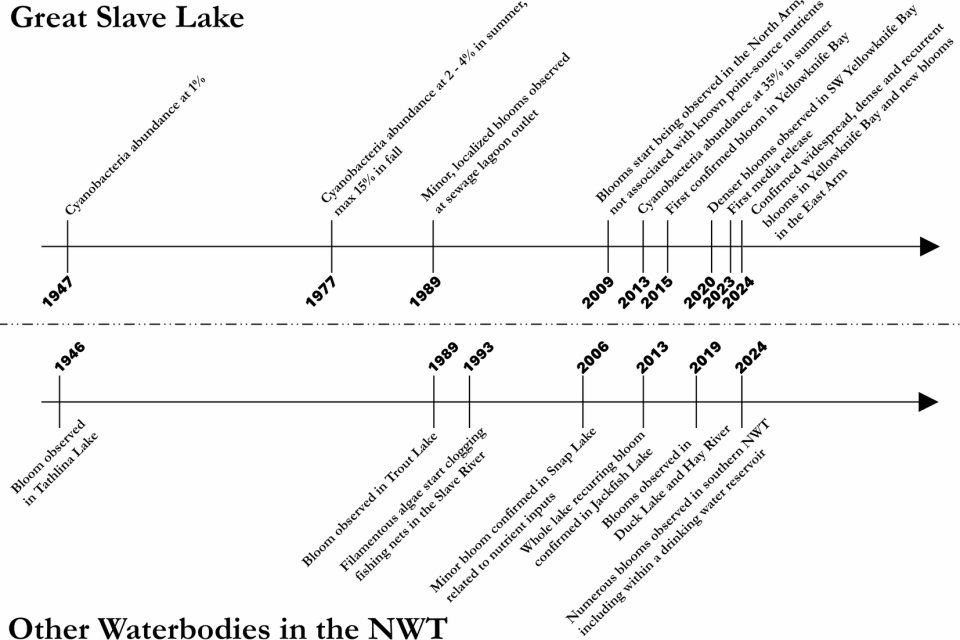
The new study details a timeline of algal bloom observations in Great Slave Lake, confirming they are a new phenomenon and becoming more frequent.
“This was quite a surprising result,” Cederwall said.
“It’s quite the unusual type of blooms that we’re seeing up here and kind-of the rapid change that we’ve been seeing.”
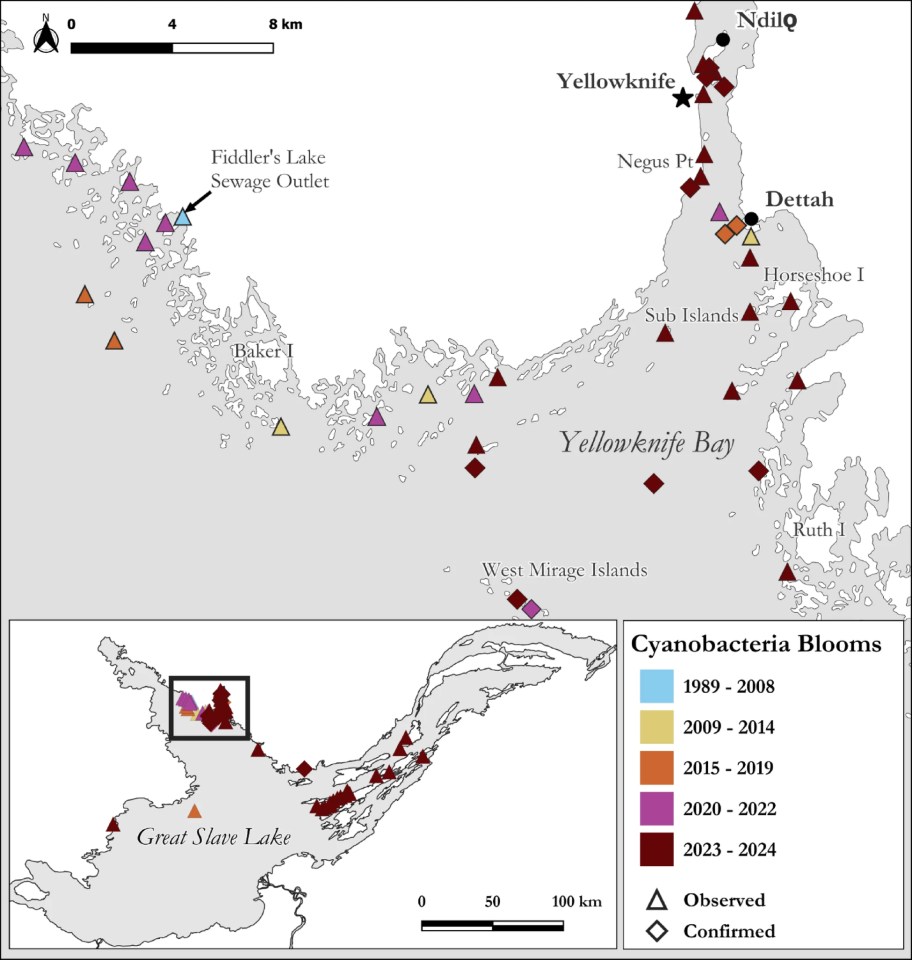
According to the study, the first suspected algal bloom in the lake was spotted in 1989 near the Fiddler’s Lake sewage lagoon discharge outlet.
Advertisement.
Advertisement.
Since 2009, the study found blooms have sporadically been observed in the North Arm, mostly in Yellowknife Bay, and near Baker Island. The first confirmed bloom occurred adjacent to the shoreline in Yellowknife Bay in 2015.
The study said blooms remained relatively rare in Great Slave Lake until the summer of 2023 with the densest and most widespread blooms observed in 2024.
In early September last year, blooms were seen for the first time in the East Arm.
Cederwall said that was “quite a shock.”
Cyanobacteria blooms can be of concern as some species of the bacteria can produce harmful toxins that pose potential health risks to people and animals.
The blooms can also be problematic for ecosystems when they decay and deplete oxygen in the water, and they can negatively impact cultural and recreational activities.
The good news, Cederwall said, is that researchers have not found toxins produced by cyanobacteria in Great Slave Lake.
Yet he said people should still take caution if they see blooms in the future. He noted that boiling water does not remove toxins that may be present.
Advertisement.
Advertisement.
“The best advice is to avoid areas that are scummy and get water from a clean source where water looks clear, not where you can’t see through it and you see the floating algae,” he said.
Importance of Indigenous, local knowledge
The study highlights the importance of Indigenous and local knowledge as, unlike in the south where cyanobacteria blooms are more common, there is no established surveillance program to track the blooms in the NWT.
Researchers found the most useful source of information on algal blooms in Great Slave Lake came from people who have long lived near and used the lake.
The study’s authors conducted surveys in several NWT Indigenous communities and interviewed more than 40 local experts including commercial fishermen, lodge operators and environmental professionals.
“Without this approach of working with all knowledge systems and the local knowledge holders who directly observe these things, we wouldn’t be able to say where the blooms have been and that blooms are new,” Cederwall said.
“We do hope this method can be used to respectfully, meaningfully incorporate these knowledges to better techniques and change broadly across the North and other places.”
What’s causing the blooms?
Researchers suspect climate change is the primary driver of increasing cyanobacteria blooms in Great Slave Lake.
“As we get warmer water with less ice cover, you’re more likely to extend the growing season so there’s more opportunity for these cyanobacteria to grow,” Cederwall said.
Advertisement.
Advertisement.
“And then having a period of warm and calm weather, which we’re seeing a slight reduction in winds, allows these cyanobacteria to rise up to the surface and then we can see them forming the scums that get blown into the shoreline that were being observed.”
Cederwall pointed out there has been rapid change in the environment. Water levels on the lake have dramatically fluctuated in recent years between record highs and record lows.
The NWT has also been experiencing bigger and more intense wildfires, with 2023 being the territory’s worst wildfire season on record.
The study said smoke and ash from wildfires can provide nutrients to fuel blooms.
Better responding in future
Cederwall said the study on algal blooms in Great Slave Lake is “a profound example” of how quickly climate change is impacting northern environments.
“This is the lake you’d expect to see kind-of the last of change from an environmental standpoint just because the resiliency, like how big it is, it takes a lot longer for it to warm up and change,” he said.
“We’re seeing it now in the biggest lake, so we expect to see more changes going on in our smaller lakes in the future as well. That might be cyanobacteria blooms but it could also be other changes, too.”
Cyanobacteria blooms have also been recently observed and researched in Trout Lake and Jackfish Lake.
Cederwall said as the North continues to warm up, having a cyanobacteria surveillance program in the NWT is becoming more pressing.
“Having that in place now would allow us to better respond to it in the future.” he said.
