


The organizer of a Yellowknife march planned for the National Day for Truth and Reconciliation says her message was misconstrued after concerns about its links to Gaza.
Kaitlyn WhiteKeyes says she took it upon herself to organize a march and vigil in the city on September 30 after being unable to find any other events planned.
Last month, WhiteKeyes – who describes her family as recognized through the Métis Nation of Alberta – posted an invite online encouraging people to meet for an Orange Shirt Day march.
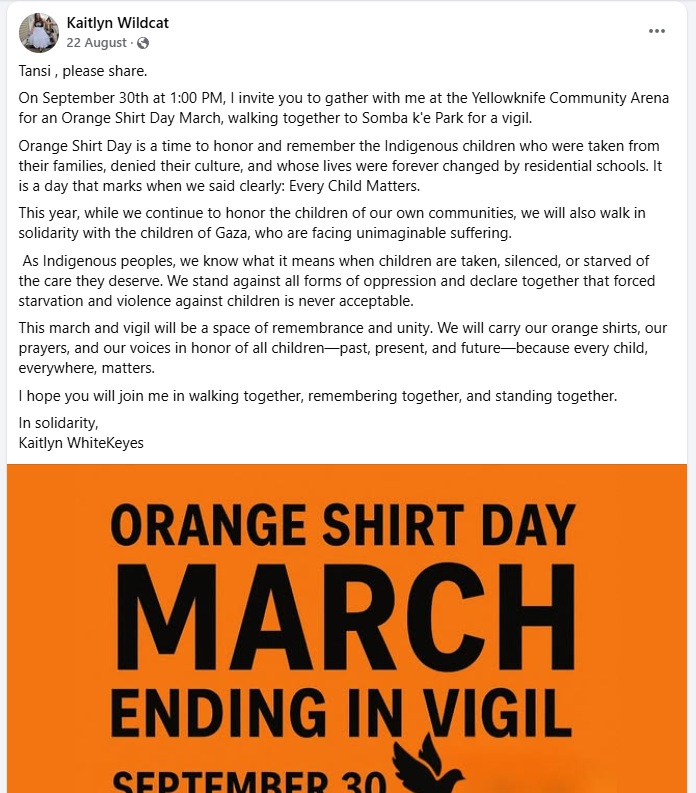
In that message, she also wrote: “This year, while we continue to honor the children of our own communities, we will also walk in solidarity with the children of Gaza, who are facing unimaginable suffering.”
Earlier this week, the CBC reported on the event with an initial headline – since updated – that read: Yellowknife march for Gaza on Orange Shirt Day draws mixed reaction. In that article, Indigenous city councillor Stacie Arden Smith said there were “364 days of the year that they can choose from to do a march specifically for the children of Gaza.”
Advertisement.
Advertisement.
The Yellowknives Dene First Nation subsequently issued a statement that read in part: “The Yellowknives Dene First Nation is troubled about a march for Gaza being planned in Yellowknife on September 30, the National Day for Truth and Reconciliation.
“September 30 is dedicated to Survivors of residential schools and to honouring the children who never came home. It is a solemn day for Indigenous peoples and for all Canadians to reflect, learn and commit to reconciliation. Linking other causes to this day, however important they may be, risks overshadowing its purpose and disrespects Survivors and Elders.”
On Friday, WhiteKeyes told Cabin Radio she had been “stomach sick” about the reaction to the event – the purpose of which, she said, has been misinterpreted.
“It was originally to commemorate Orange Shirt Day and give the community a place to gather and remember the children that were taken, our families that were taken,” she said.
Advertisement.
Advertisement.
Only later, she added, did she act on “the connection between our Indigenous children and the Indigenous children of Gaza” and invite people concerned about the situation in Gaza to join the event. (The updated CBC headline now reads: “Including Gaza in Orange Shirt Day march in Yellowknife draws mixed reaction.”)
Even so, WhiteKeyes said changes have now been made. Tuesday’s event will no longer involve a vigil and she is asking people who attend not to bring Gaza-related signs.
“To respect the IRS survivors and their legacy and how they wish the day to be carried out, I’m asking people to not come with Gaza-related signage and to come in an orange shirt so that we can gather for the true purpose of the day, and that is to make sure every child everywhere matters, and knows that they matter,” WhiteKeyes said.
“I’m sorry that my message was misconstrued. It was never my intention to overshadow the National Day for Truth and Reconciliation or Orange Shirt Day. It has always been my intention to recognize the children in residential schools and their survivors, and the ones that didn’t make it home.”
Despite the changes, she added: “I will be carrying the Gaza children in my heart, even if my sign doesn’t have a Palestinian flag on it or a piece of watermelon.”
The march begins at 1pm on Tuesday, September 30 at the Yellowknife Community Arena. It ends at Somba K’e Park.
Guide: National Day for Truth and Reconciliation NWT events
Below, read a transcript of our interview with WhiteKeyes about the event, its meaning and the reaction.
Advertisement.
Advertisement.
This interview was recorded on September 26, 2025. The transcript has been lightly edited for clarity.
Ollie Williams: What sort of event did you want to put together?
Kaitlyn WhiteKeyes: Back in August, I reached out to the YKDFN and to the North Slave Métis Alliance inquiring about what was going on [on September 30] to see how I could participate. I’m pretty avid in the community. I volunteer for a lot of different groups. I plan events. It’s not abnormal for me to step forward in these kind of times, and I didn’t get any response from them for weeks. I still actually haven’t gotten a response from them about anything that’s going on, on the day, to commemorate the children that were taken.
So when I saw that nothing was going on in the community, I stepped forward. I reached out to Yellowknife Municipal Enforcement. I’m working alone here, this isn’t an organization that’s behind me, I am just an individual who has had family in residential schools, who is an Indigenous person, and I think that the misinformation got out there and kind-of spun things in a different way.
But it was originally to commemorate Orange Shirt Day and give the community a place to gather and remember the children that were taken, our families that were taken.
The Yellowknives Dene First Nation says it is “troubled about a march for Gaza being planned in Yellowknife on the National Day for Truth and Reconciliation.” What you just described did not involve Gaza. How has Gaza come into this?
After I had reflected on current events, I really easily saw the connection between our Indigenous children and the Indigenous children of Gaza. So I reached out to another group in the community who does activism around this specific moment, and I said that I was reaching out in solidarity as an Indigenous person for the Indigenous children suffering everywhere in the world, and that if we all wanted to get together under the same commemoration and the same memorial, all of our suffering can be really be acknowledged at the same time.
Since then, I have been told that my march is for Gaza. I have been told that I don’t have the right to commemorate my own family by including other Indigenous children around the world.
Advertisement.
Advertisement.
How do you feel about that, and what impact has that had on how you feel about the event you’re holding?
Oh, I have been absolutely stomach sick.
I am not somebody that easily backs down from things. I don’t mind challenging people in positions of authority, whether that’s councils or others, but what really got me was a specific survivor said, “Hey, I’m a survivor of an Indian Residential School and this isn’t something that sits right with me.” And from that moment, I had pause of who I’m affecting and how.
I’ve spent a lot of sleepless nights and a lot of time in silence. I’ve reached out to the Elders in my life and I reached out to different organizations. It’s been really hard. It made me feel even more alone in my advocacy, which is a hard enough thing as it is, being a sole person not coming from an organization.
What would your message be to people who understood that this was either a march for Gaza planned for September 30 – or perhaps an event for the National Day for Truth and Reconciliation that had a large Gaza element to it – and weren’t comfortable with that. What do you want them to know?
I first want to apologize to any IRS survivors or other legacy Indigenous people that are negatively affected by the headlines that went around Yellowknife and, unfortunately, our very active social media community.
I’d like to apologize for any stress and discomfort that this has brought up, and it was never my intention to overshadow their suffering or even compare the suffering of anybody in the world. Suffering is suffering, and I think that the day was meant to come together to honour the suffering of children. Some of those children are still alive, and some of those children are adults that are still grieving and still working toward reconciliation.
I’m sorry that my message was misconstrued. It was never my intention to overshadow the National Day for Truth and Reconciliation or Orange Shirt Day. It has always been my intention to recognize the children in residential schools and their survivors, and the ones that didn’t make it home.
Advertisement.
Advertisement.
The Yellowknives Dene First Nation, in its statement, said: “Linking other causes to this day, however important they may be, risks overshadowing its purpose and disrespects survivors and Elders.” How do you define the event you’re organizing?
The event I am planning is a march that embodies the message of Every Child Matters. And that means everywhere. It’s not up to me. I don’t have the authority to decide which Indigenous children are worth memorializing and commemorating. I believe that in our resilience as Indigenous people, it’s now our job to be resilient for those that aren’t there yet.
We have Indigenous children in the world still suffering, and that’s oppression from colonial violence which needs to be addressed. And I understand that not everybody sees these events as linked, or that they shouldn’t be linked, but Indigenous suffering is Indigenous suffering. Children suffering is children suffering.
What do people need to know about the actual event itself?
To respect the IRS survivors and their legacy and how they wish the day to be carried out, I’m asking people to not come with Gaza-related signage and to come in an orange shirt so that we can gather for the true purpose of the day, and that is to make sure every child everywhere matters, and knows that they matter.
So come to the Yellowknife Community Arena at 1pm and we will march to Somba K’e. Before we march, there will be a brief prayer and an opportunity to smudge, and then we will walk. And I have since cancelled the vigil, just because of all of the mixed feelings. So it will just be a march from now.
Hearing you say that, it sounds like your hope now is the focus lies squarely on this being the National Day for Truth and Reconciliation at that event. Is that a fair characterization?
I will be carrying the Gaza children in my heart, even if my sign doesn’t have a Palestinian flag on it or a piece of watermelon.
I know why I’m marching, and I hope that other people can see the perspective and come from a place of understanding and togetherness.
Correction: September 26, 2025 – 17:24 MT. This article initially stated Yellowknife has only one Indigenous city councillor. That isn’t the case, there are two.
