


As a commission reviews the NWT’s electoral boundaries, dozens of people from across the territory have weighed in at public hearings and through written submissions.
The commission is contemplating whether to recommend changes to the number of MLAs in the territorial legislature or how MLAs’ districts are divided.
Among those who have shared their thoughts are existing and former MLAs, mayors, chiefs and councillors.
Those leaders have mixed views on how boundaries should be redrawn and if more seats should be added to the Legislative Assembly.
In a written submission, Yellowknife city council said any electoral boundary changes must increase the representation of Yellowknife residents.
Advertisement.
Advertisement.
Council’s submission noted that, as a capital city, Yellowknife serves as the administrative, economic and service centre for the NWT and supports residents across the territory and western Nunavut.
“Yellowknife’s significant and continuous underrepresentation when compared to our population risks undermining the principle of voter parity and the confidence of residents in the democratic process,” the city’s submission states.
Kieron Testart, the MLA for Range Lake, also raised concerns with the underrepresentation of Yellowknife and some other regions in the legislature.
He said that affects people’s democratic rights under the Charter as well as the work of the Legislative Assembly.
Advertisement.
Advertisement.
Testart said he would support a 22-member legislature – the largest number of seats being considered by the commission (there are 19 at the moment) – calling that “a prudent investment in the future of our democracy.” He pointed out the Yukon currently has 21 MLAs and Nunavut has 22.
“A larger assembly is one with more capacity to deliver results to the electorate, ensure that the needs of the public are met and equally ensure good value for money for the spending of taxpayer dollars,” he wrote.
Former Yellowknife MLA Bob Bromley also supported a 22-member legislature.
“All people of the NWT would be better off if we adhered more closely to the population representation guideline,” he wrote.
“I have found Yellowknife MLAs to be very supportive of political decisions that benefit small communities, but with our historical weighting of ridings, all people have not benefitted as they might have.”
Keeping the number of MLAs at 19
Yellowknife North MLA Shauna Morgan highlighted that her constituents are underrepresented compared to residents in other Yellowknife ridings and elsewhere in the NWT. But she said she does not believe increasing the number of MLAs is the solution.
“Continuing with 19 MLAs while making changes to boundaries will require a willingness by political representatives to adjust from what we are used to,” she wrote.
“There has been a tendency for communities and regions to fragment into smaller and smaller groups who each consider themselves to be distinct communities of interest needing distinct representation, but in this age of increased migration and frequent travel within the territory, there is also an opportunity to emphasize linkages and common ties.”
Advertisement.
Advertisement.
Morgan said if boundaries are redrawn, residents on the Ingraham Trail, which is currently part of the Yellowknife North riding, should continue to be part of a Yellowknife-based riding. All four options the commission has proposed so far would incorporate the Ingraham Trail into the Tu Nedhé-Wiilideh district.
More than 40 percent of 76 written submissions the commission received oppose that idea, including all Yellowknife MLAs who made submissions.
Julian Morse, the MLA for Frame Lake, said he is in favour of maintaining 19 MLAs, or adding as few MLAs as possible to address representation imbalances.
“The increased costs associated with adding MLAs are difficult to justify considering the population of the territory has remained stable,” he wrote.
Morse said he was “surprised” to see the options the commission is considering propose significant changes to Frame Lake, which he said has relative representational balance and is demographically diverse.
Morse noted that may be due to the cascading effects of moving the Ingraham Trail into Tu Nedhé-Wiilideh. He encouraged the commission to keep continuity in existing ridings as much as possible to “help reduce confusion and upheaval.”
Vince McKay, the MLA for Hay River South, said he believes maintaining 19 MLAs “would help balance the need for effective representation while avoiding unnecessary financial burdens.”
McKay said he is not in favour of changing electoral boundaries as he believes all ridings “are currently represented fairly and appropriately.”
Advertisement.
Advertisement.
Renaming Great Slave and a Yellowknife slate
Kate Reid, the MLA for Great Slave, said she does not feel adding an MLA to Yellowknife would be “seen with warmth by the assembly.”
She said she hopes that in reviewing electoral boundaries in Yellowknife, the commission will ensure all districts have a mix of public and private housing, renters and homeowners.
Reid, Testart and Yellowknife Centre MLA Robert Hawkins all support renaming the Great Slave district.
Reid proposed Yellowknife East as a new name, saying that would be consistent with other Yellowknife districts and noting the Tu Nedhé-Wiilideh district is already named after the lake.
Testart said the district should be renamed to “something that is culturally appropriate and relevant to Indigenous peoples.”
McKay said he was not in favour of renaming any existing electoral districts, citing costs, confusion and challenges such as difficulty reaching agreement on names.
Beyond the models being considered by the commission, Hawkins and Morgan said they opposed a proposal from a handful of Yellowknife residents who have advocated for getting rid of electoral boundaries in the city. Under that approach, residents would instead vote for a slate of MLAs to represent them.
The two Yellowknife MLAs raised concerns about how workload would be balanced among MLAs in the city. Morgan added that a slate model could lead to minority neighbourhoods in and around Yellowknife being ignored.
Advertisement.
Advertisement.
Bromley, though, voiced support for the idea.
“This would allow all residents, regardless of their cultural or other affiliations, to be able to approach the representation with whom they are most comfortable (likely improving effective representation, something that is key given their underrepresentation in the Assembly),” he wrote.
Mackenzie Delta
One option being considered by the commission would incorporate the Mackenzie Delta district into the two Inuvik districts.
In a letter, the Town of Inuvik said that “would be a huge disservice to the smaller communities as they have different needs than constituents in Inuvik.”
The town urged the commission to consider the potential growth of Inuvik, saying it anticipates 255 additional housing units will be developed in the future.
Great Slave MLA Reid also opposed merging the Mackenzie Delta district, saying communities of interest should be kept together.
The Aklavik Indian Band wrote in favour of the community having its own MLA. The band said Aklavik is made up of Métis, Gwichin, Inuvialuit and non-Indigenous residents, and placing it in the Mackenzie Delta district – where the majority of the population is Gwich’in from Fort McPherson and Tsiigehthic – is “a flawed decision.”
The band said if Aklavik is not able to have its own MLA, it should be part of an Inuvik-based riding, noting that many families relocated from Aklavik to Inuvik due to flooding in the 1960s.
Advertisement.
Advertisement.
Beaufort Delta and Nahendeh
The Hamlet of Ulukhaktok shared a hamlet resolution calling for Ulukhaktok, Paulatuk and Sachs Harbour to have their own MLA separate from Tuktoyaktuk.
The resolution states the size, distance and logistical challenges of the existing Nunakput district –which encompasses all four communities – makes it “difficult to ensure equitable representation, effective constituency services and meaningful engagement.”
Having an MLA focused on Ulukhaktok, Paulatuk and Sachs Harbour would “enhance advocacy, responsiveness and policy attention to the specific needs and priorities” of the communities, the resolution continued.
Another submission shared a similar resolution passed by the NWT Association of Communities.
Some models the commission is considering would move Nahanni Butte into the Dehcho district.
The Nahɂą Dehé Dene Band, which is based in Nahanni Butte, said it wants to remain within the Nahendeh district, which also encompasses Fort Simpson, Fort Liard, Wrigley, Sambaa K’e and Jean Marie River.
Shane Thompson, the MLA for Nahendeh, said he also opposed changes that would, in his view, make it more difficult for people in Nahanni Butte, Samba K’e and Fort Liard to access their MLA and disrupt links with Fort Simpson.
Adding a new district to the Tłı̨chǫ region
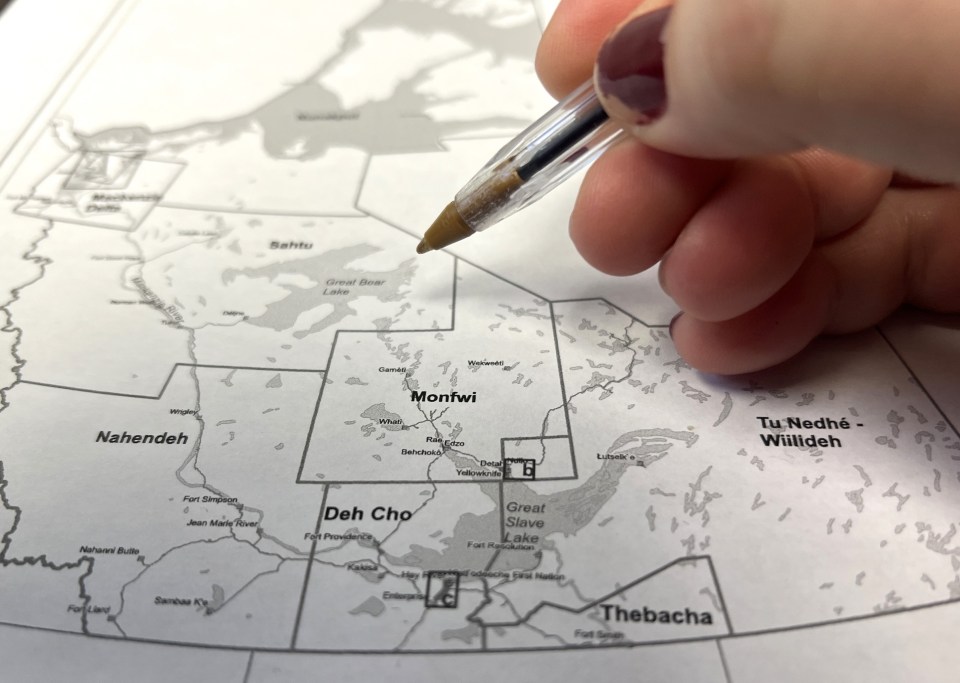
All four options would add another district to the Tłı̨chǫ region, currently represented solely by Monfwi.
Advertisement.
Advertisement.
The commission has proposed redrawing electoral boundaries in the region with Rae in one district and Edzo, Frank Channel, Wekweètì, Whatì, Gamètì and Highway 3 east to Boundary Creek in another.
In its submission to the commission, the Tłı̨chǫ Government expressed concern about any proposal that “would end up alienating one or more of our Tłı̨chǫ communities from the others by moving one or more communities into another riding or creating a new riding associated with non-Tłı̨chǫ communities.”
“The balance to be considered is one where Tłı̨chǫ would get the enhanced representation they are entitled to without affecting Tłı̨chǫ unity, which is the hallmark of our people and a central tenet of the Tłı̨chǫ Agreement,” the Tłı̨chǫ Government wrote.
More: Read all of the submissions to date
Two residents wrote to oppose separating Edzo from the rest of Behchokọ̀.
The Tłı̨chǫ Government said it expects to be engaged in the naming of any new districts in the area. It highlighted the importance of Tłı̨chǫ Yatii to cultural identity, connection to the land, governance and transmission of Tłı̨chǫ knowledge.
The commission is expected to make final recommendations to the Legislative Assembly next month.
MLAs must ultimately approve any changes to electoral boundaries.
