


Advertisement.
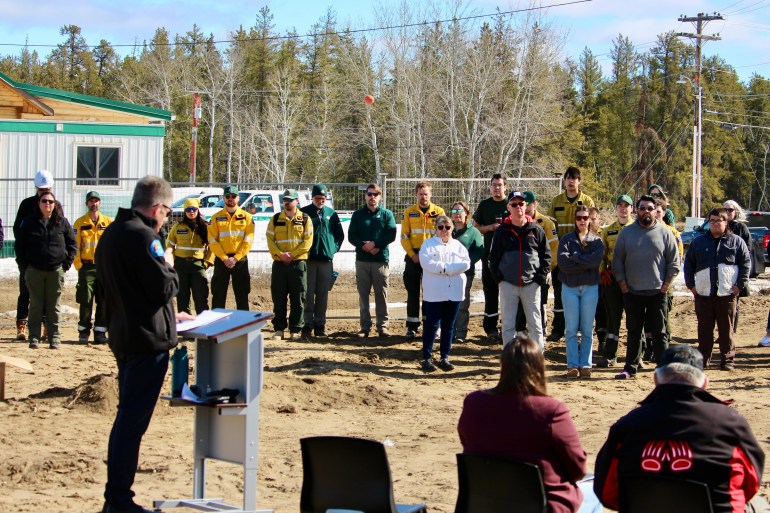
Construction has begun on a new territorial fire centre in Fort Smith that environment minister Jay Macdonald says will lead to a more efficient operation in future.
At the moment, Macdonald told Cabin Radio on Friday, staff are scattered across various buildings. As wildfire seasons get more extreme and more staff are brought on, that problem gets worse.
The new $30-million building will bring everyone under one roof while creating a “state of the art” operations centre for wildland firefighting in the NWT.
Whitehorse and Penticton-based Wildstone Builders won the contract for the work. Macdonald said he expects local firms to benefit from being subcontracted.
Advertisement.
Advertisement.
The minister spoke at a groundbreaking ceremony for the new facility last week, at the same time as he hosted new Alberta environment minister Grant Hunter in Fort Smith.
Water and oil sands were on the agenda for that meeting. Communities downstream of the oil sands are campaigning for Alberta to halt plans to allow the release of treated tailings water into rivers.
Below, read a transcript of our conversation with Macdonald after the groundbreaking ceremony and ahead of the meeting with Hunter.
This interview was recorded on May 1, 2026. The transcript has been edited for length and clarity.
Advertisement.
Advertisement.
Ollie Williams: Describe for us what this is going to become.
Jay Macdonald: This is a new all-in-one wildland fire centre, so it will contain all of the resources that are currently located in Fort Smith.
Right now, we have our forest management offices in the federal building. In the basement, we have our equipment maintenance folks and our comms folks. Part of the building is where we have part of our warehouse. The other part of our warehouse is located on King Street. This will bring all of those pieces together in one building.
Right now, we’re really struggling to find space for all of the staff that are currently working in forest management. This will provide that space in a modern, self-contained facility that will be able to operate in the event of an emergency. So if we were to lose the fibre link, it would have self-contained comms. It will have its own electricity generating station.
It will have all of our warehouse facilities, all of our work facilities for equipment maintenance and communications, and a state of the art ops room for the territory’s duty officer and supporting staff to work out of.
There may be people who hear the $30-million figure and think about how many wildfire crews that could pay for, or how many water bomber trips. There are so many cost pressures. Give me a sense of why this $30 million is best spent here.
This is the territorial coordination facility. We have our five regional operations across the territory and they’re all supported by the territorial fire centre. All of the equipment and resources flow through the territorial fire centre.
Even though some of the regional locations are seasonal, the territorial centre runs year-round. Whether that’s refurbishing wildland fire equipment or refurbishing communication equipment, supporting all of those regional operations is really a key to their success and their ability to deliver suppression activities in a timely manner – and it allows us the capacity to ensure we have those resources available to support those operations regionally.
Advertisement.
Advertisement.
This is really a key investment in us being able to do this. Right now, the operation in our current structure is not efficient because of the logistics of where things are located. It’s not coordinated together. This will deal with that issue.
You are Fort Smith’s MLA. The town has gone through concern about its economy. Fort Smith saw itself as the education capital and that has eroded a little bit. What does it mean to the town to be the wildfire capital, if you like?
This is a really important investment for our community.
As we look at the $30 million that’s been invested here, there’s a number of local contractors that have been brought on to the project by the general contractor, which is great for our community. In the short term, it will benefit those businesses and boost our economy.
Long term, this is also a real plus. With the fire centre here, those jobs are going to remain in Fort Smith and will support our economy long term. We are able to provide some really good stability for the program, in that we can be more efficient and effective and focus the time and energy of the people that we do have not only on suppression, but I think a big part of the work that we do is through mitigation and working with communities to make them more resilient to wildfire in the future.
You are hosting Alberta’s environment minister in Fort Smith. What are you hoping to talk about?
It’s a first touch-base with the minister from Alberta. We have a number of topics on our agenda that we’re going to talk to.
An Alberta minister of environment has never reached out for a conversation like this before, and I’m very happy to have this initial conversation to talk about some of the issues and concerns that are important to the NWT – water, oil sands, invasive species.
I’m certainly looking forward to the conversation, and hopefully it’ll be the start of a productive dialogue that will allow us to move forward.
