


Rarely in a Yellowknife power outage does every building get electricity back at the same time. That’s because the two power companies follow a predetermined order when recovering from a blackout.
After a citywide outage, bringing power back online is a balancing act.
Before we explain which neighbourhoods get power when, it’s important to understand why you would want to stagger those neighbourhoods.
“The voltage and the frequency are two critical pieces for the entire stability and criticality of the grid,” said Dean Hendrickson, the NWT Power Corporation’s director of energy south operations.
“Those two things are always monitored, and they have certain protection devices in order to keep the health of the entire grid. When those go out of spec or out of range, that’s when we have trips, upsets or outages.”
Advertisement.
Advertisement.
As you bring power back online after a big outage, lots of homes being re-energized at once adds a whole heap of demand to the city’s tiny island grid. There’s only so much the grid can safely cope with at once as operators try to match demand with supply while keeping an eye on voltage and frequency.
That’s why you do it in stages. And if you’re bringing diesel generators online to get power back, that also helps you gradually bring on a few generators at a time, warming them up and synchronizing them so they all maintain the same voltage and frequency.
While power corporation staff know it’s annoying for one part of the city to have power back and another area to still be waiting much later, they say it has to happen that way.
“We’ve all seen part of the city on for a certain period of time and then a big, long delay,” said Hendrickson.
Advertisement.
Advertisement.
“What we want to do is restore power to the customers as quickly as possible. So if we have generation that’s capable of coming online immediately, we will bring on two, three or four feeders and start supplying those customers.” As that’s happening, the generation is being prepped for the next neighbourhood, and so on.
Power in Yellowknife goes through three main distribution substations named Niven, Bison and Butler.
Niven, unsurprisingly, powers the Niven neighbourhood. Bison is near the Bison Hills area of the city. Butler is located behind the city’s Walmart. If you live in Yellowknife, your home is served by one of these three.
Getting power from the Jackfish substation to the three distribution substations and beyond is Naka Power’s responsibility. NTPC generates the power, then Naka distributes it to your house.
Here’s the order, from one to 12, in which neighbourhoods get their power back after a major outage:
- Bison
- Butler
- Butler
- Butler
- Niven
- Butler
- Bison
- Bison
- Bison
- Niven
- Niven
- Niven
In other words, one of the four neighbourhoods served by the Bison substation is always the first to get power back. Then three of the four Butler neighbourhoods are next, then one in Niven.
But most people on the Niven substation – which also serves the Engle Business District – are waiting till the very end of the line.
Hendrickson and Stefan Christensen, an NTPC system control manager, were keen to point out that the order is devised by Naka Power, not NTPC, but both companies follow the same list to ensure their actions match up.
Advertisement.
Advertisement.
There is also a 13th destination on the list: Stanton Territorial Hospital. Why is the hospital last?
“There are certain key infrastructures that have backup generation: the hospital, the school, government buildings,” said Christensen when Cabin Radio toured the Jackfish facility in early January.
“The reason we have the hospital last is because we want to bring them back when the system is fully stable and we’re not going to provide any interruptions or disturbances to their medical equipment.
“They have two generators there that are fully capable of handling the hospital for days without issue. What they want from us is [to be reconnected] when the system is stable and we’re not closing any other feeders – because when we close a feeder, you have a big spike in the frequency. They want to have everything smooth before we bring them back onto hydro.”
Check out the map
Naka Power helpfully provided a map that shows whether your part of Yellowknife is in Niven, Butler, or Bison territory. (It doesn’t tell you which precise number you correspond to, otherwise everyone in “12” would go crazy after this article.)
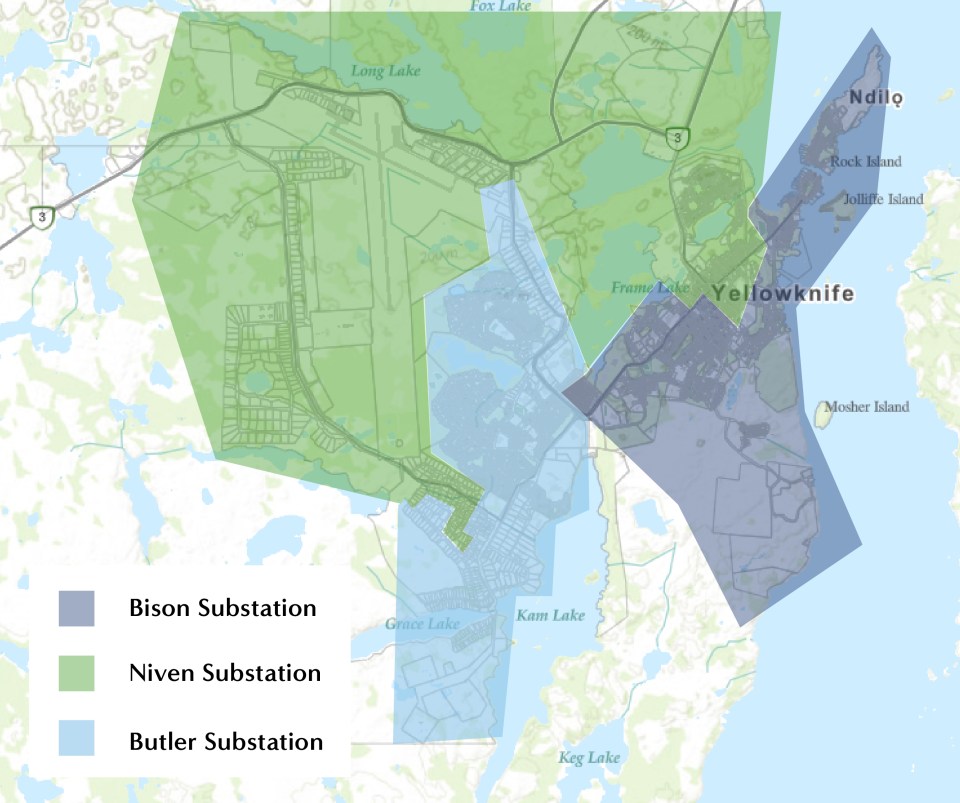
The power distributor says there are reasons for the order it follows.
“When there’s a power outage in Yellowknife, electricity can’t be turned back on everywhere at the same time. The order in which power is restored is based on critical customers connected to each line, the way residential areas were originally built, and whether stand-alone generation capability is available,” Naka Power stated by email.
“The underlying goal is to restore lines that serve customers who are most sensitive to power outages earlier.”
Advertisement.
Advertisement.
For example, Naka stated, the line serving seniors’ facilities operated by Avens is high up the priority list to ensure it gets stable power to help residents as soon as possible.
After those critical customers have been handled, Naka moves on to residents, and then the order “considers how each area was originally built.”
“For example, some areas share older infrastructure or have more complex repair needs,” the company wrote, “which can make them more sensitive to power outages and affect where they are placed on the restoration sequence.”
“The priority list for power restoration is not permanent,” Naka hastily added. “Naka Power Utilities (NWT) reviews these priorities annually to make sure it reflects community needs and the realities of the electrical system.”

