


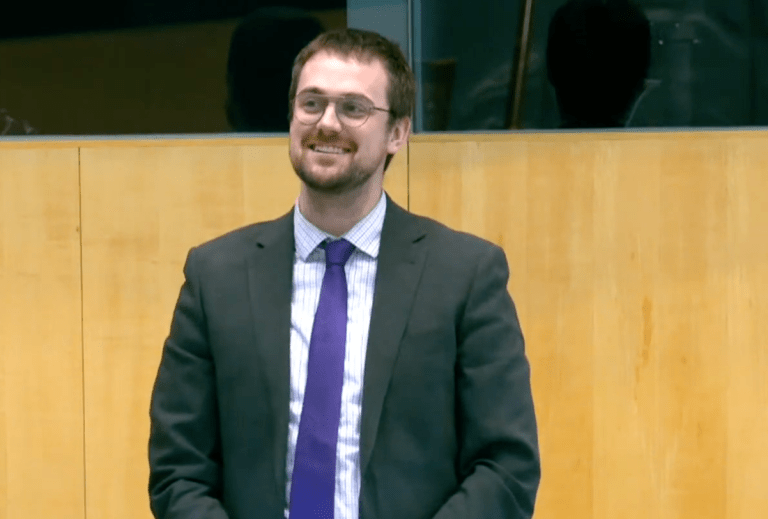
“It’s a beautiful, glorious day. I really couldn’t be happier.”
At least once a year for four years, Rylund Johnson stood in the House as an MLA and lobbied cabinet to eliminate twice-yearly time changes in the NWT.
On Monday, more than two years after stepping down as Yellowknife North’s MLA at the 2023 election, Johnson got his wish.
Premier RJ Simpson said this week the territory will follow Alberta in moving to a permanent year-round time, almost certainly daylight saving time.
Reached by phone late on Monday afternoon, Johnson was prepared to lean into the part he had played between 2019 and 2023 as the NWT’s leading advocate for dropping seasonal time changes – a mantle since inherited by the likes of Frame Lake MLA Julian Morse.
Advertisement.
Advertisement.
“A couple months ago when BC did this, I was also just screaming with joy. It seemed that it was maybe finally possible for the NWT to follow suit,” he told Cabin Radio.
“And here we are, after so many years. We’re getting rid of the time change.”
The NWT government had maintained for years that Alberta needed to make the move first to ensure the territory remained in sync with its provincial near neighbour.
When Alberta Premier Danielle Smith announced on Monday her intention to push through permanent daylight saving time in the province – despite a plebiscite in 2021 narrowly won by opponents of such a move – the NWT waited only a few hours before declaring it would also get rid of time changes.
Advertisement.
Advertisement.
“It makes me extremely grumpy every year,” said Johnson of turning clocks forward or back. “Beyond that, I’ve always viewed it as a symbol of ridiculousness … something we continue to do because God-knows-when some decision was made.”
Rylund Johnson on time change: 2020 | 2021 | 2022 | 2023
The NWT could go for permanent daylight saving time (far more likely) or permanent standard time. Johnson said he does not care which wins out.
“I have no preference at all. As long as we get rid of the time change, I’m happy,” he declared.
“I mean, at this point, I think the ship has sailed. Obviously we’re going to do the same thing as BC, Alberta and the Yukon [which would be permanent daylight saving time].
“I know that some people have very strong opinions about which one is which. I’ve always found – especially in the North, where we have hours of sunlight and hours of darkness – a lot of those studies and arguments don’t really make sense. We’re already dealing with a time change. Let’s not make it more complicated.”
His only regret?
“You know, we were already planning a party,” he said of November 1, which would have been – and still might be, depending on how quickly things move – the day the clocks next go back in the NWT.
“We were all going to wear clocks. And you know, it’s a bit sad, because it sounds like we will never get to change clocks ever again,” said Johnson.
On being told that people who campaign for years to end time changes can hardly claim to be overcome with nostalgia the moment they win, he added: “But I would have liked to have notice a couple months ago. And then when we changed our clocks at that time, we would have known it was for the last time, and it would have been a joyous occasion.”
