

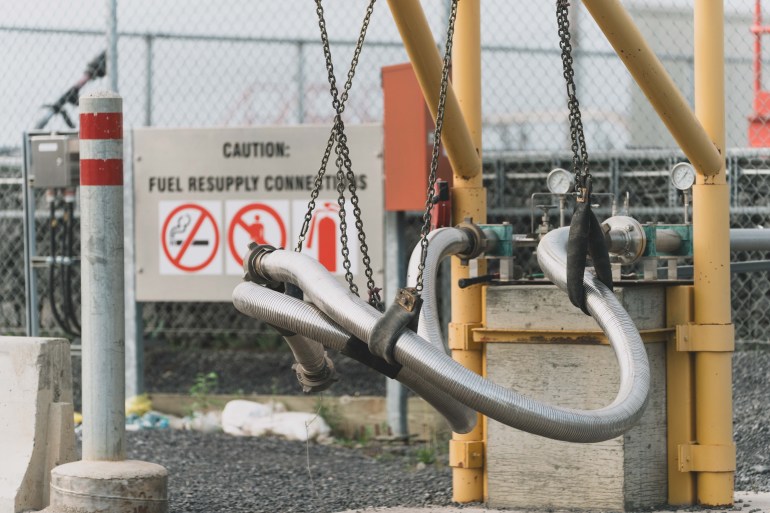
The NWT’s infrastructure minister says the global fuel crisis is “on the radar” as airlines add surcharges to some tickets to try to keep up with rising costs.
Some parts of the world are experiencing fuel shortages and resulting flight cancellations as the Iran-US-Israeli war keeps the Strait of Hormuz, a vital fuel shipping channel, closed.
Canada’s national airlines have begun cutting flights on some routes as they adjust to higher prices, with Air Canada’s Yellowknife-Toronto route among services set to be scrapped. The airline said the war was to blame.
More generally, Canada is insulated from global fuel scarcity to some degree because of the volume of oil produced domestically.
Though international flights will be jeopardized if fuel runs low in foreign destinations, experts have said widespread flight cancellations within Canada are less likely because of that domestic supply. (Any such cancellations in the North through fuel shortages would have immediate and significant consequences for affected communities, many of which have no road alternative.)
Advertisement.
Advertisement.
Even so, infrastructure minister Vince McKay said “discussions are happening” about the prospect of the territorial government having to put measures in place if prices continue to rise – for fuel of all kinds – and if the crisis in the Strait of Hormuz does not end soon.
McKay said the GNWT’s barging service, in particular, was watching the fuel situation. Barges deliver aviation fuel to some northern communities along the Mackenzie River during each summer.
“This is something on our radar and we’re constantly looking at it,” McKay told Cabin Radio on Tuesday at the Northern Air Transport Association’s annual conference in Yellowknife.
Earlier this month, the federal government suspended the federal fuel excise tax on gasoline and diesel until Labour Day in a bid to bring down costs for drivers.
Advertisement.
Advertisement.
Gas prices in Yellowknife rose from roughly 148.5 cents per litre to 185.7 cents per litre between March 10 and March 31 according to data from fuel pricing website GasBuddy as the Iran war began.
While prices in the NWT capital have since dropped slightly – the same website was quoting an average of 176.9 cents per litre as of Tuesday – they remain much higher in more isolated communities.
Across Canada, jet fuel prices are reported to have more than doubled since the war began. In the North, airlines like Air Tindi and Canadian North have added surcharges to some routes or services as a result.
Minister focuses on airstrip upgrades
The Northern Air Transport Association brings together commercial operators that move passengers and cargo across the North by air. Its annual conference in Yellowknife this week marks the group’s 50th anniversary.
During a panel on Tuesday afternoon, McKay focused on the NWT’s infrastructure deficit. He told attendees the GNWT views upgrading northern airfields as a priority. “We’re definitely needing to upgrade and get with the times,” he said.
McKay said the territory is looking at how it can harness the billions in coming military spending to benefit communities beyond Yellowknife and Inuvik, which are expected to be the focal points.
“We’re expanding on the federal government’s dual-use ideas and realizing that we can also expand it to other communities throughout the Territories,” he said.
“There’s definitely a need for more infrastructure money … I spent 15 years on town council in Hay River, three years here, and I think that’s all I’ve ever done is ask for more money. So we’ll continue to do that.”
Advertisement.
Advertisement.
Speaking to Cabin Radio afterward, McKay said he saw this week’s conference as an opportunity to get more information in front of the federal government about the NWT’s aviation needs.
“We rely a lot on our airstrips, so we need to concentrate on them. We need to try to make sure that they’re up to standard,” he said.
“We’re using aircraft that they don’t use anywhere else. We need to upgrade our airports. We need to do some work on that in order to continually connect the communities.”
