

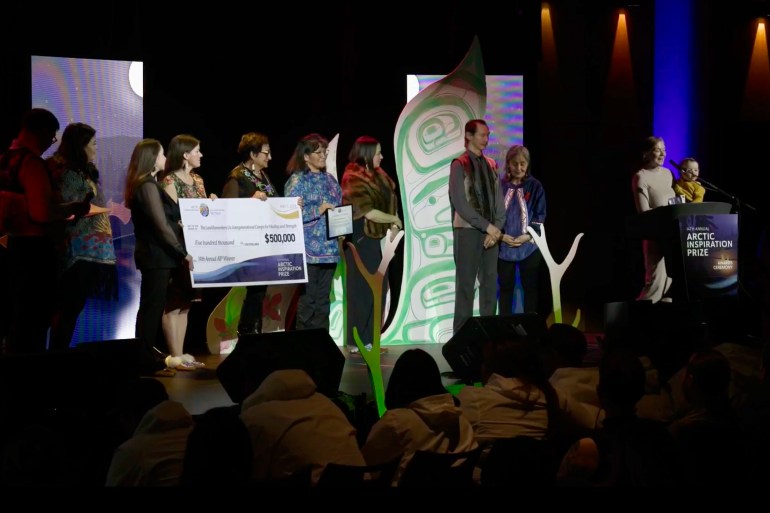
An NWT project that brings together residential school survivors and families for on-the-land camps won $500,000 at Tuesday’s annual Arctic Inspiration Prize ceremony in Whitehorse.
The project – titled The Land Remembers Us: Intergenerational Camps for Healing and Strength – won the largest sum awarded on the night. A $1-million top prize, ordinarily awarded at each year’s ceremony, was not given out this year.
In a press release, Arctic Inspiration Prize organizers said the on-the-land camps would “support healing, cultural renewal, and knowledge sharing through storytelling, skills, and community connection.”
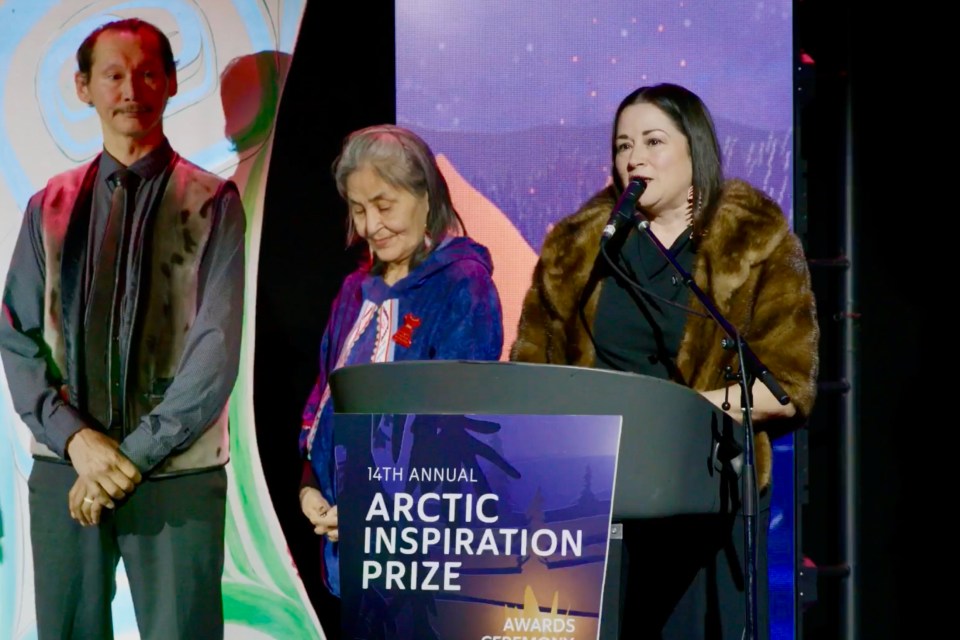
Each camp will be co-hosted with local Indigenous partners, attendees at Tuesday’s ceremony were told.
“This prize is transformational for our communities and for this work,” Gwichyà Gwich’in historian and Indigenous studies scholar Crystal Gail Fraser – a project member for The Land Remembers Us – said at the ceremony inside the Kwanlin Dün Cultural Centre in Whitehorse.
Advertisement.
Advertisement.
“It will support intergenerational on the land, learning, camps, language, cultural revitalization, recreation and opportunities for survivors and families to reconnect with each other, but also with the land.”
In a news release issued after this article was first published, the project team said they will design and deliver three regional on-the-land camps and one territorial on-the-land gathering with the money.
The Land Remembers Us team includes Fraser, Paul Andrew, Kristi Benson, Jess Dunkin, Sharon Anne Firth, Rebecca Gray, Josanne Kenny, Amos Scott, Tammy Steinwand-Deschambeault, Lorna Storr and Kristen Tanche.
Partners in the project include the How I Survived advisory committee, the NWT Recreation and Parks Association, the Dehcho First Nations’ Health and Wellness Division, the Gwich’in Tribal Council’s Department of Culture and Heritage, the Tłı̨chǫ Government’s Department of Culture and Lands Protection, and the University of Alberta.
Advertisement.
Advertisement.
“The relevance of this project for the NWT cannot be overstated,” Marie Wilson – a former commissioner of the Truth and Reconciliation Commission – was quoted as saying.
“More than a century of multigenerational residential school impacts still permeate every community here,” Wilson stated.
“By creating sustained opportunities for healing and connection on the land, The Land Remembers Us will address residential and day school impacts by supporting cultural reclamation, continuity and wellness to the benefit of individual participants, their families, communities and future generations.”
A Yukon project titled Southern Lakes Caribou in the Schools won $475,000.
It was described by organizers as “a K–12 program connecting students with caribou through land-based learning and cultural knowledge, strengthening stewardship and relationships between youth and the Southern Lakes ecosystem.”
Four projects are each taking home around $100,000 from the prize’s youth category:
- Dene Language Workshops: The Stories We Tell will feature youth-led media workshops in the Dehcho that pair language learning with filmmaking, “capturing stories and conversations with Elders to create accessible, community-based language resources”;
- Earth, Fire and Flood will be a youth-driven NWT exhibition “transforming a performance piece into a museum and online experience, sharing stories of climate impacts on land, culture, and community life”;
- Łä̀ch’i Kų̀ Indigenous Tourism Collective in Champagne and Aishihik First Nations territory, Yukon, will be “a youth-led initiative supporting Indigenous tourism operators by managing logistics and bookings, allowing knowledge holders to focus on cultural teaching and language-based experiences;” and
- the Arctic Drone Soccer Program in Nunavik will be an Inuit-led program “introducing youth to drone technology and aviation through hands-on learning and competition, building skills, confidence, and pathways into STEM careers.”
“As young Dene, we’re excited, passionate and grateful to begin this opportunity, and we’re really excited to work with our communities,” said Anonda Canadien, accepting a $100,000 award on behalf of Dene Language Workshops: The Stories We Tell.
“We – the northern people – we control our narratives,” Canadien said.
Advertisement.
Advertisement.
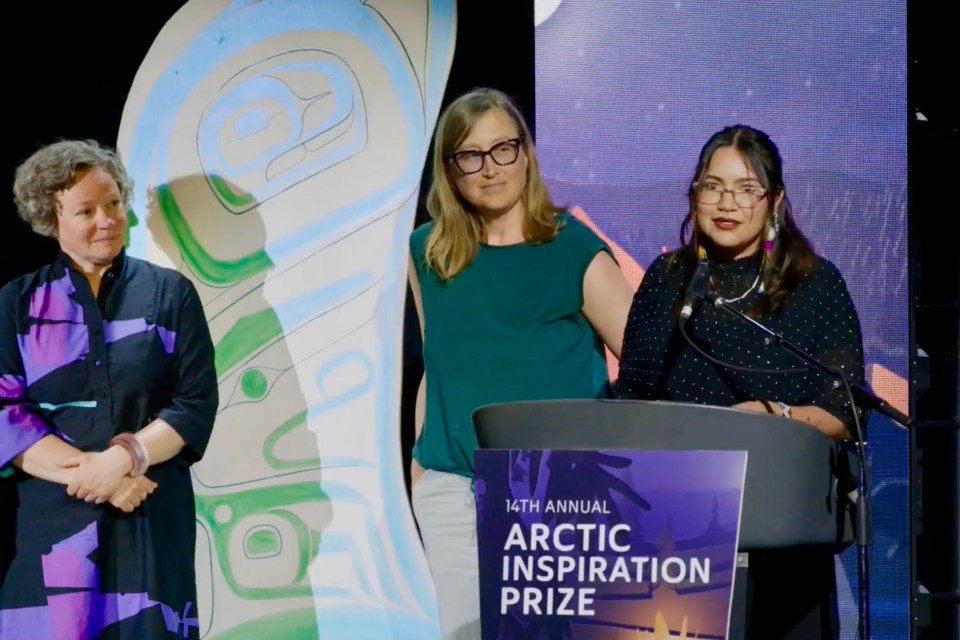
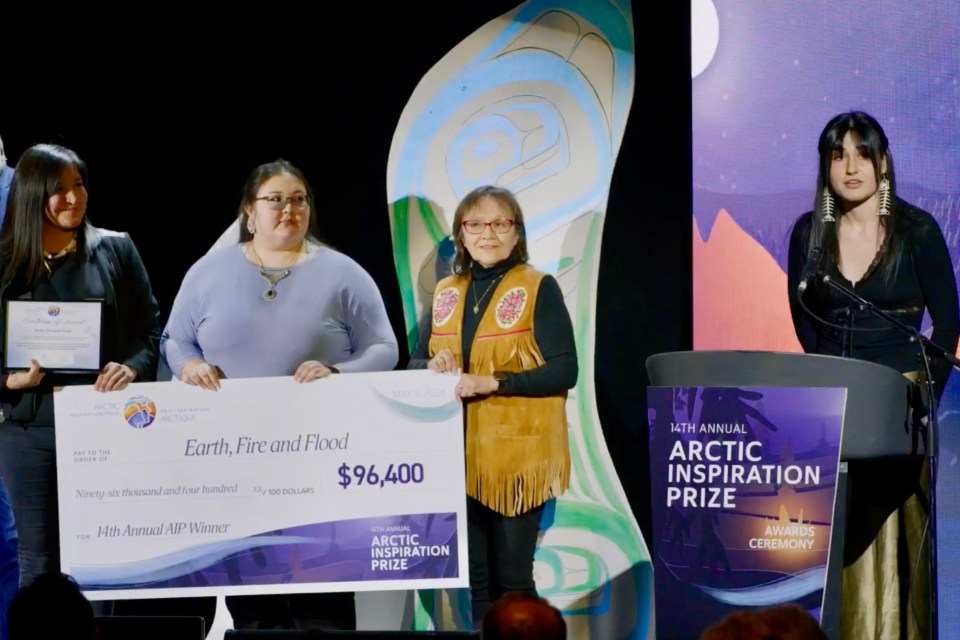
Łı́ı́dlı̨ı̨ Kų́ę́ First Nation member Shaznay Waugh, accepting $96,400 on behalf of the Earth, Fire and Flood project, set out why the work matters.
“When I was 14, I witnessed a wildfire for the first time in my life. The sky had a haunting orange hue that did not let any blue escape, and the smoke was so thick we could barely see in front of us as we walked,” Waugh said.
“I thought I would tell this story to my grandchildren and they would struggle to believe me, but these stories are becoming more and more common.
“A fear I share with members of my own community is that these will no longer be teachings we pass down to our grandchildren to warn them. Eventually, this will become their everyday reality.”
This year’s Arctic Inspiration Prize ceremony took place on Red Dress Day, also known as the National Day of Awareness for Missing and Murdered Indigenous Women, Girls and 2SLGBTQQIA+ People.
A moment of silence was held at the venue.
“While we are here tonight to acknowledge and to uplift and to celebrate [the Arctic Inspiration Prize], it is also important to acknowledge that just today, just outside, there’s a fire, people have been walking and gathering and creating together to draw awareness to missing and murdered Indigenous women and girls,” said co-host Kluane Adamek.
The Arctic Inspiration Prize, awarded for the first time in 2012, has grown into a sizeable annual contribution to good causes, overseen by a northern-based board and funded by the North’s companies and governments.
However, the 2026 ceremony marked a rare reduction in year-on-year funding announced, down from more than $3.7 million in 2025 to just under $1.4 million this year.
