


Advertisement.
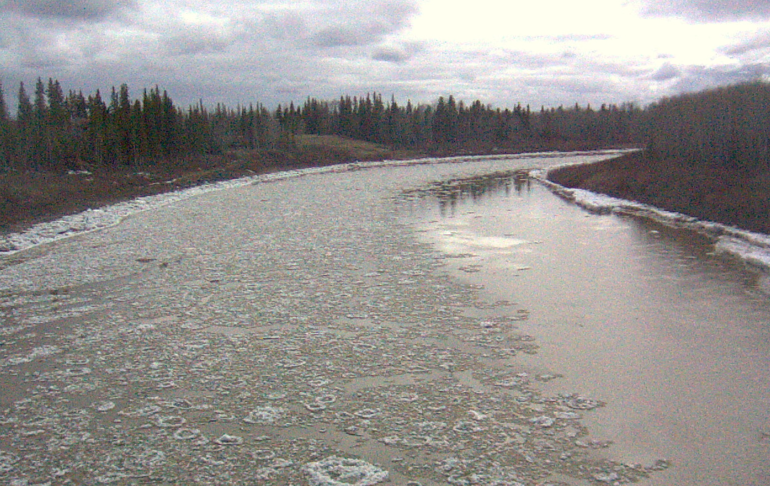
Remaining ice around Hay River is between Great Slave Lake and the downtown area, officials said in a Friday afternoon spring breakup update.
“Water levels appear to have peaked and levelled off at the Alberta/NWT Boundary Monitoring station earlier today. Water levels peaked at the low side of average historic values,” the town’s 2:30pm update stated.
The town said crews continue to monitor breakup with warmer temperatures expected to result in ice movement this weekend. Officials said breakup near the community is “progressing smoothly and efficiently, with no flooding.”
Residents can visit the Town of Hay River’s website for live cameras, water gauge data and preparedness information.
Advertisement.
Advertisement.
Meanwhile, in Jean Marie River, Chief Melanie Norwegian-Menacho told Cabin Radio on Friday “there are no threats to the community at the time.”
A GNWT water monitoring bulletin issued on May 7 said Mackenzie River water levels near Jean Marie River were rising slowly under the ice. Norwegian-Menacho said that increase has now stopped.
She said people will be monitoring the river overnight and during the weekend, advising residents to prepare emergency backpacks in case they are needed.
In its May 7 report, the GNWT said river ice remains largely intact upstream of Fort Simpson along the Mackenzie River. Water levels around Norman Wells were also rising while ice remained largely intact.
Advertisement.
Advertisement.
The GNWT said water levels are rising in the Peel River “earlier than normal” but ice remains intact near Fort McPherson.
Ice on the Arctic Red River has begun to break “with water levels rising rapidly and
satellite imagery indicating open water sections in the headwaters,” the GNWT stated.
Finally, water levels along the Slave River were reported to have risen earlier this week before returning to normal as of May 7.
