

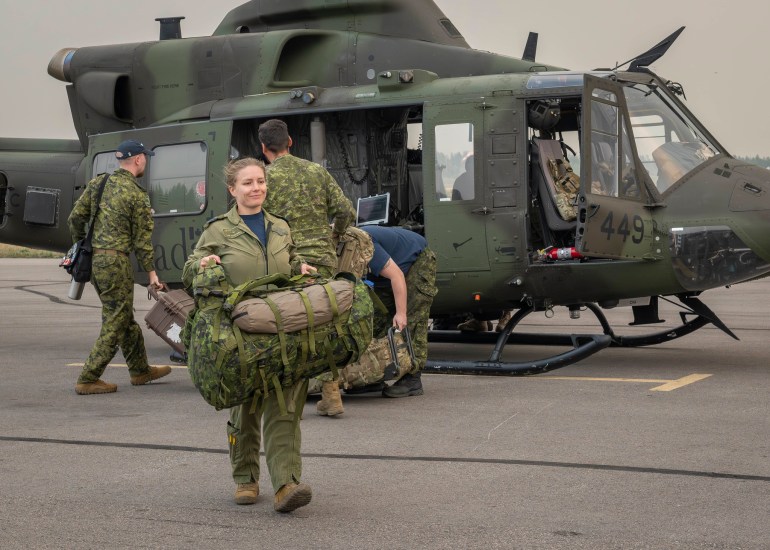
As military interest and investment in the North expands, so does the need for the armed forces’ oversight bodies to get a grip on life in northern Canada.
Mario Baril, the Department of National Defence’s ombudsman, has just finished a week-long trip to the Northwest Territories.
Baril’s office exists to ensure fairness in the way DND carries out its operations and treats its employees.
He’s been in the job since last summer. The past week represented his first trip to Yellowknife, meeting with organizations ranging from the Canadian Coast Guard to the Canadian Rangers.
“The realities of the North are so different than what we see in the south,” Baril told The North Today on Cabin Radio.
Advertisement.
Advertisement.
“Down south in Ottawa, we will hear about the international missions or what is going on in the south. Rarely do we have this opportunity to understand how difficult it is to be deployed in the North and deliver on these missions.”
Baril recently issued his first report since taking office. That report focused on fairness for reservists, plenty of whom are based in Yellowknife and across the North.
“I feel very strongly about this one,” said Baril, describing discrepancies in how reservists accessed healthcare and support when injured. Those issues were identified a decade ago but not acted upon, his office found. He has given DND until January 2027 to act.
“We discovered there is a little bit of a cultural divide between the regular forces and the reserve force,” he said.
Advertisement.
Advertisement.
“The cultural divide in the top ranks is certainly something that is worrisome. I really want, as an ombud, to ensure that the reservists are considered full members of the Canadian Armed Forces.”
Below, read the full transcript of our interview.
This interview was broadcast live on May 8, 2026. The transcript has been edited for length and clarity.
Ollie Williams: How do you define the job you do?
Mario Baril: We advocate for fairness. Government is so big and there’s multiple directives, policies and legislation. People get lost into all of this complexity of government. That’s where the ombud comes in. Fairness in decision-making is a key factor.
The complexity of CAF is just amazing. I’m still learning nine months later as to the complexity. Every time we have briefings and meet with CAF leadership or the deputy minister, I engage them on what we observe and how we could make substantive and long-lasting changes for the benefit of CAF members.
What brings you here?
I’m doing a national tour. One of the objectives is for people to be comfortable understanding our mandate and to create connections.
Advertisement.
Advertisement.
Up until now, I’ve done the easy ones from Ottawa – so I went to Petawawa, I went to Trenton. But then I thought: “We need to go to the North,” given the fact that there’s so much profile in the North right now in terms of investments and so on.
As the military is ramping up its spending, as it’s ramping up its work in the North, what kind of things will we see from you and your office?
The realities of the North are so different than what we see in the south. We hear a lot from our constituents that they feel the cost of living here is very different. Access to healthcare, access for their children to go into French school, the family situation, being able to get a job and so on. How we develop policy in the south should be sensitive to the North.
What has been the most useful is connecting with the Rangers, for example. In Ottawa, I wouldn’t have had that opportunity to connect with them. Now, I’m hearing what the lived experience is like for them in the wintertime, using their Ski-Doos in very harsh conditions.
What happens if that equipment breaks? How much compensation do they get for using their own equipment? This is just one of the concrete examples. If there were any issues of fairness where they feel compensation is not aligned to our realities and we require more policies tailored to the North, I think that’s so important.
Let’s take a real-world example about fairness. We have plenty of reservists in Yellowknife. Just recently, your office issued a report looking into issues that affect reservists in Canada and had done for 10 years. Virtually nothing had changed. Tell us about that.
I feel very strongly about this one, because this is my very first report. We knew of the issues 10 years ago, right? We were interested in finding out what would have been the barriers for not having this addressed.
We discovered there is a little bit of a cultural divide between the regular forces and the reserve force, where we often hear from our constituents that they do not get the same level of attention, they do not get the same level of policy reviews. So from that side, the cultural divide in the top ranks is certainly something that is worrisome. I really want, as an ombud, to ensure that the reservists are considered full members of the Canadian Armed Forces.
Advertisement.
Advertisement.
This was playing out in things like injuries, for example, right? And issues related to compensation when you get injured, where it was different if you were a reservist.
Correct. So in the case of access to healthcare, for example, we found out in many cases – through our individual investigations – that they were not receiving the same level of attention. The policies were not actually aligned to their needs.
We were told other priorities came along and there were financial issues. Now, we are in a different situation where the CAF has a lot of funding. I’m giving them a hard time frame. It’s not only a report card saying “you failed on these,” it’s a report card more to say: “We’ll give you until January to look into these matters.” January 2027.
And if they don’t do anything by January 2027, what powers do you have?
I have access. I’m the special advisor to the minister. I have access to the decision-maker on a quarterly basis and at any time. I also have access to parliamentary committees. I’ve never been afraid of speaking truth to power.
So I would say access to ministers, access to media, telling the media what is working, what is not working, but parliamentary committees as well, and then the report cards that we do on an ongoing basis.
Have you heard anything that’s changed your outlook at all in terms of understanding what DND does in the North, and what you might need to stay on top of here?
Upon my arrival on Monday, I got the JTF North to brief me on their operations. Just understanding the complexity and how it’s difficult and how they are challenged is very interesting.
Advertisement.
Advertisement.
Down south in Ottawa, we will hear about the international missions or what is going on in the south. Rarely do we have this opportunity to understand how difficult it is to be deployed in the North and deliver on these missions.
I think awareness from their side, knowing that the ombud’s office is there for fairness – but also for the ombud’s office to have a high level of awareness – is equally important in my point of view.
Some issues of fairness are systemic. They spread across different divisions, different departments, different geographic areas. But often fairness is very individual, and comes down to individuals experiencing something in a way they feel they shouldn’t. What do members of the military in the North need to know about when your office can help them and what they should do?
If in doubt, always communicate proactively with our office. We have seven, eight people that are receiving around 3,000 calls per year. When in doubt, call us.
Often people will say it’s an office of last resort. I like to use a different message. Let’s be proactive here. If there’s something that you feel is not right, give us a call and we’ll support you.
