


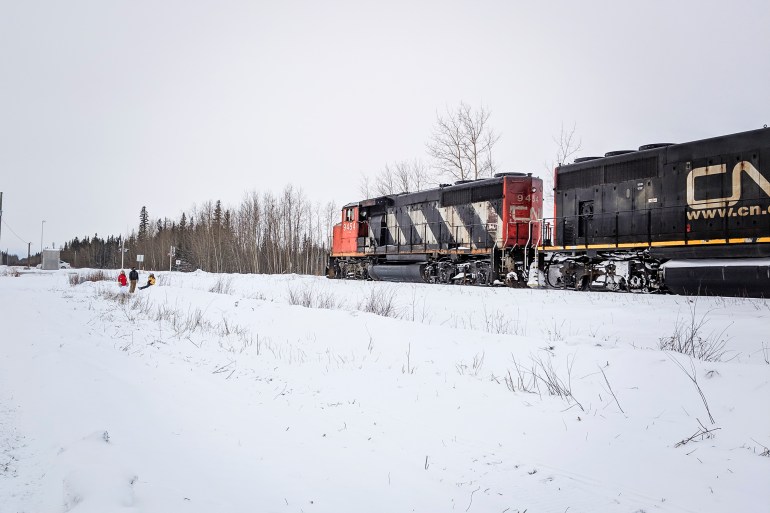
The GNWT is still fighting to have the Federal Court of Appeal force CN to reopen the Enterprise-Hay River rail line, which has been damaged and out of use since the 2023 wildfires.
While CN repaired the line from Alberta to Enterprise after those fires, it declined to fix the remaining 35-kilometre section from Enterprise up to Hay River, which had previously been a major rail hub for cargo – especially fuel – headed by barge to communities along the Mackenzie River.
Without a working rail line to Hay River, a cargo facility in Enterprise has become the new hub. Freight must be trucked to Hay River or other destinations from Enterprise.
When CN refused to comply with a GNWT request to change its mind, the territorial government took the company to the Canadian Transportation Agency, an independent tribunal. The GNWT argued CN had failed to meet its obligations under federal law and had a duty to maintain the line all the way to Hay River.
However, the CTA sided with CN.
Advertisement.
Advertisement.
Now, having been granted leave to appeal the CTA’s decision, the GNWT is arguing in the Federal Court of Appeal that the tribunal got multiple things wrong.
A one-day hearing is anticipated some time this summer.
Here’s a rundown of the main arguments the GNWT is advancing and how CN responds. (The CTA has declined to defend its verdict, telling the court it will not participate in the appeal.)
CTA ‘didn’t strike reasonable balance’
The GNWT argues prior case law had established that the CTA, as a tribunal, must strike a “reasonable balance” between the interests of the rail company and the other parties in a case like this.
Advertisement.
Advertisement.
In particular, the GNWT cited a case – Rosner v Hudson Bay Railway Company – that established one important criterion of this balancing exercise: whether the cost of repairs was “patently disproportionate.”
The GNWT says the CTA’s decision applied the “patently disproportionate” test in relation to the financial viability of the Hay River line, whereas the law intends for the phrase to relate to the viability of the entire railway company. (CN has lately reported profits of about $1 billion every three months. The cost of repairing the Hay River line was estimated to be $16 million.)
In his submission, GNWT lawyer Thomas Wallwork calls the CTA’s interpretation of this “absurd.”
“The financial aspects of ‘reasonableness’ are concerned with preventing rail carriers from being forced into bankruptcy, not protecting their profit margins,” he writes.
In its response, CN disputed that the existing case law suggests “the only relevant financial consideration is the financial capacity of the railway.”
The company says the CTA “did not fail to conduct the requisite balancing exercise, as alleged by GNWT. GNWT simply does not agree with the result of that balancing exercise.”
Was there a lack of traffic?
Much of the CTA’s decision rests on whether or not the line had enough – or any – traffic.
CN had argued that two shipping companies made up almost all of the traffic on the line before the wildfires. After the fires, one company said it was fine shipping to Enterprise instead of Hay River.
Advertisement.
Advertisement.
The CTA ruled that the GNWT hadn’t provided any evidence that anyone was offering to send freight via rail to Hay River any more. (If nobody is trying to use the line, why rebuild the line?)
In its appeal, the GNWT says this makes no sense.
“The reason no traffic could be offered is precisely because CN failed to repair the destroyed Line. Shippers are not unwilling or unable to tender traffic for their own reasons; rather, CN had made it physically impossible to do so by leaving the line inoperable,” the GNWT contends.
“The CTA’s approach creates a circular standard: because CN did not repair the line, no traffic could be offered; and because no traffic was offered, CN’s service obligations were not triggered.”
The GNWT says the CTA decision ultimately “penalizes shippers for failing to perform an apparently impossible act.”
CN says traffic on the line was already down to 3,000 rail cars per year before 2023 and would be expected to halve to 1,500 cars if the line was reopened.
Kristen MacDonald of law firm MLT Aikins, representing CN, writes that the CTA’s decision “flowed directly from a lack of supporting evidence [that any traffic was being offered]. In short, these are factual determinations and are not subject to appeal.”
The discontinuance timeline
Rail companies looking to stop operating a line have to go through a process known as discontinuance. This involves various public notices, discussions with affected parties and opportunities for possible buyers to come in.
Advertisement.
Advertisement.
The GNWT and CN dispute how long the discontinuance timeline should be for the Hay River line.
The timeline matters because it has implications for aspects of the CTA’s ruling. The CTA had concluded: “It would be unreasonable to require CN to repair the Line to provide service for, at most, a matter of weeks before the [discontinuance] process is completed.”
But if the CTA got it wrong in accepting CN’s calculation of the discontinuance timeline, and there were actually months still to go, this would challenge the CTA’s rationale.
The GNWT says the last expected day of the discontinuance process should have been March 29, 2026, not the date given by CN of November 28, 2025.
CN disputes this, saying the November date should stand and the GNWT’s calculations are wrong.
Can the court order CN to reopen the line?
The GNWT submits that the CTA was wrong on “disproportionate” repair costs, wrong on the traffic issue and got the discontinuance timeline wrong.
The territory argues that as a result, the Federal Court of Appeal should skip sending the case back to the CTA for a fresh go-around and should instead simply order CN to reopen the Hay River line.
Wallwork writes that the appeal court already has all the information it needs.
Advertisement.
Advertisement.
“This Court is in as good a position as the CTA to judge whether CN breached its level-of-service obligations, as well as the appropriate remedy to apply,” he states.
CN argues the Federal Court of Appeal has no power to compel the company to reopen the line, not least because the CTA split the issue into two parts – was CN in breach of its obligations and, if so, what the remedy should be – and only ever ruled on the first part, meaning there is no remedy for the court to review.
More broadly, CN asserts there is basically nothing anyone can do now to make it reopen the Hay River line.
“Neither the [CTA] nor this Court have the power to prevent a railway from discontinuing its lines, nor to order a railway to resume operating a line following discontinuance,” MacDonald writes.
CN maintains the line was fully discontinued as of late last year.
The GNWT says that can’t be allowed to stand.
“Some remedy must flow for the failure to meet level-of-service obligations at the time of breach,” Wallwork writes.
“Otherwise, the statutory rights of shippers and northern communities are rendered illusory and the regulatory scheme is deprived of meaningful effect.”
