


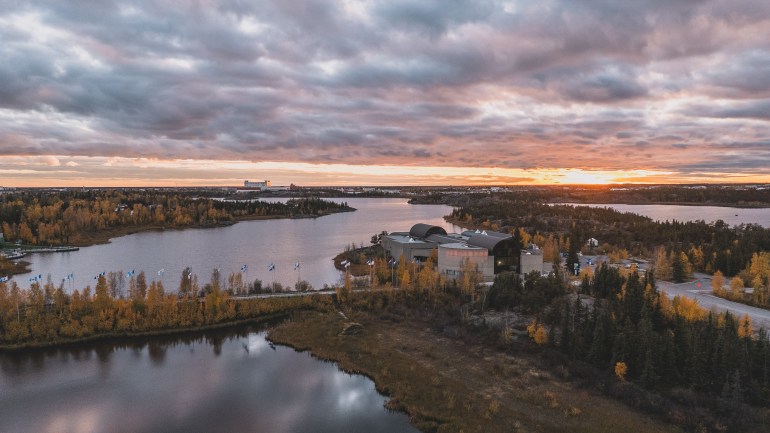
The City of Yellowknife and GNWT say they’re trying to work together to speed up the process by which the city gets access to fresh land for development.
For years, the city has said the GNWT needs to hand over land more quickly. The territory says the delays aren’t its fault.
Mayor of Yellowknife Ben Hendriksen asked MLAs during a public briefing last Thursday for three things:
- the transfer to the city of commissioner’s land referred to as the Frame Lake parcel;
- increased access more generally to commissioner’s land, which is public land held and administered by the GNWT; and
- a “coordinated, time-bound process to move this work forward.”
“The city’s ready to move. The limiting factor is the land,” said Hendriksen.
But environment minister Jay Macdonald said the territory can’t go ahead with the Frame Lake land transfer until it receives a formal recommendation to do so from a committee comprising representatives of various levels of government.
Advertisement.
Advertisement.
This group, known as the Capital Area Committee, oversees development in the area near the Legislative Assembly – which includes much of Frame Lake. The city, GNWT, RCMP, Department of National Defence and Indigenous governments are represented on the committee.
In an email to Cabin Radio after this article was first published, Hendriksen said neither the terms of reference for the committee or a city by-law require a recommendation from the committee before the GNWT can transfer the land around Frame Lake.
Nathen Richea, assistant deputy minister at the Department of Environment and Climate Change, said during the briefing that because of a memorandum of agreement signed between the GNWT and the City of Yellowknife, the GNWT “would wait for that recommendation to proceed.”
Richea said the committee’s recommendation is delayed as consultation continues among its members.
Advertisement.
Advertisement.
Macdonald said the GNWT and city developed a bulk land transfer model to speed up the transfer of vacant commissioner’s land, saying that model has been used in Yellowknife to transfer land in Niven and Grace Lake.
Land supply ‘exhausted’
The city wants speedy access to the Frame Lake area because it forms a central pillar of a new-look community plan that would turn the land north of the lake into 1,000 new homes.
Hendriksen, who spoke ahead of Macdonald at the public briefing and was not asked about the committee and its recommendation, said 59 percent of the land within the city’s boundaries is considered unavailable for development because it is owned by the federal government or is contaminated, among other reasons. He said all but one percent of remaining land is commissioner’s land.
“The city has made every effort to maximize the land we do control,” said Hendriksen, citing subdivisions in Grace Lake, Niven and Hall Crescent nearing completion and fully sold, ongoing infill development, and vacant land and building bylaws.
He said the current supply of land is “exhausted” and the city expects to need at least 65 hectares of residential land, 17 hectares of commercial land, and 89 hectares of industrial land. (Some of these numbers are higher than the areas an August 2025 growth projections report said the city would need in a “high growth scenario.”)
According to Hendriksen, the land around Frame Lake would offer the city 24.6 hectares of developable land. He said the city considers it a priority to not only expand housing and infrastructure, but also increase access to the Frame Lake Trail.
To ensure the city is ready to develop around Frame Lake if the land transfer application is approved, Hendriksen said the city is already designating land around Frame Lake in its community plan, is engaging with Indigenous governments, and technical and environmental assessments are in progress.
