


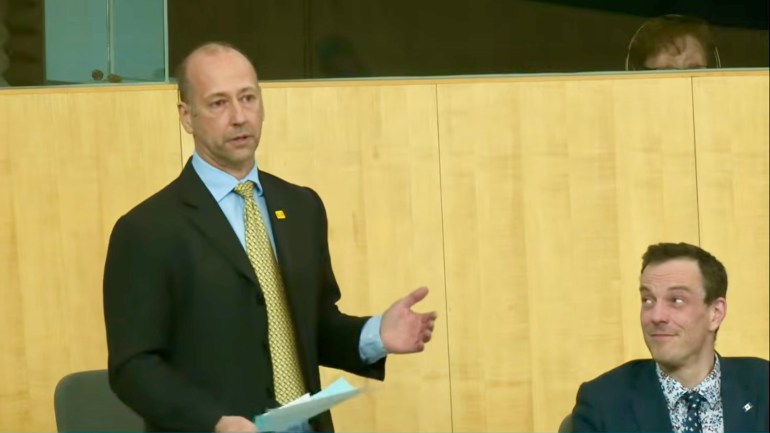
Several regular MLAs passed a motion calling on the NWT government to develop and fund a comprehensive territorial crime reduction strategy to address “serious and evolving criminal activity.”
Introducing the motion, Yellowknife Centre MLA Robert Hawkins, described it as “a call to reclaim our neighbourhoods in some ways, our communities, our families, to strengthen them.”
“We need one strategy, one budget, one goal,” he said. “The safety of our people matter.”
Hawkins said the motion was created based on feedback he and Range Lake MLA Kieron Testart gathered at public safety town halls they organized in Yellowknife, advice from the RCMP and “technical expertise” at the legislature.
Testart said he felt the motion “addresses the full continuum” of public safety issues from “root causes all the way to the symptoms.”
Advertisement.
Advertisement.
Beyond a crime reduction strategy, the motion asks for territorial supports for northern youth, increased community policing capacity, bail reform advocacy, the establishment of a permanent residential addictions treatment facility, and legislation to license and regulate private security companies.
Inuvik Boot Lake MLA Denny Rodgers said while the motion was ” not the be all and end all,” he supported any effort to reduce crime.
Sahtu MLA Danny McNeely similarly said he supports any opportunity to advocate for addressing and minimizing drug addiction in the NWT.
“It’s just beyond a crisis and we need every ounce of reflection and support from this government to address that,” he said.
Advertisement.
Advertisement.
Mackenzie Delta MLA George Nerysoo, Dehcho MLA Sheryl Yakeleya and Monfwi MLA Jane Weyallon Armstrong also expressed support for the motion, highlighting the impacts of addiction and drug-related crime on communities.
Frame Lake MLA Julian Morse said while he had some reservations, he supported calling for the NWT government to summarize and assess its crime reduction tactics. He said if the government determines a territorial strategy would help with crime reduction, he wants to ensure it is evidence based.
Morse said increasing resources to address the root causes of crime is “the ultimate solution”
“Reducing poverty, increasing education rates and literacy rates, these are the things that help people come on the path to a productive life,” he said.
‘Meaningful action and not rhetoric’
Not everyone agreed Hawkins’ motion was the right approach to addressing crime in the NWT.
Yellowknife North MLA Shauna Morgan said while she agreed with many of the actions proposed in the motion, she did not think “mashing them all together haphazardly into one crime reduction strategy is actually going to make any meaningful difference to reduce crime.”
She said the motion failed to “come to terms” with how to deal with people involved in the illicit drug trade who are from the territory, as it focuses on “southern-based criminal gangs.” At the recent public safety town hall organized by Hawkins and Testart, RCMP said 40 percent of people charged with drug trafficking in the NWT are from down south.
Morgan said she was also not clear on what regulating the private security industry, which largely deals with loitering and trespassing, has to do with stopping violent crime or gang activity.
She said referring to crime and public safety so broadly fails to include the high rates of family violence, intimate partner violence and sexual violence in the territory.
“I don’t believe it’s helping to continue talking in broad, sweeping terms about crime in general without defining the problems we’re trying to tackle, with only vague ideas about who the bad guys are or appear to be and how to get them out of here,” she said.
Great Slave MLA Kate Reid also criticized Hawkin’s motion as “disjointed and confusing” and said she could not support “something just for the sake of doing something without measured evidence-based actions.”
She said no standing committee had conducted “thoughtful oversight” into the territory’s current crime reduction approach.
“The people of the NWT deserve meaningful action and not rhetoric,” she said.
Reid pointed to comments NWT RCMP Chief Superintendent Dyson Smith made at the recent town hall, including that if there was greater investment in mental health and addictions supports, he would support reducing policing.
‘We need to push and push on this file’
Hawkins said he felt the MLAs who did not support his motion had “put a lot of time and energy to pick it apart.”
“Okay, if that’s what you’re here to offer,” he said.
Advertisement.
Advertisement.
Hawkins seemed particularly unhappy with the comments Reid shared from the RCMP saying “they are facts, but they’re not the only facts.”
Regarding his motion, Hawkins said he felt it would be “better to get something on the table and work with it than to sit here and do nothing.”
“Even if it doesn’t work out, we need to push and push on this file,” he said.
The motion passed with eight MLAs voting in favour and two opposing.
Cabinet members abstained from voting on the motion, as is their usual practice for motions made by regular MLAs. Abstaining gives the NWT government 120 days to respond to Hawkin’s motion.
Motions proposed by regular MLAs are not binding on the government meaning they are often largely an opportunity for MLAs to discuss issues and state their positions in the legislature.
