


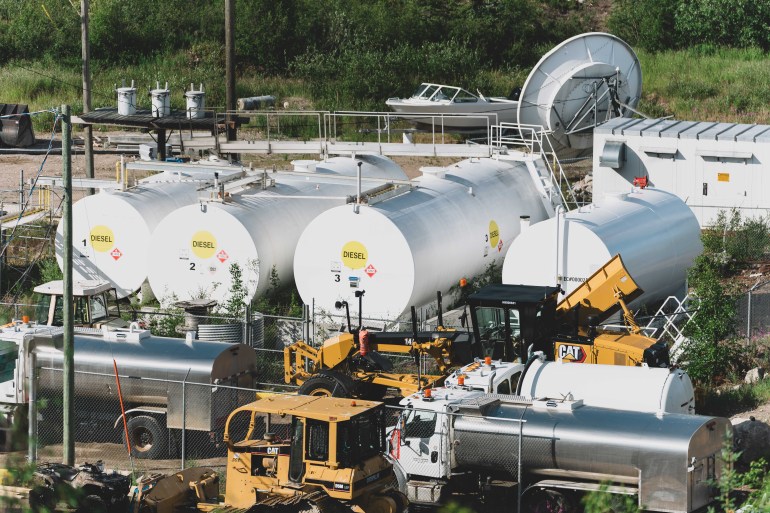
The latest GNWT fuel price list helps illuminate how the cost of gasoline and home heating is changing in some of the North’s more isolated communities.
Globally, fuel prices have spiked after the US-Israel-Iran war shut off access to the Strait of Hormuz, a critical supply route.
However, that doesn’t automatically mean prices across the NWT are continually rising.
Updated fuel prices published by the territorial government this week show big increases in some communities, while prices hold steady or even drop slightly in others.
The GNWT publishes these lists a few times a year because there are 16 communities in the territory where no private-sector firms offer fuel. Instead, the territorial government manages the purchase, transportation and storage of fuel.
Advertisement.
Advertisement.
Most of those communities are isolated and have no year-round road access.
Once major resupply operations are complete – by winter road, for example, or via summer barge – the GNWT issues a new price list adjusted for the cost of bringing in the fuel.
This week, for example, the GNWT stated: “Prices have been updated in Colville Lake, Délı̨nę, Gamètì, Jean Marie River, Nahanni Butte, Sambaa K’e, Tsiigehtchic, Tulita, Wekweètì, Whatì, and Wrigley to reflect the cost of fuel delivered through the 2026 winter resupply program.”
We put the current per-litre prices of gasoline and home heating fuel up against prices from July 2025 and February 2026 to see how things have changed. (Some prices were also amended in April.)
Advertisement.
Advertisement.
The first chart shows gasoline prices at four points in the past year.
Unsurprisingly, communities in the high Arctic have the costliest gas, though prices actually came down for Paulatuk and Sachs Harbour between February and April. These communities saw no changes to their fuel prices this week, alongside Fort Good Hope, Łútsël K’é and Ulukhaktok.
Colville Lake, Gamètì and Tsiigehtchic all saw their gas prices climb by more than 20 cents per litre since April.
In the latest update, prices held steady in some communities and dropped slightly in Tulita and Sambaa K’e.
Overall, the figures show about a third of the NWT’s communities are paying more than $2.00 per litre for gas. (Some aren’t shown in this list because they’re served by the private sector.)
Home heating fuel prices show more pronounced changes for some communities.
Gamètì residents, for example, were paying $1.97 per litre for home heating fuel until the latest alterations. That has now increased by 56 cents per litre to $2.53, a 28-percent hike.
The increases for Wekweètì and Wrigley are not far behind, while residents of Jean Marie River and Whatì are paying 30 to 40 cents more per litre than they did in February.
Advertisement.
Advertisement.
Overall, one of the biggest increases came in aviation fuel. Jet A-1 fuel in Délı̨nę will now cost $2.95 per litre, up from $2.04 per litre in February, a 44-percent increase.
“Wholesale prices for petroleum products increased during this resupply season, in some cases considerably, necessitating retail price increases for some fuels,” a spokesperson for the NWT’s Department of Infrastructure told Cabin Radio in a statement.
“Additionally, in the case of jet fuel, it was important to benchmark pricing to be consistent with nearby communities where jet fuel is available (Norman Wells and Yellowknife) to ensure supply availability in Délı̨nę for community needs until the next resupply season.”
Having said in February that the next price changes would come in July, the GNWT has now issued updated prices in both April and June.
“Pricing changes are always completed as soon as possible following community resupply,” the spokesperson said.
“In this instance, a smooth winter resupply program that concluded a little earlier than usual allowed for the pricing calculations and the price change work to be completed sooner than planned.”
The full price lists by community are on the GNWT’s website.
