


Advertisement.
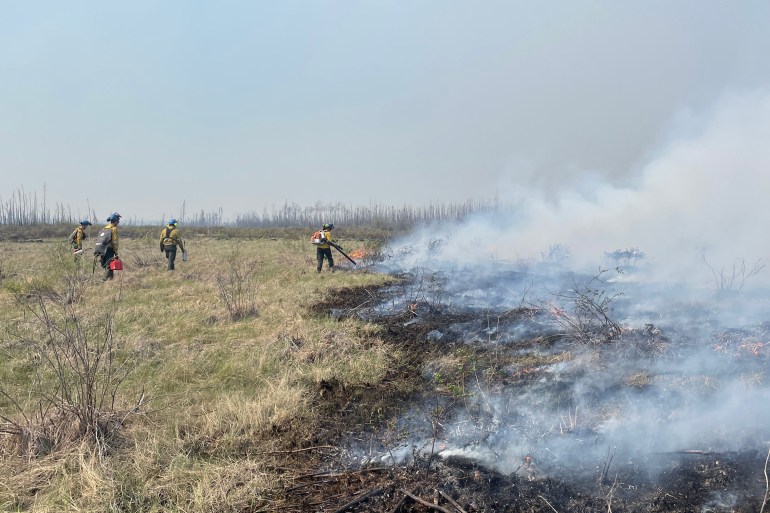
While a wildfire grows near a whooping crane nesting area in Wood Buffalo National Park, one park ecologist says it may only threaten a small number of birds.
Nicolas Comerford, ecologist team lead in the Wood Buffalo National Park, said his team was about halfway through its annual whooping crane nest survey when a wildfire broke out near the nesting areas.
The lightning-caused fire, which has been burning for the past two weeks, is estimated to be 46,674 hectares in size as of Wednesday evening, according to Parks Canada. By Thursday it had crossed the park border into the broader NWT and is now known as the Klewi Complex.
The survey, which counts and maps nest locations to track population growth over time, found 118 nests in the Greater Wood Buffalo Range. This is up from 115 in 2025 and a new record for the survey, Comerford said.
Advertisement.
Advertisement.
He said there were only a small number of nests close to the fire perimeter.
“We don’t have confirmation yet on whether those nests have been truly affected by the fire,” said Comerford.
“Because the fire operations are ongoing and pretty important right now, it’s difficult for us to get in there and actually check.”
He said his team has been liaising with fire crews and sharing the location of the nests so they can avoid disturbing them.
Advertisement.
Advertisement.
“It’s important to note, whooping cranes have evolved with fire on the landscape. Whether this will affect a very small number is possible, but it’s currently unknown,” said Comerford.
He said wildfires, which are common in the Wood Buffalo area, help to maintain the cranes’ habitat by preventing forests from encroaching on wetlands and drawing out water from those areas. Additionally, fire helps preserve long sight lines the cranes tend to prefer, which gives them more time to see and respond to possible predators.
“When the fires are actively burning, there’s potential for health effects from the smoke, and theoretically there can be potential for fire to get to a nest, [but] we don’t have any evidence of that ever taking place,” said Comerford.
He said he hasn’t observed any unusual whooping crane behaviour.
“From what we’re seeing, they’re still found around the fire perimeter, they’re still living their lives and they’re still foraging, as would happen naturally,” he said.
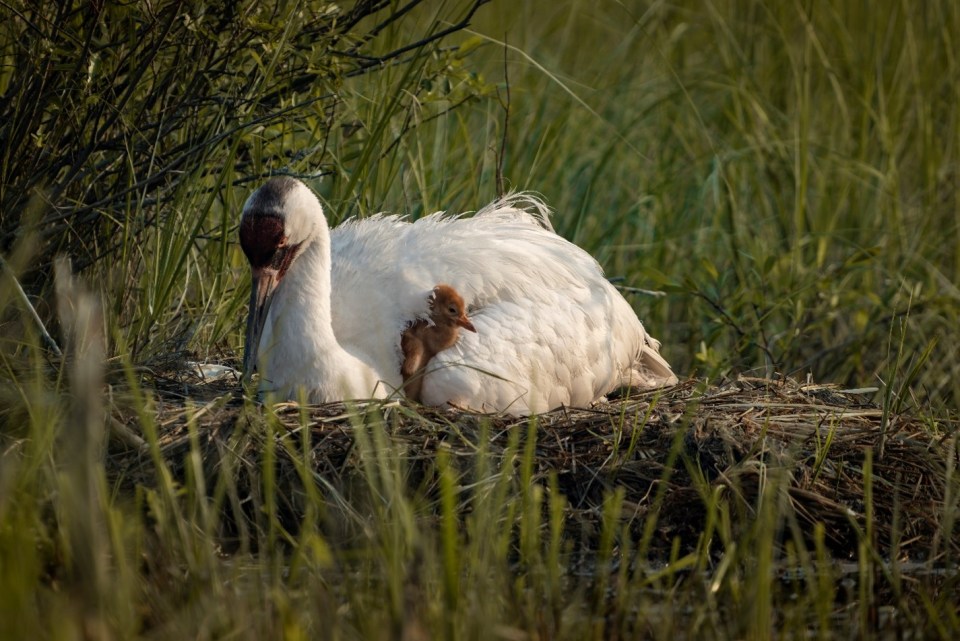
Data collected during fieldwork in 2023 seems to indicate fire may not have a significant impact on cranes in the area.
“We had one crane that was relatively close to some of the fires, and they still managed to raise their young and to hatch the eggs,” said Comerford.
He said the ecology team has installed cameras at about 90 nests, including some near the current fire perimeter, which he said will help inform research on the factors that influence cranes’ ability to raise their chicks, including fire.
Advertisement.
Advertisement.
Low water ’cause for concern’
Comerford said that while the fires in the area may not be a great threat to the birds, low water levels observed during the annual survey could pose a problem for the endangered species.
“Even though we had pretty good snowpack this winter, a lot of that snow either evaporated, sublimated away, or ended up in our rivers,” said Comerford.
“We’re seeing early fire behaviour with climate change and if you pair that with low water levels on the land, there’s a bit more cause for concern regarding nesting cranes in that sense.”
He said shrinking wetlands in the Prairie Pothole Region due to human development, in addition to overhunting and egg collection, are responsible for the near-extinction of the species.
Cranes rely on food from wetlands and higher water levels can help deter predators, Comerford said.
“We do know that whooping crane productivity – the number of chicks that survive post-hatching – is correlated to the amount of water on the landscape,” he said.
Water levels across the NWT have dropped since an “exceptional” drought began in 2022.
“If we have persistent low water levels over quite a few years, this could be a sign that maybe the system is changing and we need to potentially change the way we manage the species at that point,” said Comerford.
Advertisement.
Advertisement.
Parks Canada is actively looking at how climate change might be changing environmental conditions in Wood Buffalo National Park, Comerford said.
Whooping cranes, the tallest birds in North America, are celebrated annually in Fort Smith (though the inaugural festival was postponed in 2023 due to wildfire).
The birds nearly went extinct, with their population plummeting to only 21 animals in 1941, before eventually rebounding with the help of captive breeding programs and researchers using ultralight aircraft to teach young cranes migratory routes. (Think Fly Away Home, but with cranes instead of geese).
Today, the Wood Buffalo whooping cranes are the only wild migratory population.
The birds are also celebrated every year in Port Aransas, Texas, where they spend their winters.
