

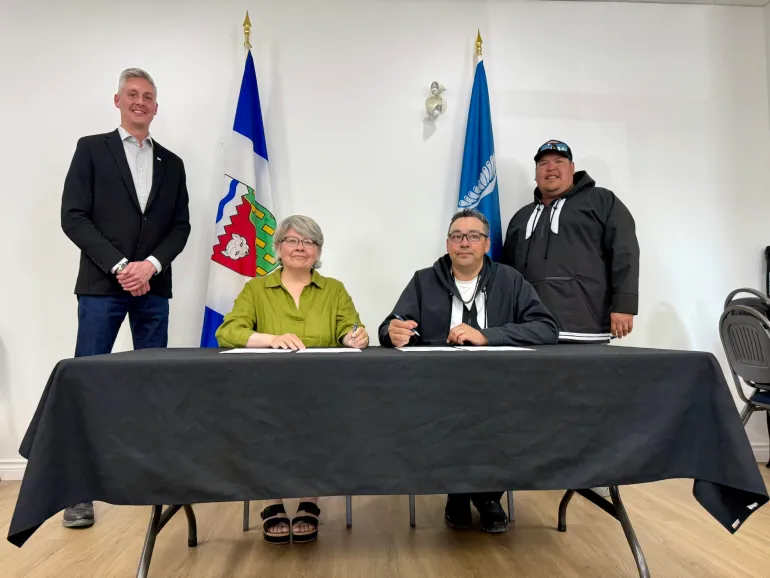
The NWT government and Inuvialuit Regional Corporation held their most detailed meeting in years on Thursday while committing to a new housing agreement.
Thursday’s bilateral meeting – meaning a formal government-to-government discussion – was the first of its kind between the GNWT and IRC in about a decade, Premier RJ Simpson told Cabin Radio.
Both sides came out of the meeting saying they might not wait one year for the next conversation, never mind 10.
“We have this relationship now that we can send a text or give a phone call to each other,” said IRC Chair Erwin Elias.
“We may have it written that it would be annual or something of that nature but, at the end of the day, we spoke a lot about how we don’t have to wait for these meetings to happen any more, and we can connect tomorrow or next week or whenever we feel like it.”
Advertisement.
Advertisement.
Asked if it felt like a reset in relations, Simpson replied: “Yes.”
Describing what had changed, the premier said Chair Elias – elected at the start of the year – had been “very open” to conversations, while the two had worked together on a Tuktoyaktuk school renovation when Elias was the hamlet’s mayor and Simpson the education minister.
“I knew that he was very collaborative, always came with solutions as opposed to just complaints, and so I was really looking forward to the meeting,” said Simpson. “And it didn’t disappoint.”
Elias said he believes the relationship “is going to be really meaningful to the Inuvialuit and to the GNWT.”
Advertisement.
Advertisement.
‘Working together’ on housing
Inside an Inuvik hotel conference room, the governments used the meeting to sign a memorandum of understanding on housing.
The agreement covers collaboration on the planning, building, maintenance and repair of homes, data sharing, and improvements to programs and services.
Through the MOU, a housing working group featuring IRC and Housing NWT staff will be established.
The GNWT said it has previously signed similar agreements with the Tłı̨chǫ Government, Sahtu Secretariat, Délı̨nę Got’ine Government, Gwich’in Tribal Council and Acho Dene Koe First Nation.
Elias said the housing agreement would ensure the two governments don’t duplicate each other’s work while trying to roll out much-needed new homes or improvements to repair and maintenance programs.
“We were working in silos and now we’re going to be working together,” said NWT housing minister Lucy Kuptana.
“I think the Inuvialuit have been leading on the housing space in the last number of years, but doing that as a singular.”
Now, Kuptana said, Housing NWT will focus on public housing retrofits and improvements, while the IRC will look at the broader picture across the six Inuvialuit communities.
Advertisement.
Advertisement.
“[Let’s say] so-and-so in Paulatuk needs a new ramp for their private home. How can we both contribute to making this a reality for this individual, for this Elder?” Kuptana said.
“People or organizations sometimes don’t talk to each other, and that sometimes causes bureaucracy pile-up. I just want to reduce red tape.”
Simpson said other topics at the bilateral ranged from child and family services to collaboration on legislation and how the IRC can better access materials like gravel for the pads beneath buildings.
Even so, he focused on the housing agreement as a major development.
“We’re going to make sure we are not stepping on each other’s toes,” Simpson said.
“If there’s work happening in one community by one government, maybe the other government focuses on a different community, so we can make sure we’re doing things as efficiently as possible.
“I think that’s an area where we’re going to see a lot of progress in the next couple of years, because of this meeting.”
