


Who’s eligible for evacuee financial supports in the NWT? What does “as soon as possible” mean in terms of receiving a payment? How have things changed since 2023?
It’s three years since the NWT, deep in a wildfire-driven crisis that saw a dozen communities evacuated, found itself having to think through what evacuees need – and what it could afford.
People who fled their homes that year will remember initial days where nobody seemed to know precisely what was available and policies seemed to be invented on the fly to cope.
Now, in 2026, the evacuee financial support system has a couple more years of evacuations under its belt and is being offered to residents of Fort Simpson and Wrigley, who are being hosted in Yellowknife and Fort Smith respectively.
The main GNWT evacuee financial support page is here. That page will help you claim the $800 available to adult evacuees and the $400 per dependant.
Advertisement.
Advertisement.
We sat down with Bill MacKay, the NWT Department of Finance’s deputy minister, to better understand some of the payment system’s rules and timelines – and how it has changed.
This interview was recorded on June 30, 2026. The transcript has been lightly edited for clarity.
Ollie Williams: Broadly speaking, what is available to people right now?
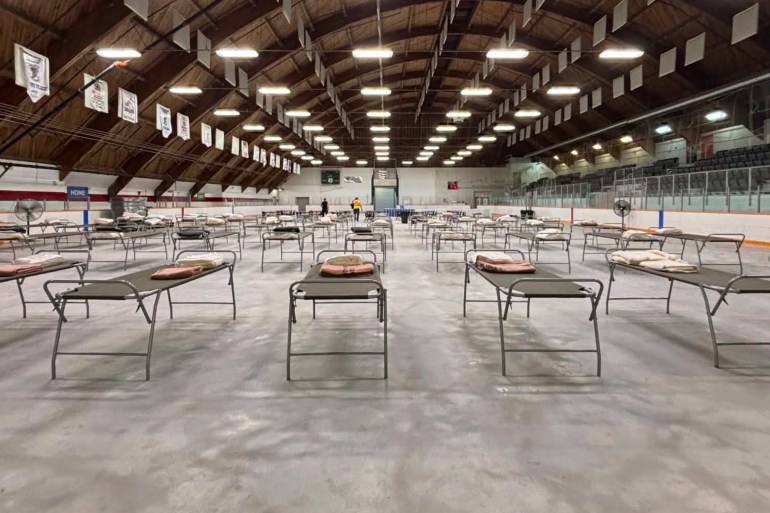
Bill MacKay: The government as a whole provides that if you’re under an evacuation order, you can go to the evacuation centre, where you’re provided lodging as well as food, so you get the basics and necessities there.
Advertisement.
Advertisement.
You also receive, from the Department of Finance, the Emergency Evacuation Relief Program. That is for eligible residents – you get $800 per adult and $400 per dependant under 18, so that’s just a flat payment. It can be used to offset expenses you may have expended for temporary accommodations, food, groceries, fuel, and any other expenses. It’s not meant to offset all costs, but it’s meant to help people that are under stressful situations.
What does “eligible resident” mean? I’m sure it means you have to have been living in a community that’s under an evacuation order, but is there anything more to it?
You have to have been evacuated from your home community due to an official evacuation order, so if you leave before an evacuation order has been issued, you’re not eligible. And you have to be registered as an evacuee with your community government.
Many residents and communities that have been evacuated are familiar with that process, but in a community that hasn’t been evacuated before, they should talk to their community government to find out how to be registered.
Next, you have to live in the Northwest Territories and demonstrate your residency, so that can be done in a number of ways – your driver’s licence, your utility bills, anything that can prove you have a residence in the Northwest Territories.
Finally, if you’re submitting expenses through your insurance – many people have house insurance and are able to submit expenses if they’re subject to evacuation orders and forced to leave their house – you’re not eligible for the evacuation payment.
I can understand why some people might end up leaving before an official evacuation order is declared. I understand why the government has a rule in place that says if you left before an order, you can’t claim this. What I’m not sure about is how on earth the government would know.
You have to register as an evacuee, so you can’t register as an evacuee unless there’s an evacuation order. So that’s basically how the government would know.
Advertisement.
Advertisement.
You could have left the community before the evacuation order, and subsequently registered as an evacuee though, couldn’t you?
Yeah, and that would be fine. You just can’t make your own decision to evacuate and ask for the assistance until there is an evacuation order. So if you’ve left your community and there’s an evacuation order, then you can go onto the portal.
I see what you’re saying. In other words, you can’t declare your own evacuation in the absence of the broader community doing so.
That’s right.
That makes more sense now. The GNWT has obviously had a lot of practice at this – we’ve had a lot of evacuations. What happens to refine the system each year? Are there tweaks being made to this?
We do an internal evaluation of the program after each year. You’re right, we are getting used to this. It’s the fourth year in a row we’ve done some iteration of this program, so what we’ve really tried to focus on is the feedback we’ve received from residents.
First of all, we had a program that was specific to specific losses like lost income or specific accommodation requirements, those kinds of thing. We’ve made it more simple, or more broad, so you can use that $800 basically for anything. We don’t ask for any proof of using that money or require it to be used for any specific purpose – it’s just to offset additional expenses that we know the evacuees have. So we’ve made it simpler that way, in terms of the types of things it can be used on.
The other thing we’ve done is we’ve expanded the ways that you can apply for it.
Advertisement.
Advertisement.
Originally – in 2023, when Yellowknife was evacuated along with some other communities like Hay River, Fort Smith – that was a big evacuation. We had to set this program up on the fly. It was mainly done through the web portal. We did have some in-person applications at evacuation centres, but as time went on, we realized that the portal is probably the simplest way to get your application processed, and the simplest way for the government to process the application.
But there are many people who for whatever reason had to leave in a hurry, or they are under stress or don’t have access to the internet, who need assistance in applying for this. So we have stepped up the number of people we send to evacuation centres and really try to assist residents where they are. We’ll focus on the people who are most in need to ensure that they get their applications in right away after they arrive.
We’re always open to continuing to improve, so I would encourage people that are accessing the program to let us know how it is going. But we are really hoping this can be a simple program where you put in your application and you get paid within two days, and that will help you weather the additional expenses of evacuation.
I think you’ve answered my last question there, which was going to be: I know the website says you get paid as soon as possible. Is two days the benchmark that you aim for with that?
We don’t have a service standard per se. We do aim to be as quick as we can. I would say the majority of people in the past have been paid within two to three days. There have been people that have waited up to two weeks, just for different reasons.
This is a program that the government runs – thankfully – only during certain periods of time. So most of the people that are working on the program have other jobs and, if there is a big influx of applications at one time, that might delay payments.
We do what we can to get the payment turned around, and two to three days is ideal for us, but we don’t guarantee any time period.
