


Advertisement.

The NWT Power Corporation wants to lower the minimum water level at some reservoirs along a chain of hydro plants that provides most of the North Slave’s power.
The region has experienced several recent years of low water. Below a certain level mandated in the power corporation’s water licence, power generation switches instead to diesel plants in Behchokǫ̀ and Yellowknife.
In September this year, the power corporation said water levels for hydro generation were at a record low. A spokesperson called water levels on the Snare system “about as dire a situation as we’ve seen.”
Over the course of a typical year, roughly 95 to 98 percent of electricity in the North Slave comes from hydro. This year, that figure was no higher than 55 percent as of September.
Advertisement.
Advertisement.
At a public hearing this week, the power corporation will argue that its new water licence for the Snare hydro system – northwest of Yellowknife and north of Behchokǫ̀ – should include a lower minimum water level in two reservoirs.
If approved by regulators, the new water licence would “reduce the minimum water elevation at Bigspruce Reservoir from 217.9 to 217.6 metres and at Snare Falls from 201.8 to 201.5 metres,” in the words of the application.
Bigspruce Reservoir is at the top of the Snare hydro system. The Snare Falls reservoir, or forebay, is about halfway down.
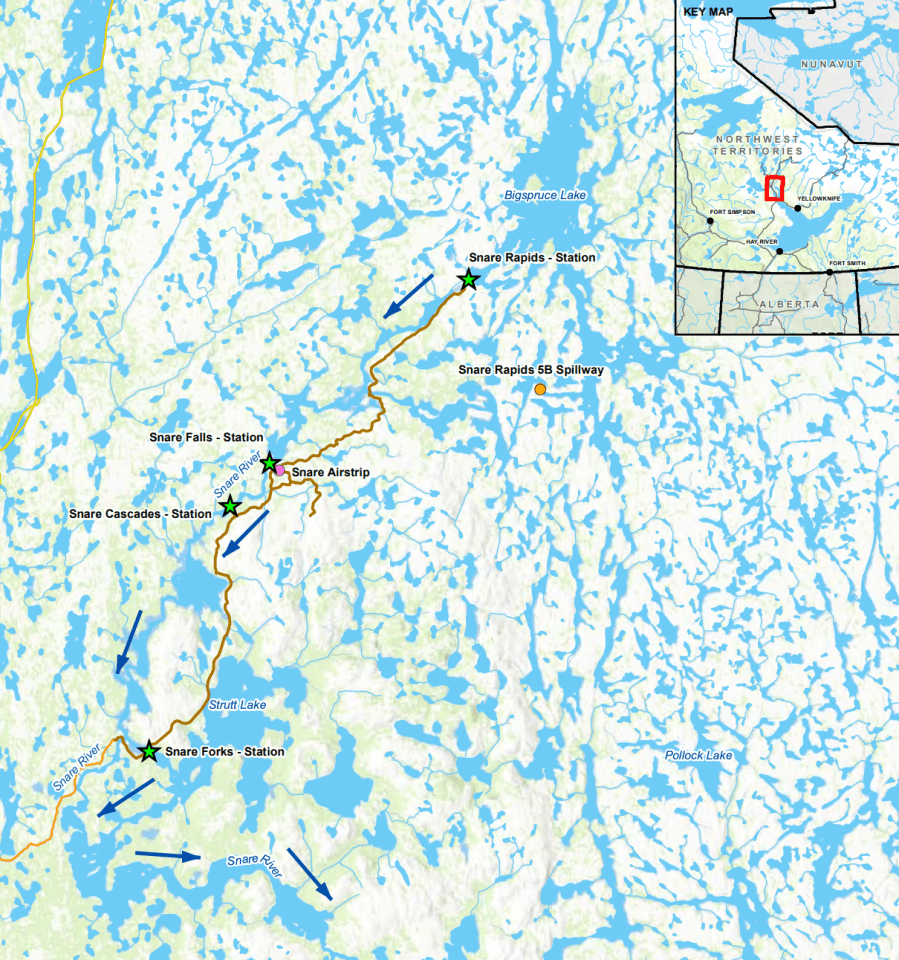
NTPC characterizes these as “very minor changes” to the water licence, the renewal of which is the reason for the public hearing – a standard process when a water licence like this is renewed.
Advertisement.
Advertisement.
Dropping the minimum water level at Bigspruce from April 15 to August 15 will let NTPC “increase use of hydroelectric power rather than diesel” in low water years, the power corporation argues in a presentation accompanying its application. The change at the Snare Falls forebay would allow more flexibility around maintenance work.
In 2005, 2015 and again earlier this year, the power corporation had to ask regulator the Wek’èezhii Land and Water Board for temporary exemptions to the current minimum water levels.
“With the low water levels and climate change predictions, instead of having to ask on a very time-sensitive basis for approval to lower their water levels, they’re asking for those water levels to be lowered by 0.3 metres – basically a foot,” said Ryan Fequet, executive director of the Wek’èezhii Land and Water Board.
“That would allow them to avoid last-minute requests for consideration, because there have been so many low-water years.”
Fish protection
The flip side is that minimum water levels exist to help protect fish and fish habitat.
Fish in the area include whitefish, pike, walleye, trout, burbot and grayling. Federal agency Fisheries and Oceans Canada says any change to reservoir water levels has to bear those fish in mind.
“Water level reductions may impact spring and fall spawning fish and fish habitat,” the agency notes in a presentation associated with the public hearing.
The federal government recommends that the proposed reduction in minimum water level should only occur when necessary, and not within established spawning periods.
Advertisement.
Advertisement.
Fisheries and Oceans Canada will be one of three intervenors to present at Wednesday’s public hearing. It will be joined by the NWT’s Department of Environment and Climate Change alongside the Tłı̨chǫ Government.
The Tłı̨chǫ Government has said it supports NTPC’s proposals as long as “fish and fish habitat are protected.” The Tłı̨chǫ Government is also asking for the power corporation’s new water licence to “include a requirement to periodically submit a report on how climate change has or is predicted to effect” the Snare hydro system.
The GNWT’s main concern is that the power corporation is seeking a 39-year term for its renewed water licence.
The territorial government says that should be capped at a maximum of 25 years.
The public hearing will be streamed live on the Tłı̨chǫ Government’s Facebook page and Cabin Radio’s website. As well as presentations from the power corporation and the intervenors, members of the public can also ask questions or voice concerns.
The hearing is being held in Behchokǫ̀ at the Kǫ̀ Gocho Centre. It begins at 9am.
“There’ll be a bus going from Yellowknife to Behchokǫ̀ and back to help reduce the carbon footprint and avoid traffic, and allow people to sleep or work on the bus on the way back,” Fequet said.
This article appears as part of a paid promotion between the Wek’èezhii Land and Water Board and Cabin Radio, designed to promote public interest in regulatory proceedings in the Northwest Territories.
