



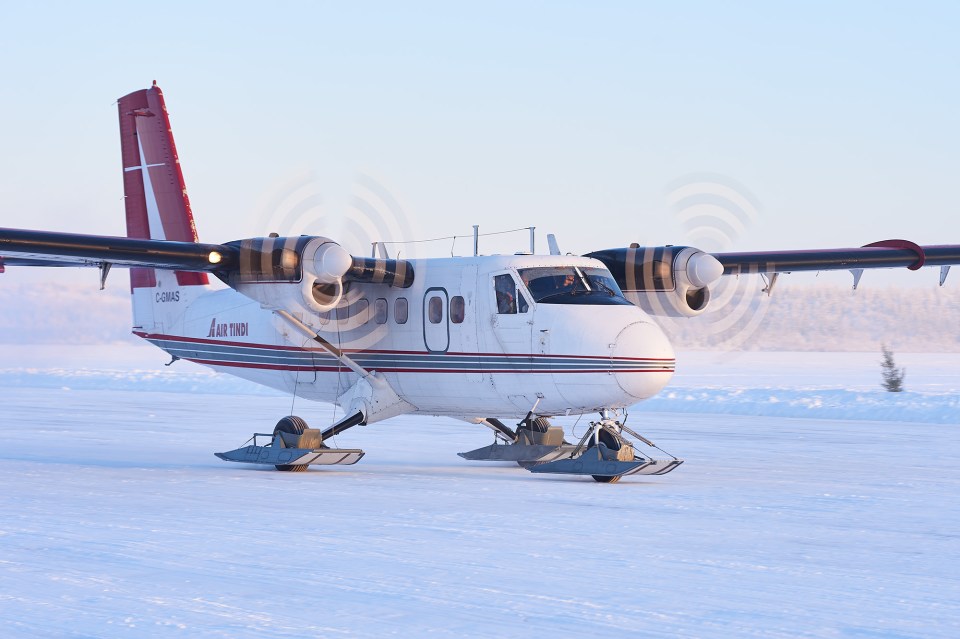
As new footage and images emerged, Air Tindi said the Twin Otter that came down near Diavik diamond mine last week hit a hill in near-whiteout conditions.
All eight passengers and two crew members survived the accident on tundra 300 km northeast of Yellowknife, though some were injured.
On the same day that Air Tindi president Chris Reynolds explained more about what happened, the Department of National Defence released video footage showing search-and-rescue technicians jumping from a Hercules aircraft on the night of the crash.
One of those technicians told Cabin Radio the jump to the site, in high wind and blowing snow, was the most challenging of his career.
Sgt Vincent C-Benoit agreed with Reynolds’ assertion that those aboard the plane had been “very lucky” to emerge relatively unscathed. C-Benoit added the stranded group’s ability to set up a survival shelter and place lights on the ground to guide in rescuers showed a high degree of preparation that helped them survive.
Advertisement.
Advertisement.
An image of the scene shows the Twin Otter perched precariously atop a small hill at the edge of a lake.
The flight, carrying construction workers for the winter road that connects Yellowknife to isolated diamond mines, was heading from one frozen lake to another.
Reynolds said an initial assessment by Air Tindi concluded the crash was weather-related.
“The flight crew was circling over the landing area, looking for snow drifts. They hadn’t committed to landing yet. They didn’t realize they had descended into basically a whiteout,” Reynolds told Cabin Radio.
Advertisement.
Advertisement.
“The only time they realized that they had descended was when they saw a hill in front of them, and that’s basically where they impacted.”
A Transportation Safety Board of Canada investigation is under way. The TSB has described the aircraft as “substantially damaged.”
Reynolds said the two crew members involved are “sore and slow moving” and being offered support as the TSB investigation progresses.
Air Tindi says it has now instructed crews to ensure pre-landing safety discussions are held at an earlier point, above the minimum regulated threshold, while the investigation continues. More changes may be introduced in the longer term.
“Flying north of the treeline in Canada, with the featureless terrain and on skis, is some of the most difficult flying in the world. The flight crew that was flying it, particularly the captain, was probably one of the most experienced you can ever find in the area. So we have to take all that into account. It wasn’t a crewing issue or anything like that,” Reynolds told Cabin Radio.
“We have to make sure we have a robust-enough plan that we can prevent it from happening to anybody in those challenging conditions.
“While we continue our investigation, we’ve basically set a point before a landing is attempted that the flight crew will discuss together what they’re seeing, at a higher-than-regulation minimum visibility and ceiling. There will be more corrective actions in time, but you don’t want to rush them either. Right now, we’re just basically increasing the limitations and making sure there’s a mutual discussion at a safe-enough altitude before an inspection and a landing is attempted.”
Praise for Diavik responders
In a separate interview, search-and-rescue technician Sgt C-Benoit and Hercules commander Cpt Jason Shaw described intensely challenging conditions as rescuers arrived at the scene that night.
Advertisement.
Advertisement.
“The weather was multiple little cloud layers, low visibility due to the blowing snow, as well as high winds. By that point in the day, it was night as well. For me personally, this was probably the most difficult weather I’ve operated in,” said Shaw, adding that a “window in the weather” presented itself, allowing the three technicians to jump.
“It was the most challenging jump in my career, but we got good training and it’s something we train for every day,” said C-Benoit, who – like his colleagues – jumped with equipment weighing up to 100 lb strapped to his front.
The three were able to land close to the accident site, despite what C-Benoit called blizzard conditions on the ground, and immediately set about constructing heated tents.
They were soon joined by four members of the nearby Diavik diamond mine’s emergency response team, who arrived by snowmobile.
“I was really relieved to see them coming to help us. Those four men were hard workers, they were prepared to work outside and they were good people. I was really happy to have them,” said C-Benoit.
Asked if the airline’s internal culture would be examined as part of its response to the crash, Reynolds said that was “something we’re going to look into” – but he stressed his confidence that getting the job done doesn’t outweigh safety considerations at Air Tindi.
“Nobody wants to have this happen. The flight crew never planned on this to happen, the company never planned on this happening,” he said.
“While you may want to do a good job, your main priority is to keep everybody safe.
Advertisement.
Advertisement.
“In this scenario, they thought they were being safe. They had visual reference, they could see. They basically accidentally descended into really bad visibility due to blowing snow in flat light conditions – and never planned it, and never knew it until the very end, when they saw the hill in front of them.”
For Shaw and C-Benoit, the successful rescue operation – all 10 people were transported safely to Yellowknife the day after the crash – demonstrates the success of the training that search-and-rescue crews undergo.
Joining Shaw and C-Benoit in the mission were first officer Cpt Martin Tuzim, air combat systems officer Cpt Jeremy Simmonds, flight engineer Cpl Dan Trommelen, loadmaster Cpl Cory Steward, and search-and-rescue technicians MCpl Alexandre Fortin and MCpl Matthew Henry. The Hercules crew is part of 435 Transport and Rescue Squadron, based in Winnipeg.
“I’m a big proponent of training, especially the junior members at the squadron,” said C-Benoit.
“It paid on that night, specifically, because the two members that were with me were junior members. They did an incredible job there on the ground, and being able to land there safely and execute the mission like they’ve been training for.
“That’s a memory I will always remember for sure: the vastness of the Arctic and to be there on the ground, being the one that’s going to provide help.”
Correction: January 6, 2024 – 11:41 MT. The list of personnel aboard the Hercules, based on a list provided by the Department of National Defence, initially omitted first officer Cpt Martin Tuzim. DND has since sent an updated list and this article has been updated accordingly.
