


Advertisement.
The first time they reached the NWT, they caused an international incident. Then they accidentally sank a truck in the Arctic. None of that seems to have deterred them.
The Transglobal Car Expedition is making its way back north.
The expedition’s aim is to spend 17 months driving across the planet. Having started in New York City on January 9, they’ll drive up through the NWT and across the Arctic in specialized vehicles before heading down through Europe and Africa.
They’ll sail to Antarctica, drive across it, sail to Chile then head all the way back to New York City complete the trip.
Advertisement.
Advertisement.
Team members include Vasily Shakhnovsky, a Russian former oil and gas executive once reported by Forbes to have wealth well in excess of $1 billion, and Vasily Elagin, a Russian mountaineer and explorer. Canadian driving specialist Andrew Comrie-Picard and Icelandic polar trucking expert Emil Grimsson are also part of the crew.
In March 2022, the team came to the Northwest Territories to do a trial run from Yellowknife to Resolute using adapted Ford pickup trucks and special ATVs designed to off-road their way to the North Pole across the ice.
There were two problems.
First, their jet – carrying Russian team members – landed in Yellowknife just after Canada had imposed airspace restrictions on Russian-chartered flights following Russia’s invasion of Ukraine.
Advertisement.
Advertisement.
The plane was grounded, fines were handed out and the plane was ordered to depart the territory empty.
Despite that initial setback, the expedition crew spent time prepping for their trial run in a Yellowknife hangar and then set off for Resolute, driving up the winter road to the diamond mines before departing off-road across Nunavut.
The good news? They reached Resolute.
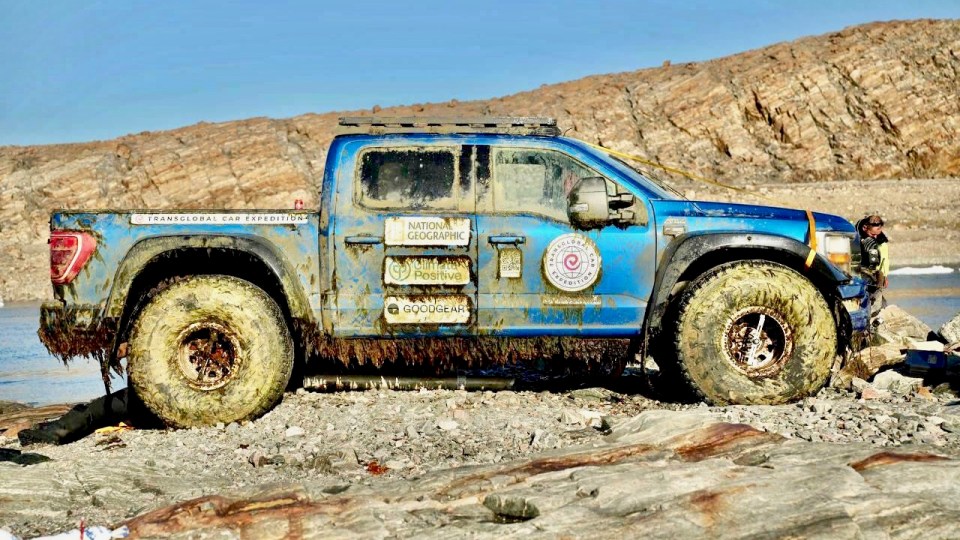
The bad news? A modified expedition F-150 sank through sea ice while returning from Resolute to Cambridge Bay.
Half a year later, crew members came back to haul the truck off the sea floor near Nunavut’s Tasmania Islands.
“This recovery operation was never about getting a truck back. It was about doing the right thing and respecting the land,” said Comrie-Picard at the time, attempting to reassure northerners that the expedition would not further damage the environment.

Now, almost two years after those events, the expedition had reached North Dakota as of Monday and is wending its way back toward the Arctic.
Under the schedule published on the expedition’s website, the vehicles – including modified six-wheel-drive F-350s alongside “Yemelya” amphibious vehicles designed for ice crossings – are due to arrive in Hay River on January 29 and Yellowknife on January 30.
Advertisement.
Advertisement.
They will then depart Yellowknife on February 1 bound for Cambridge Bay, Resolute, the North Pole, Nuuk in Greenland and eventually a sea crossing to Denmark, where the global journey will continue south toward Africa.
In a press release, the expedition said it had “set ambitious goals that encompass extreme sport adventure, technological innovation, scientific data collection and educational initiatives.”
Those goals include work on the detection of cosmic rays – apparently, nobody has studied cosmic rays at the North Pole before – as well as efforts to improve sea ice measurement. Without referring to its 2022 mishap, the expedition said its work would “give unique insights into the present state of sea ice.”
If everything goes to plan this time, the expedition should conclude in the summer of 2025.
