


Advertisement.
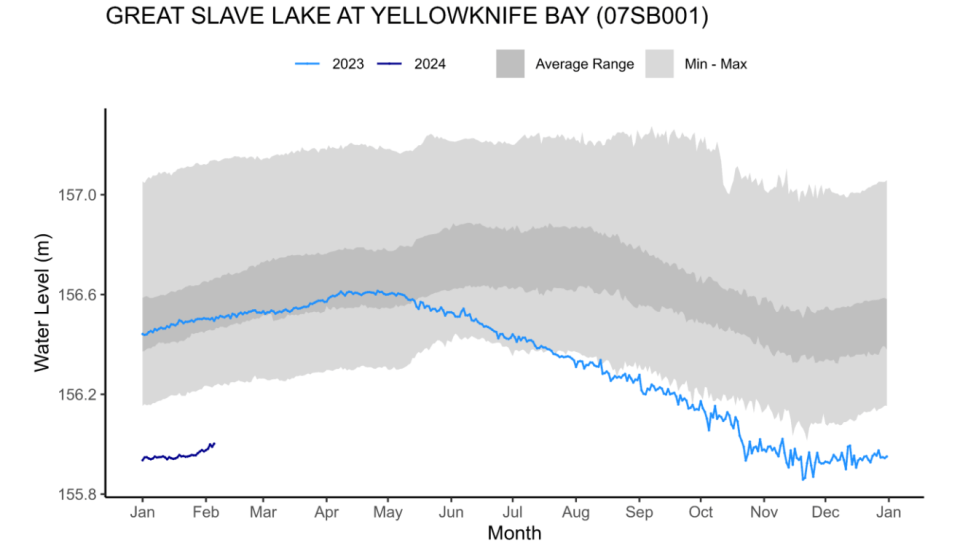
Not only do water levels across much of the NWT remain at record lows, but the situation is no better in southern areas that normally send water into northern rivers and lakes.
Those are conclusions from the NWT government’s latest water monitoring bulletin, issued earlier this week.
The continuing lack of moisture raises the prospect of another difficult wildfire season, though the precise intensity of any fire season relies on a range of variables.
“The Slave River was below average over the summer and remained that way through fall and into winter,” this week’s bulletin stated.
Advertisement.
Advertisement.
“Great Slave Lake remains at the lowest water level ever recorded for this time of year.”
Much of the South Slave is now considered to be in extreme drought, a somewhat worse situation than a year earlier.
Inuvik is the only NWT region with above-average snow water equivalent – a measurement of the water that would remain if the snow melted, which is used as a means of gauging how much water is in any given ecosystem.
The Beaufort Delta has seen unusually snowy conditions this winter, unlike most of the territory.
Advertisement.
Advertisement.
Importantly, the lack of snowfall seen in places like Hay River and Fort Simpson extends south to places like Fort St John, Peace River, High Level and Fort Chipewyan.
In those communities, snow water equivalent is at or near the lowest it has been for this time of year since 1950.
Data from northern Alberta and BC shows “the snowpack is well below average so far this winter,” the GNWT’s bulletin concluded.
More accurate snow surveys will be conducted by the Department of Environment and Climate Change near the end of March “to get a better understanding” of the situation as communities prepare for the summer fire season.
